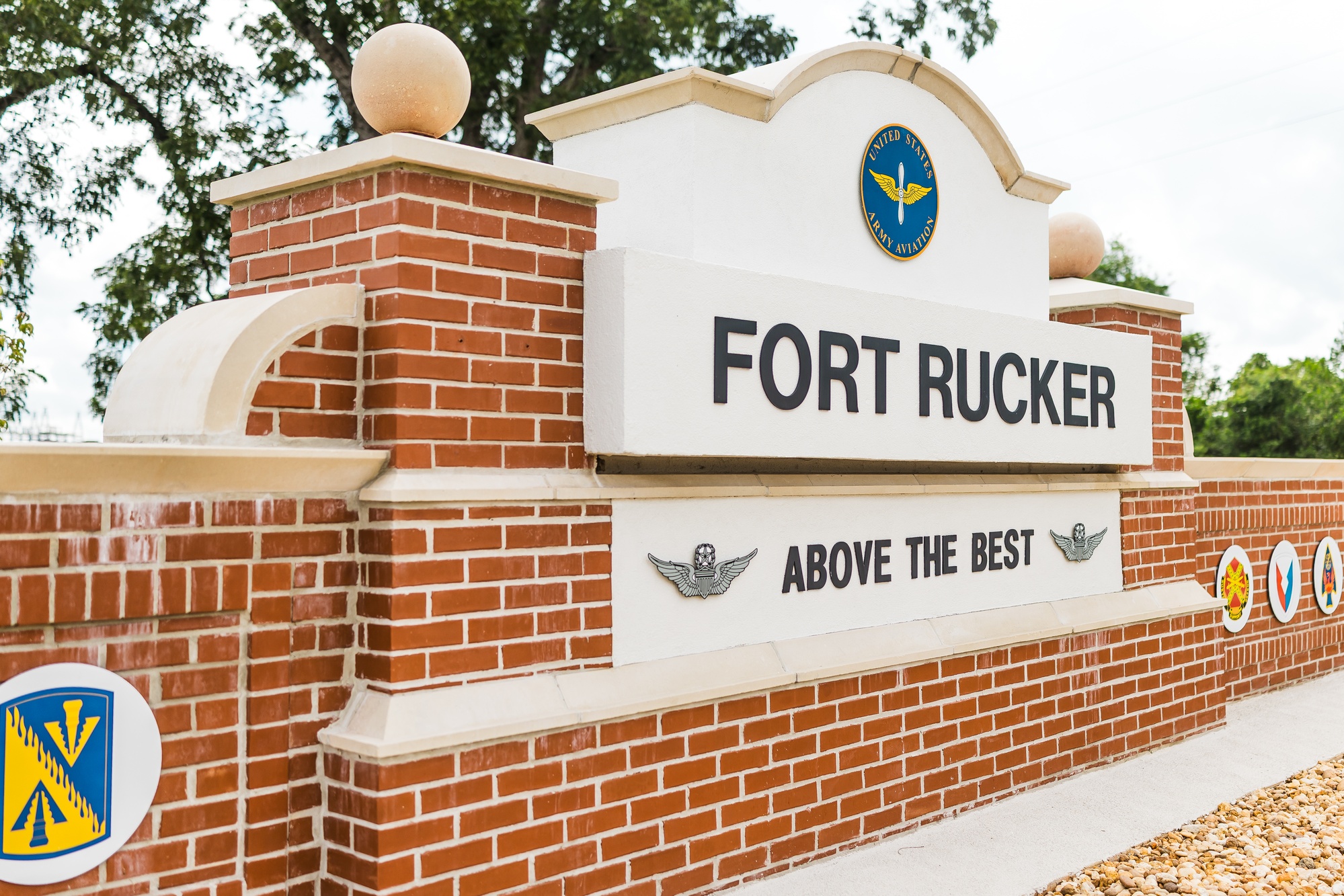
Fort Rucker: The Home of Army Aviation
If you wear Army wings, odds are you earned them at Fort Rucker. Spread across sixty some thousand acres of the Wiregrass, the scrubby southeast Alabama country named for the tough grass that grows there, out past Daleville and Enterprise and Ozark where the nearest real airport is Dothan, Rucker is the Home of Army Aviation and the schoolhouse every Army helicopter pilot passes through. The sky is full of Black Hawks and Apaches and the trainers that teach people to fly them, the humidity sits on you like a wet field jacket, and a brand new aviator's first taste of the place is months of flight school and the grad ride home on a vintage Huey. It is a tight aviation town where everybody is either flying, fixing, or teaching.
None of that buys a Soldier any mercy from the military justice system. Army Aviation Soldiers run into the UCMJ like everyone else, and when they do, a court martial at Rucker is a fight for a career, a retirement, the wings you worked for, and sometimes your freedom. The only way to win it is to deny the prosecution the easy conviction it expects and force it to prove every element of what it has charged. Military defense is all Bilecki Law Group does, and Army Aviation Soldiers fly us in from around the world for these cases, to Okinawa, Germany, and Korea, when only the best will do, and while we are not across the street from Rucker, we are close, a short flight from our Tampa office.
The Aviator This Post Is Named For
Fort Rucker carries its old name again, and this time it honors a combat aviator, which could not fit the Home of Army Aviation any better. Captain Edward W. Rucker, a Missouri man, flew for the United States in the First World War, when flying itself was still half the danger and the machines were canvas and wire. Over France he and his fellow aviators took on a numerically superior enemy formation and waded in anyway, breaking up the enemy and finishing the mission against odds that should have been the end of them. He came home with the Distinguished Service Cross and the French Croix de Guerre with palm for it. The post also keeps faith with the Medal of Honor dustoff pilot Michael Novosel, whose name now marks the Soldier Service Center, so both aviators are remembered here. Rucker flew straight at a fight he was supposed to lose, and that is the posture we bring against the military justice system.
Why Soldiers at Fort Rucker Fly Us In
The military justice system does not exist to find the truth. It exists to maintain order and discipline, and it does that by making examples, because a visible conviction keeps the rest of the formation in line whether the accused was guilty or not. Military prosecutors run a high conviction rate, and the deck is built to favor them. The military justice system has a habit of asking everything of good Soldiers and then, at the first sign of legal trouble, leaving them behind, and we exist to make sure that does not happen.
A serious case at Rucker is investigated by Army CID, and for sexual assault, domestic violence, and other covered offenses, the decision to refer charges to a court martial does not belong to your command. It goes to an independent Special Trial Counsel in the Army's Office of Special Trial Counsel. Tim Bilecki spent years inside that system as an Army JAG defense counsel and then a Senior Defense Counsel before going civilian, and he has spent his civilian career taking the hard cases other lawyers tell their clients to plead away. When prosecutors at Rucker see that kind of counsel enter a case, the easy conviction they expected is gone.
UCMJ Charges We Defend at Fort Rucker
These reflect the cases we see most at Fort Rucker. If your allegation is different, we still defend it, because we handle every UCMJ charge.
Sexual Assault and Sex Offenses (UCMJ Article 120 / Article 134). The Army's SHARP campaign was built on a legitimate goal, but its execution has put good Soldiers in the crosshairs. Commands are under so much pressure to be seen taking it seriously that a rumor or an uncorroborated allegation can be enough to end a career, the accused is presumed guilty from the first day, and even where there is not enough evidence to prefer charges the command will pursue administrative separation. Soldiers have also learned to weaponize an allegation against a former partner or to derail an investigation into their own conduct. If you are facing an Article 120 or 134 allegation, you need experienced counsel immediately and you need to fight for every element.
Fraud and Larceny (UCMJ Article 121). BAH fraud is the most common of the financial charges we handle here, and it usually traces back to an overzealous investigator playing a game of gotcha or an honest mistake by a young Soldier trying to provide for a family. Intent to defraud is a required element, and the government has to prove you knowingly set out to cheat it, not merely that you were overpaid. There is always more to the story, and we make sure the full story gets told. We defend BAH and OHA fraud, larceny, wrongful appropriation, extortion, and conspiracy to defraud cases.
Domestic Violence and Assault (UCMJ Articles 128b and 128). Domestic violence is now one of the largest parts of our practice, and the Office of Special Trial Counsel charges it with the same force it brings to a sexual assault. Under Article 128b the victim can be a spouse, an intimate partner, or a family member, and strangulation or suffocation is its own serious charge even absent visible injury. The consequence many never see coming is Lautenberg: a qualifying domestic-violence conviction bars firearm possession and can end Army careers. We handle assault under Article 128 as well. The Army trains Soldiers to be aggressive, and that switch does not flip off cleanly off duty, especially after a deployment. Most off duty fights should never reach a courtroom, but the charges escalate fast when more than one person piles on or a weapon comes into it, even a tire iron out of a truck bed, and the command comes down hard when a civilian is involved even if the civilian started it. What really happened usually looks very different once the whole thing is reconstructed. Self defense is a recognized defense, and we fight assault, aggravated assault, manslaughter, and murder cases.
Drug Offenses (UCMJ Article 112a). A positive urinalysis is serious, but it does not end the matter. The chain of custody has weak points, innocent exposure is a recognized defense for certain substances, and whether use was knowing and wrongful is a fact the government has to prove. These cases reward counsel who knows both the science of the testing and the elements the prosecution must establish, and the truth behind a hot sample is usually more complicated than the investigator's first guess.
Military Specific Offenses (UCMJ Articles 77 to 134). The punitive articles are the Army's catch all for discipline, and they are enforced unevenly from one command to the next, which is how a Soldier ends up facing a charge that would never have surfaced at the last duty station. Charge stacking is meant to inflate the maximum punishment and pressure a plea, and sometimes these are charges you fight on principle. Each count demands its own proof, and held to that standard across the board, the prosecution often cannot keep the full list intact.
Even an Aviator's Mistake Is Worth the Fight
We will be straight with you about the reality that you may have made a mistake and run afoul of the UCMJ. It is the seriousness of the case that decides whether you need us, not your rank. If it is genuinely minor and does not call for a civilian trial lawyer, your free Trial Defense Service counsel can handle it, and we will tell you so, because we do not take every case, and we will not pocket a Soldier's money for a matter that does not need a civilian lawyer. But when the case is serious, and the more time you have in the more there is to lose, it is all on the line: your career, your retirement, your rating, your good name, and your freedom. A court martial conviction is a federal criminal conviction. Under the sentencing rules now in force, a judge sentences within set confinement parameters, with mandatory minimum punishments for the most serious offenses, so it can mean real confinement, a punitive discharge that follows you for life, and on a covered sex offense sex offender registration, whether you are a brand new aviator or a senior warrant. It is worth the fight, because investigators sink their own cases with sloppy work and prosecutors gamble on thin files, counting on a Soldier who will not push back.
Army Aviation lives by leave no man behind, and the military justice system breaks that promise the moment a good Soldier is in trouble. We do not. If you are facing an investigation or court martial at Fort Rucker, reach out for a free defense strategy session. We will tell you exactly what you are facing. We are based in Tampa, the world is our area of operations, and Rucker is near the heart of it.
Cases Connected to Fort Rucker
These cases include trials, hearings, investigations, and administrative matters. A connection to this location does not necessarily mean that the trial occurred here.
- Case connected to this location: Bilecki Walks Five Article 120b Sexual Assault of a Child Specifications Off the Charge Sheet for Special Forces CW2 in Germany; Article 119b SPCM Plea, No Punitive Discharge, No SORNA, 20-Year Retirement
FAQ
I'm a flight school student or a warrant officer candidate. What does a pending charge do to my training and my wings?
It can end the very thing you came here for. A Soldier under investigation can be suspended from flight training, removed from a class, or held in place while the matter is open, and a candidate can be dropped from the warrant officer or flight program entirely, because removal from a training pipeline runs on a command's administrative judgment, not on proof beyond a reasonable doubt. An allegation alone can cost you a class date, a flight slot, or your appointment, none of which waits for a finding of guilt, and time lost in flight school is rarely recovered cleanly. That is why the early phase matters so much. Getting counsel engaged before you give a statement, while the command is still deciding what to do with you, can be what keeps your wings within reach.
I'm a rated Army aviator. What does an investigation do to my flight status and my aviation career, separate from the court martial?
It moves on its own track. When a commander questions whether you should keep flying, the Army convenes a Flying Evaluation Board under the aviation-service regulations, an administrative board that decides whether to retain, disqualify, or medically suspend you from aviation service; while an FEB is pending, suspension from flying duties is mandatory, and your flight pay rides on that aviation-service status. The FEB is not the court martial and runs on a lower standard, so a single allegation can ground you and put your wings at risk even if the criminal charge is later dropped. For a career aviator that can cost as much as the charge itself, which is why the FEB has to be defended in its own right, from the start, not treated as a side effect of the criminal case.
Army CID wants to interview me at Fort Rucker. Do I have to talk to them?
No. Do not sit down with CID without a lawyer. The interview is evidence collection, and Article 31b of the UCMJ lets you stay silent and ask for counsel before any question. At a school post like Rucker, where a career is still being built, the urge to cooperate and make it disappear is strong and usually a mistake. CID will also title you as the subject at a low threshold that can follow you in background and clearance checks. For covered offenses like sexual assault, an independent Special Trial Counsel, not your command, decides whether to refer charges to a court martial, and the best defense work comes before that decision. Decline, ask for counsel, and call a lawyer first.