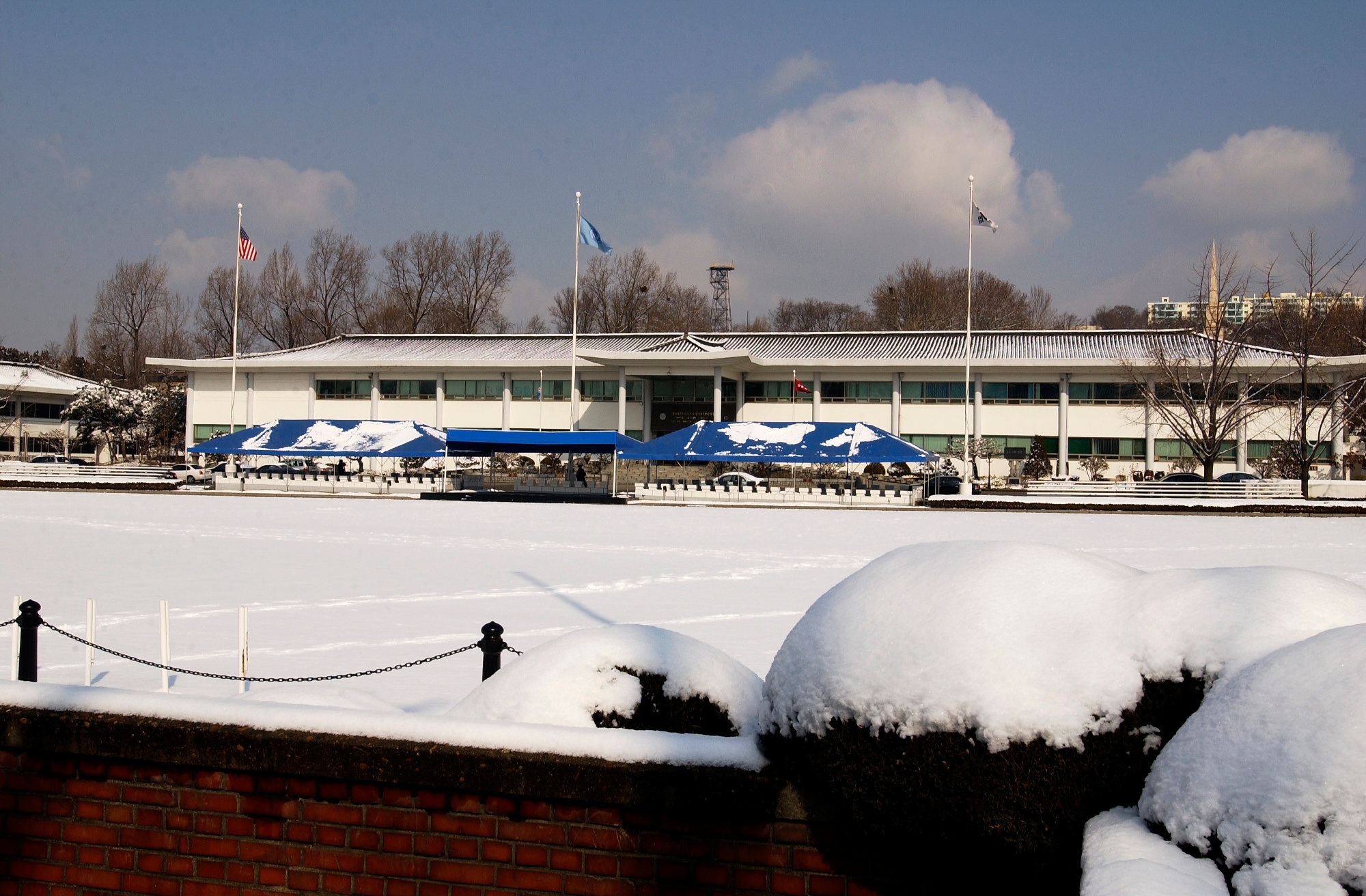
USAG Yongsan: The Old Heart of the U.S. Army in Korea
For most of a century, Yongsan was the center of gravity for the American military in Korea. In the middle of Seoul, with the bars and clubs of Itaewon pressed right up against the gate, it housed U.S. Forces Korea, United Nations Command, Combined Forces Command, and Eighth Army, foreign armies having occupied the same ground almost continuously since the 1880s. Those headquarters have since moved south. Eighth Army shifted to Camp Humphreys in 2017, U.S. Forces Korea and United Nations Command followed in 2018, and the last major command left in 2022. The land is steadily returning to Korea to become a national park, and what remains at Yongsan now is a residual footprint: the Dragon Hill Lodge and other remaining U.S. activities. K-16 airfield is a separate site in Seongnam, supported by the same garrison.
That does not mean the UCMJ stopped reaching Soldiers connected to Seoul. Wherever a Soldier is assigned, attached, or simply living in the Yongsan and Seoul area, the military justice system can still come for them, and a court martial is still a fight for a career, a retirement, and sometimes freedom, with the added complication that the Korean legal system can reach an off post incident at the same time the Army does. The only way to win that fight is to deny the prosecution the easy conviction it expects and force it to prove every element of what it has charged. If your case is tied to Yongsan, here is the reality of how it now works, and what it takes to defend it.
The Marines Who Took This City Back
The ground Yongsan sits on was fought over hard. In late September 1950, after the landing at Inchon, American forces fought their way into Seoul block by block to take the capital back, and one of the men who fell in that street fighting was Private First Class Eugene Obregon. On September 26, 1950, Obregon, a nineteen-year-old ammunition carrier, saw a fellow Marine cut down and lying exposed in the open. Armed only with a pistol, he ran out into the fire, shooting one-handed, and dragged the wounded man toward cover. As an enemy force closed in, he picked up the wounded Marine's carbine and put his own body between his comrade and the advancing enemy, firing until he was killed. His sacrifice saved the other man's life. He gave everything he had on the streets of this city so the Marine beside him would live, and that refusal to leave a brother behind is the standard we bring to a fight with the military justice system.
Why Soldiers Connected to Yongsan Fly Us In
Tim Bilecki ran the defense in this theater. From 2008 to 2010 he served as the Senior Defense Counsel for the Army's Trial Defense Service across the Pacific Rim, stationed at Camp Casey and then here at Yongsan, personally responsible for the defense of Soldiers throughout Korea, Okinawa, and mainland Japan. He worked these commands from the inside, on this peninsula, before he ever came back as civilian counsel, which is why Korea has remained central to this firm's practice ever since. The firm began in Hawaii taking cases in only three places, Hawaii, Korea, and Japan, and moving its office to Tampa did not change where its work is rooted.
The military justice system was not built to find the truth. Its purpose is to preserve good order and discipline, and it pursues that by making a public example of someone, because a visible conviction keeps the rest of the force in line whether the accused was guilty or not. Military prosecutors win at a high rate, and the rules favor them. Overseas, a command that fears an international incident will push a case it would handle quietly at home.
With the headquarters moved south, the Army's military justice for Korea now runs through Eighth Army at Camp Humphreys. A serious case is investigated by Army CID, and for sexual assault, domestic violence, and other covered offenses the decision to refer charges to a court martial no longer belongs to your command; it goes to an independent Special Trial Counsel in the Army's Office of Special Trial Counsel, which keeps a field office at Camp Humphreys. There is also a host nation layer, because under the U.S.-Korea Status of Forces Agreement the Korean authorities hold the primary right to prosecute most off post offenses against Korean nationals, and in a place like Itaewon that is not a remote possibility. We know how cases move here, and when prosecutors see that kind of counsel fly in, the easy conviction they expected disappears.
UCMJ Charges We Defend in the Yongsan and Seoul Area
Sexual Assault and Sex Offenses (UCMJ Article 120 / Article 134). The Army's SHARP campaign began with a legitimate goal, but its execution has turned the accusation itself into the case, treated as established before the investigation is finished, and when the evidence will not support a charge the command falls back on administrative separation. An allegation can be wielded to retaliate or to pull an investigation off the accuser's own conduct, and a command under pressure to show compliance is in no position to weigh those motives. These cases route to an independent Special Trial Counsel now, and they call for counsel who will investigate independently and contest the case early, before charges are preferred.
Fraud and Larceny (UCMJ Article 121 / Article 107). Overseas allowance rules are where these cases get built. The frequent Korea version is a Soldier on an unaccompanied tour drawing housing money against a dependent supposedly living in a high cost stateside city when the family is somewhere cheaper or somewhere else, and an investigator who decides the paperwork was a deliberate scheme. Since the dependency form is what drives the rate, the government stacks the charge: larceny under Article 121 plus a false official statement under Article 107, the form serving as both the lie and the means of the theft. Intent is the element that decides it. A finance mistake, a bad answer from a clerk, a misread of the command sponsorship rules, or a family that actually relocated is not fraud, and an overpayment to be repaid is not proof you meant to cheat. We defend BAH and OHA fraud, larceny, wrongful appropriation, and conspiracy to defraud, and we make the prosecution prove the intent rather than infer it.
Domestic Violence and Assault (UCMJ Articles 128b and 128). Domestic violence under Article 128b has become a major part of our Korea caseload, charged by an independent Special Trial Counsel as aggressively as a sexual assault. It reaches a spouse, an intimate partner, or a family member, and makes strangulation or suffocation a separate, serious charge even with little or no injury. A qualifying conviction triggers the federal Lautenberg firearms bar, potentially career ending for a Soldier who has to be able to carry a weapon. The Article 128 assault side is real work too. Itaewon, the bar district that grew up right against the old Yongsan gate, was for generations the off post heart of the American presence in Seoul, and along with the clubs of Hongdae across the city it is where a great many of these cases start. Itaewon in particular is famous for its nightlife and infamous for the trouble Soldiers have found there, and a long night of drinking that ends in a confrontation with a Korean national becomes a serious matter fast, because the command does not want the diplomatic fallout. What really happened usually looks different once the night is reconstructed from the evidence instead of from whoever reached the authorities first. Self defense is a recognized defense, and we handle assault and aggravated assault under Article 128, manslaughter under Article 119, and murder under Article 118.
Drug Offenses (UCMJ Article 112a). The drug cases we see in Korea are driven less by a stray positive test than by what service members bring into the country or get their hands on once they are here, synthetic drugs especially, along with substances ordered online or carried in from off post. The chain of custody on any sample is open to challenge, innocent ingestion is a recognized defense, and the government still has to prove that any use or possession was knowing and wrongful. Korea adds a host nation dimension, because Korean drug enforcement is severe and can proceed alongside the UCMJ case, which makes getting counsel in early all the more urgent.
Military Specific Offenses (UCMJ Articles 77 to 134). Failure to obey, unauthorized absence, dereliction, false official statement, and conduct unbecoming get added to a charge sheet to inflate the maximum punishment and the pressure to plead. Every specification still has to be proven beyond a reasonable doubt on its own, and the weak ones on an inflated charge sheet are the first to fall.
Even If You Slipped Up in Seoul, Fight the Case
Not every Soldier who comes to us is innocent. Some made a bad call and know it. That does not mean accepting the worst the system can hand out, prosecuted by an institution looking to make their case a warning. What decides this is the seriousness of the case, not your rank. If it is genuinely minor and does not call for a civilian trial lawyer, your free counsel at the Trial Defense Service can handle it, and we will tell you so plainly, because we do not take every case and we will not take a Soldier's money for one that does not need us.
But when the case is serious, everything is on the line at once: your career, your retirement, your good name, and your freedom, plus a Korean prosecution that can run on top of the court martial. A court martial conviction is a federal criminal conviction. Under the sentencing rules now in force, a military judge sentences within set confinement parameters, with mandatory minimum punishments for the most serious offenses, so it can mean confinement a judge has little room to avoid, a punitive discharge that follows you for life, and on a sex offense a place on a registry, regardless of rank. That is why you fight, because the system is built on the assumption that you will not.
If you are facing an investigation or court martial connected to Yongsan or anywhere in the Seoul area, reach out for a free defense strategy session. We will fly to Korea, give you a straight read on what you are facing, and show you how we would defend it. The investigation is already moving. The only question is whether you will have counsel doing the same for you.
Cases Connected to USAG Yongsan
These cases include trials, hearings, investigations, and administrative matters. A connection to this location does not necessarily mean that the trial occurred here.
- Case connected to this location: Army O-3 Investigated for $300K Fraud Hires Bilecki, Case Resolved with GOMOR
- Case connected to this location: Bilecki Secures Full Acquittal for E-4 Alleged as Biggest Spice Dealer in Korea
- Case connected to this location: Army Captain Secures No Jail Plea Deal in $30K BAH and OHA Fraud Case
- Case connected to this location: Army MSG Receives GOMOR for Hazing, Bilecki Rebuts, Retirement Saved
- Case connected to this location: Army SFC Cleared of Larceny After Allegedly Gambling Away $250K Military Funds
- Case connected to this location: Charges Dropped Against Army Sergeant Accused of Rape on Four Victims in Korea
- Case connected to this location: Bilecki Exonerates Soldier Fighting for His Friend’s Life From Stabbing Charges
- Case connected to this location: Army CSM in Korea Cleared of Sexual Misconduct Charges After Fraternization Plea
- Case connected to this location: Army Captain Partly Acquitted in Double Rape Case Despite DNA Evidence
- Case connected to this location: Army SGT Affair Leads to Rape Allegations, Bilecki Secures Chapter 10
- Case connected to this location: DoD Worker Claims Unwanted Touching, Army MAJ Barely Escapes Charges with GOMOR
- Case connected to this location: Army PFC Fully Acquitted After Being Charged for Stabbing on Dubious Evidence
- Case connected to this location: Bilecki Keeps Allegations of Domestic Violence Out of Court Martial
- Case connected to this location: Wife Discovers Infidelity and Threatens False Accusations, Bilecki Exposes Lie
- Case connected to this location: Bilecki Walks Five-Charge GCM at Camp Humphreys to 150 Days, No Punitive Discharge After Government Stacks Resurrected Fort Campbell GOMOR Onto Yongsan Bar-Fight Charge Sheet
FAQ
Yongsan has mostly closed and moved to Camp Humphreys. If my case is tied to Yongsan or Seoul, is there even still a court here, or does everything go south?
It goes south to Camp Humphreys. The headquarters and the military justice machinery moved there, so your case is investigated by CID and processed through Eighth Army and the Office of Special Trial Counsel field office at Humphreys, even if the conduct happened in Seoul. A residual footprint remains at Yongsan, but the convening authority and the courtrooms for Korea are centered at Humphreys now. That does not weaken the case against you or change your rights; it mostly changes the logistics, which is one more reason to have counsel who knows the current Korea system rather than the way it worked when Yongsan was the headquarters. Because the convening authority and the courtrooms for Korea now sit at Camp Humphreys, our Camp Humphreys page covers that side in depth.
A night out in Itaewon or Hongdae led to an allegation, and CID wants to talk. Do I have to talk to them?
No, and not without a lawyer. The bar districts in Itaewon and Hongdae have long been where a night out turns into a UCMJ case, and once CID is involved the interview is evidence collection, not a chance to explain. Under Article 31b of the UCMJ you can stay silent and ask for counsel, and you should; CID will also title you as the subject of the investigation at a low threshold, which can follow you in later background and clearance checks. For covered offenses like sexual assault, the charging decision belongs to an independent Special Trial Counsel, whose Korea field office is at Camp Humphreys, not to your command. The highest leverage work happens before charges are preferred. Decline the interview, ask for counsel, and call a lawyer before you say anything.
My OHA or command sponsorship paperwork in the Seoul area is under review. Can a housing allowance mistake become a criminal charge?
It can, if the government decides the claim was knowingly false. In the Seoul area these issues usually turn on command sponsorship: whether your dependent is command sponsored, where they are actually living, and whether the allowance you drew matches that reality. When it does not, an audit or a CID financial investigation can recast the overpayment as larceny under Article 121, which carries real confinement and a punitive discharge. But the government has to prove intent, that you knowingly set out to cheat the Army, not merely that the paperwork was wrong. The defense is to hold the prosecution to that burden, because an honest error on a notoriously complicated form is not a crime.
My case was deferred, but now I'm facing a GOMOR. Can I fight it?
Yes, you fight it, and you should, because a GOMOR is not the end of the line, it is the start of a second one. After the Special Trial Counsel defers the case, or after a not-guilty finding, the command can act administratively on the same facts at the preponderance standard, meaning more likely than not rather than beyond a reasonable doubt. A General Officer Memorandum of Reprimand is the usual vehicle, and your rebuttal, due within a few duty days, is where the case is actually contested, because the imposing general then decides whether it is filed locally and disappears or filed permanently in your AMHRR. Permanent filing can seriously damage a career and lead to an officer show cause board or enlisted retention review, depending on the governing rules and separate referral decisions. The rebuttal is a legal argument, not a character letter, so get counsel on it immediately.