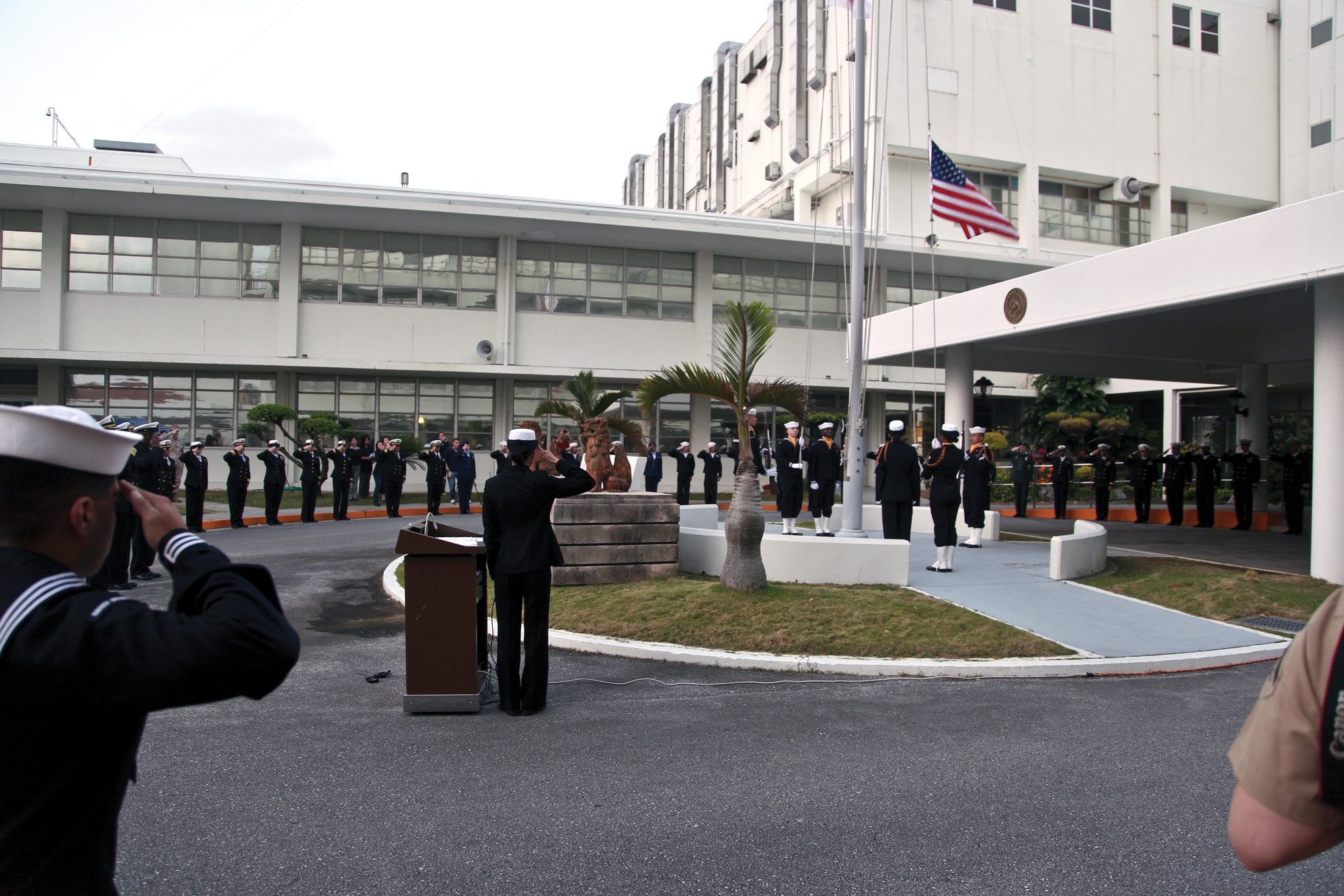
Camp Lester: The Base That Healed the Fleet, Now Winding Down
For half a century, Camp Lester, the post older hands still call Camp Kuwae, was where the Navy took care of its own on Okinawa. It sat in Chatan, just up from the beach and a short walk from what is now American Village, and the U.S. Naval Hospital Okinawa anchored it. That hospital moved to Camp Foster in 2013, the old hospital building is slated to come down, and the land is on the list to be returned to Japan once its remaining functions consolidate elsewhere. What is left at Lester now is a residual footprint: some family housing, the schools that have served Okinawa's military families, and a handful of support facilities, in a base that is quietly being handed back.
That winding-down does not mean the UCMJ stops reaching the Marines and Sailors connected to Lester and the Chatan area. Wherever a service member is assigned, housed, or simply living near here, the military justice system can still come for them, and on Okinawa there is a second layer most never think about until it lands: an off base incident can put you in front of the Japanese authorities at the same time the command is building a court martial. A case tied to Camp Lester is still a fight for a career, a record, and sometimes freedom, and the only way to win it is to deny the prosecution the easy conviction it expects and force it to prove every element of what it has charged. If your case is connected to Lester, here is the reality of how it now works.
The Corpsman This Ground Is Named For
It is fitting that the base built around a hospital carries the name of a Navy corpsman. Hospital Apprentice First Class Fred Faulkner Lester was a medical corpsman attached to the 1st Battalion, 22nd Marines, 6th Marine Division during the Battle of Okinawa. On June 8, 1945, he crawled into an open field swept by machine gun, rifle, and grenade fire to reach a wounded Marine, and he was shot several times while dragging the man back toward cover. Too badly wounded to treat the Marine himself, he directed two of his own squad in how to do it, and then, knowing his wounds were fatal, he refused all aid for himself and kept coolly directing the care of two other wounded Marines until he died. He gave the last minutes of his life making sure other men were treated before himself, and the camp, and the hospital it was built around, carried his name. That is the standard we bring to a fight with the military justice system: take care of the people depending on you, and do not quit while there is still something you can do.
Why Service Members Connected to Camp Lester Fly Us In
Okinawa is a place this firm works constantly. For the better part of two decades Tim Bilecki has tried military cases up and down this island, from Camp Foster in the south to the camps strung along the north, and the trips long ago became too many to count. From 2008 to 2010 Bilecki served as the Senior Defense Counsel for the Army's Trial Defense Service across the Pacific Rim, responsible for the defense of service members throughout Korea, Okinawa, and mainland Japan, where his read on how Pacific cases move was formed. We know the commands here, and we know exactly where an Okinawa case goes now that so much has consolidated onto Camp Foster.
The military justice system does not exist to find the truth. It exists to keep order and discipline, and it does that by making a public example of someone, because a conviction serves that purpose whether the accused was actually guilty or not. With Lester drawing down, the legal machinery for these cases runs through the III MEF and Marine Corps Installations Pacific structure based around Camp Foster. A serious case is investigated by NCIS, and for sexual assault, domestic violence, and other covered offenses the decision to refer charges to a court martial no longer belongs to your command; it goes to an independent Special Trial Counsel in the Marine Corps Office of Special Trial Counsel. Under the U.S.-Japan Status of Forces Agreement the Japanese authorities hold the primary right to prosecute most off base offenses against Japanese nationals, and when prosecutors see that kind of counsel fly in, the easy conviction they expected is gone.
UCMJ Charges We Defend in the Camp Lester Area
Sexual Assault and Sex Offenses (UCMJ Article 120 / Article 134). The pressure on commands to show results on sexual misconduct has made the accusation itself the heart of the case, treated as settled before the investigation is done, and when the evidence will not support a charge the command falls back on administrative separation. An allegation can be used to retaliate or to pull an investigation off the accuser's own conduct, and a command focused on demonstrating compliance is in no position to weigh those motives. These cases run through an independent Special Trial Counsel now, and they demand counsel who will investigate independently and contest the case early, before charges are preferred.
These same dynamics drive the NCIS online sting cases that have become a fixture of Okinawa practice, the "To Catch a Predator" operations that have arrested service members across the island. An agent works an adults only site as a young woman, claims to be underage only after the chat turns sexual, and arrests the target at a staged meeting where no real child ever existed, so the charge is an attempt under Article 80 that turns on intent. The defenses are entrapment, the agents' departure from the Internet Crimes Against Children protocols, and the absence of the specific intent the government must prove. We won the first one ever tried on Okinawa and have defended many since, with strong results.
Fraud and Larceny (UCMJ Article 121 / Article 107). Overseas pay and housing rules are complicated, and an allowance drawn against a dependent listed somewhere other than where they actually live, or a claim that does not reconcile, gets written up as deliberate fraud once an investigator decides it was. Because the housing or dependency form is what authorizes the rate, the charge usually comes stacked, larceny under Article 121 and a false official statement under Article 107. Intent to defraud is a required element, and the government has to prove you knowingly set out to cheat it, not merely that a payment came out wrong, which a finance office mistake or a family that really moved will not establish. We defend property and financial charges, from BAH and OHA fraud to larceny, wrongful appropriation, and conspiracy under Article 81 to defraud, and we make the prosecution prove the intent it would rather assume. The actual entitlement depends on the orders, dependent status, authorized location, and applicable housing rule; an address discrepancy alone does not establish an overpayment or criminal intent.
Domestic Violence and Assault (UCMJ Articles 128b and 128). Domestic violence under Article 128b is among the offenses we defend most, charged by an independent Special Trial Counsel and treated like any covered offense. It applies to a spouse, an intimate partner, or a family member, and makes strangulation or suffocation a separate, serious charge even with little or no injury. A qualifying conviction carries the federal Lautenberg firearms bar, which for most service members can be career ending because the job requires carrying a weapon. Plain Article 128 assault is part of the docket too. American Village and the Chatan strip put service members shoulder to shoulder with locals and tourists most nights, and a confrontation that involves a Japanese national becomes a serious matter fast, because the command does not want the diplomatic fallout, whether or not your service member started it. What really happened tends to look different once the night is reconstructed from the evidence rather than taken from whoever reached the authorities first. Self defense is a recognized defense, and we handle assault and aggravated assault under Article 128, manslaughter under Article 119, and murder under Article 118.
Drug Offenses (UCMJ Article 112a). Japan enforces some of the strictest drug laws in the developed world, and that severity drives how the command treats any allegation on the island, where a substance brought onto Okinawa or obtained off base can carry both a UCMJ charge and exposure to the Japanese system. A positive urinalysis is serious, but on its own it proves far less than the government pretends. The chain of custody can be challenged, innocent ingestion is a recognized defense, and the government still has to prove that any use or possession was knowing and wrongful. These cases demand counsel fluent in both the evidence and the host nation pressure behind them.
Military Specific Offenses (UCMJ Articles 77 to 134). Unauthorized absence, dereliction, disrespect, false official statement, and fraternization get stacked onto a charge sheet to inflate the maximum punishment and the pressure to plead. Every charge must be proven separately, and held to that on each one, the prosecution often cannot keep the whole list intact. We fight each charge rather than letting it become leverage the government did not earn.
Made a Mistake Near Camp Lester? Don't Just Take the Hit
Not everyone who comes to us is innocent. Some made a bad decision and know it. That does not mean accepting the worst the system can hand out, prosecuted by an institution eager to make their case a warning. Whether a case like yours needs a firm like ours is a question of seriousness, not rank. If it is genuinely minor and does not call for a civilian trial lawyer, your free detailed defense counsel through the Defense Service Office can handle it, and we will tell you so plainly, because we do not take every case and we will not take a service member's money for one that does not need us.
But when the case is serious, all of it is on the line at once: your career, your retirement, your good name, and your freedom, and on Okinawa the Japanese authorities, who can pursue you on top of the court martial. A court martial conviction is a federal criminal conviction. Under the sentencing rules now in force, a military judge sentences within set confinement parameters, with mandatory minimum punishments for the most serious offenses, so it can mean confinement a judge has little discretion to avoid, a punitive discharge that follows you for life, and on a sex offense a place on a registry, regardless of rank. That is why you fight, and the prosecution is counting on you not to.
If you are facing an investigation or court martial connected to Camp Lester or anywhere on Okinawa, reach out for a free defense strategy session. We will fly to the island, tell you exactly what you are facing, and lay out how we would defend it. The investigation is already moving. The only question is whether you will have someone in your corner doing the same.
Cases Connected to Camp Lester
These cases include trials, hearings, investigations, and administrative matters. A connection to this location does not necessarily mean that the trial occurred here.
- Case connected to this location: AdSep Board Finds No Basis for Alleged Abusive Sexual Contact for Navy NCO
- Case connected to this location: Sailor Admits Over-Clothes Touching a Sleeping Victim, Bilecki Secures Plea Deal
FAQ
Camp Lester is basically closing. If I am assigned to housing here, where does my case actually get handled?
Through the island's consolidated structure based at Camp Foster, even though Lester itself is closing. A serious matter is investigated by NCIS and processed through the III MEF and Marine Corps Installations Pacific legal structure around Camp Foster, with covered offenses going to the independent Special Trial Counsel and any confinement at the regional brig on Camp Hansen. Being housed at a drawing-down installation changes the logistics, not the rules that apply to you, which is one more reason to have counsel who knows where an Okinawa case really goes.
I am a Navy corpsman, not a Marine. Does the Marine Corps justice machine still apply to me?
Yes. The UCMJ applies to you as a Sailor exactly as it does to the Marines you serve alongside, and a corpsman attached to a Marine unit can find his case running through the Navy and Marine Corps justice system on Okinawa. Whether you are tried at a Navy or a Marine court martial turns on your status and your chain of command, and that detail can affect the convening authority and how the case is handled. It is exactly the kind of jurisdictional question that is easy to get wrong and worth having counsel sort out early, because getting it right can change the whole shape of your case.
NCIS contacted me about a sexual assault allegation in the Lester and Chatan area. Should I talk to them?
Decline, and get counsel first. An NCIS interview is evidence collection, not a chance to clear it up, and under Article 31b of the UCMJ you have the right to stay silent and to a lawyer; agents will often suggest that cooperating now will make the problem go away, which is not how it works. The decisive moment comes before any charge is preferred: engage a defense early and the independent Special Trial Counsel, who decides covered offenses, may decline to prefer, which is how many Article 120 allegations end, with no court martial at all. Stay silent, ask for counsel, and get a lawyer engaged before the investigation leads to charges.