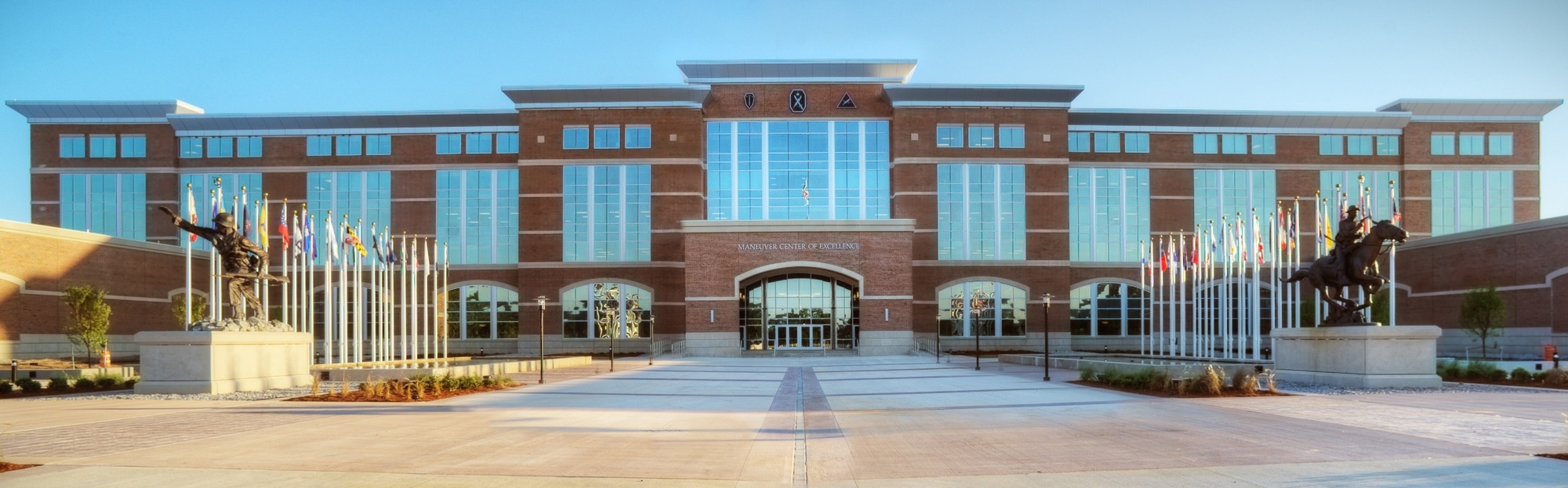
Fort Benning: Where the Army Makes Its Infantry, Armor, and Rangers
Anyone who came through Benning remembers it in the body before the mind: the red Georgia clay that gets into everything, the old shark attack waiting off the cattle truck at Sand Hill, the 250-foot jump towers standing over the post like something off a world's fair midway, and the Follow Me statue daring you to keep up. Out at Harmony Church, Ranger students haul themselves through the cold water at Victory Pond, and across the Chattahoochee in Columbus and Phenix City, Victory Drive has been separating young Soldiers from their paychecks since their grandfathers wore the uniform. Benning is the Maneuver Center of Excellence, the home of the Infantry and Armor, Ranger School, Airborne School, Officer Candidate School, and Sniper School, and just about every ground combat Soldier passes through here at some point.
It runs on a constant churn of trainees, students, cadre, and permanent party, with a command that enforces the UCMJ hard to keep all of it in line. When the system sets its sights on a Soldier at Benning, it does not matter how good that Soldier has been or what tab they wear. A court martial here is a fight for a career, a retirement, and sometimes freedom, and the deck is stacked toward the prosecution. You may love the Army, but you cannot coexist with a military justice system that is working to destroy you. The fight is coming, and you had better be ready to fight back. Military defense is all Bilecki Law Group does, and Soldiers fly us in from around the world for these cases, to Okinawa, Germany, and Korea, when only the best will do, and while we are not across the street from Benning, we are close, a short flight from our Tampa office.
The Infantryman This Post Is Named For
Fort Benning has its name back, and the Soldier it honors now was an infantryman barely out of his teens. Corporal Fred G. Benning, a Nebraska kid who enlisted in 1917, was in the Meuse-Argonne in October 1918 when his platoon leader was killed and the advance threatened to collapse. Benning, eighteen years old, took command on the spot and led what was left of the platoon forward through heavy enemy fire to its objective. He came home with the Distinguished Service Cross, the nation's second highest award for valor. The Home of the Infantry could not ask for a truer namesake: a young Soldier who stepped up the instant the man in charge went down and kept his people moving. That is the standard this post is built on, and it is the posture we bring to a fight with the military justice system. When the situation falls apart, you take command of it.
Why Soldiers at Fort Benning Fly Us In
Your innocence is not enough to set you free, and believing otherwise is exactly the mistake the system counts on. The military justice system is not built to find the truth. It is built to produce convictions that keep the ranks in line, and to do that it has to make a public example of someone. If it decides you will not fight back, it will make that example out of you. The only sensible response is to fight, and to make clear from the first day that you are not the easy win the prosecution was hoping for.
A serious case at Benning is investigated by Army CID, and for sexual assault, domestic violence, and other covered offenses, the decision to refer charges to a court martial no longer belongs to your command. It goes to an independent Special Trial Counsel in the Army's Office of Special Trial Counsel. Tim Bilecki came up inside that system as an Army JAG defense counsel and then a Senior Defense Counsel before going civilian, and he has earned a reputation as a brawler that service members fly in from around the world. Prosecutors who hate to lose often start looking for a better resolution the moment they see that kind of counsel step off the plane, because a real fight is the last thing they want.
UCMJ Charges We Defend at Fort Benning
The cases below are the most common at Fort Benning. If yours is not here, call anyway, because we defend the full spectrum of military charges.
Sexual Assault and Sex Offenses (UCMJ Article 120 / Article 134). The Army's SHARP campaign was built on a legitimate goal, but its execution has put good Soldiers in the crosshairs. Commands are under so much pressure from above to be seen taking it seriously that a rumor or an uncorroborated allegation can be enough to end a career, and even where there is not enough evidence to prefer charges, the command will pursue administrative separation. It does not matter whether you are innocent or whether the encounter was consensual, because the institution needs results, and a Soldier facing these charges can become the result it needs. If you are looking at an Article 120 or 134 allegation, you need experienced counsel immediately.
Fraud and Larceny (UCMJ Article 121). BAH fraud is the most common of the financial charges we handle, and it is usually an error or a misunderstanding that an investigator decides to treat as a deliberate scheme. The government has to prove intent to defraud, that you knowingly and intentionally set out to cheat it, not merely that you were overpaid, and many of these cases do not survive once the defense forces that burden. We handle conspiracy to defraud, BAH and OHA fraud, larceny, wrongful appropriation, and extortion.
Domestic Violence and Assault (UCMJ Articles 128b and 128). Domestic violence under Article 128b has become a major share of what we do, charged now by an independent Special Trial Counsel and weighed like a sexual assault. It covers a spouse, an intimate partner, or a family member, and singles out strangulation and suffocation as their own offense whether or not there is a mark to show. The hidden cost is the Lautenberg Amendment: a qualifying conviction bars you from a firearm or ammunition, which can end a Soldier's career. Plain Article 128 assault is still part of the work here. Trainees and young Soldiers at Benning find out fast that an off duty fight is part of military life, often fueled by youth and alcohol, and most of those scrapes should not end a career. The trouble starts when a weapon enters the picture, even something grabbed off a table, or when the other party is a civilian, because then the charges escalate and the command comes down hard even when the civilian started it. The full story usually looks very different once it is reconstructed rather than told by whoever ended up hurt. Self defense is a recognized defense, and we take assault, aggravated assault, manslaughter, and murder cases.
Drug Offenses (UCMJ Article 112a). Georgia has some of the strictest drug laws in the country, but that does not mean controlled substances are hard to find around Benning, and very often it is a civilian who brings them into the picture while the Soldier is the one left facing the consequences. State law does not control the UCMJ in either direction. A positive urinalysis is serious but not the end of the fight, because the chain of custody on the sample can be picked apart, innocent ingestion is a recognized defense, and the government still carries the burden of proving the use was knowing and wrongful, and these cases call for counsel who understands both the science and the elements the prosecution must prove.
Military Specific Offenses (UCMJ Articles 77 to 134). Fraternization, unauthorized absence, disobeying a lawful order, conduct unbecoming, and the rest of the punitive articles are where prosecutors pile on, because it does not matter how minor a charge is if it raises the maximum punishment and pressures you toward a plea. Sometimes you fight these on principle. Each charge requires proof, and forced to establish every one, the prosecution frequently cannot sustain the full list.
Beating a Rigged System Takes a Fight
The deck is stacked from the start. The prosecution gets a nearly unlimited budget while assigned defense counsel have to beg for resources and watch their own careers if they win too often. That is not a fair fight, and if you play by the prosecution's rules you will lose. Your one real chance is to put up a fight from the very beginning, which is why Soldiers fly Bilecki in to defend them.
You did not start your career expecting to be here, and you may well have made a mistake, but you now know that the UCMJ is enforced unevenly, and conduct that passed without comment at one duty station has landed you in trouble at Benning. You did not ask for this fight, but it is yours to win. If you are facing an investigation or court martial at Fort Benning, reach out for a free defense strategy session. We will tell you exactly what you are facing, run our own investigation, fight at the Article 32 hearing, and take the case to trial if that is what it takes. Reach out, and get us into the fight.
Cases Connected to Fort Benning
These cases include trials, hearings, investigations, and administrative matters. A connection to this location does not necessarily mean that the trial occurred here.
- Case connected to this location: Bilecki Walks Eight-Specification Article 80 / 82 / 134 Undercover ICAC Kik GCM at Fort Moore to Plea on a Single Specification; Article 82 CSAM Solicitation Dismissed, Article 80 Attempted Sexual Assault of a Child Dismissed, BCD in Lieu of Mandatory Dishonorable Discharge
- Case connected to this location: Bilecki Reduces Article 80 Attempted Article 120b GCM on Army SGT at Fort Riley to Single Article 134 Indecent Language SPCM Plea with No SORNA
- Case connected to this location: Bilecki Walks Article 120 and Article 134 Off Charge Sheet After Arraignment for Army MAJ at Fort Moore; Medical Retirement Preserved
FAQ
Army CID wants to interview me at Benning. Do I have to talk to them?
No, and especially not if you are young and trying to be helpful. Benning is full of trainees and first term Soldiers, and the instinct to explain yourself and clear it up is exactly what gets people charged. A CID interview is evidence collection, and under Article 31b of the UCMJ you can stay silent and ask for a lawyer before you answer anything. CID will also title you as the subject at a low threshold that can follow you in background and clearance checks for years, even if the case is dropped. For covered offenses like sexual assault, an independent Special Trial Counsel, not your command, decides whether to refer charges to a court martial. Decline, ask for counsel, and call a lawyer before you say a word.
I'm a drill sergeant or cadre and a trainee made an allegation against me. Can that really end my career?
Yes, it can. At a training installation an allegation by a trainee against cadre is treated as something the command cannot be seen ignoring, and the institutional response often runs well ahead of the evidence. Even a thin or uncorroborated complaint can trigger suspension from your duties, a relief for cause, or administrative action that ends a career on its own. The power dynamic the Army is sensitive to cuts against you by default. A real defense puts the actual facts and context back into the picture and forces the government to prove the specific charge, rather than letting the allegation stand in for proof. Get counsel before you give any statement.
I'm an officer candidate at OCS, or in another course tied to my commissioning or career progression. Can an investigation cost me my commission?
It can, and the threshold is lower than people expect. You do not have to be convicted of anything to be relieved, recycled, or dropped from Officer Candidate School or a career course, because removal from a training or commissioning pipeline runs on a command's administrative judgment, not on proof beyond a reasonable doubt. An allegation alone can stall or end a commission before it starts, and a drop for a conduct or honor issue follows you. That is why the early phase matters so much here. Getting counsel involved before you give a statement, while the command is still deciding what to do with you, is often what determines whether the pipeline stays open.