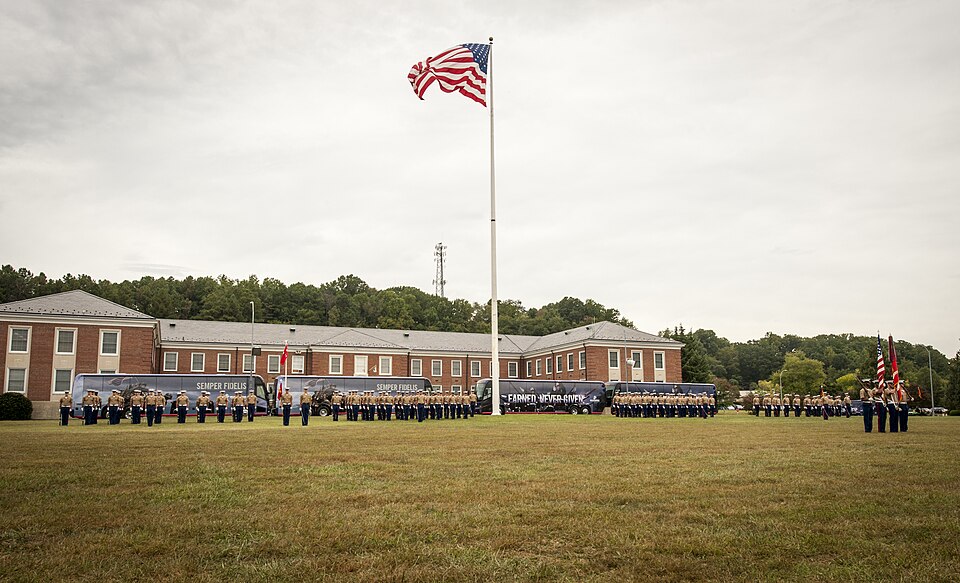
MCB Quantico: The Crossroads of the Marine Corps
On the Potomac about thirty-five miles south of Washington, Marine Corps Base Quantico is the Crossroads of the Marine Corps, the place that makes its officers. The Basic School that trains every newly commissioned Marine officer is here, along with Officer Candidates School, Marine Corps University, and the Marine Corps Combat Development Command, and the FBI Academy, the DEA, and NCIS headquarters share the same wooded ground, a federal law enforcement campus on a Marine base. Some twelve thousand Marines, officer candidates, and senior staff are here at any time, with families settled in Stafford, Triangle, and Garrisonville and the I-95 grind toward DC a fact of daily life. Because the population skews toward officers and officer candidates, the cases here lean toward fraternization, conduct unbecoming, and candidate misconduct alongside the usual sexual assault, domestic violence, and drug allegations, and a command responsible for the officer corps will protect that institution hard.
Military defense is all Bilecki Law Group does, and Marines and Marine officers bring us in from our office in Tampa because a contested court martial is decided by trial experience, not proximity, and we bring it wherever the case is.
The Officer Who Covered the Grenade with His Body
Quantico exists to make Marine officers, and the standard for a Marine officer was set at Inchon by First Lieutenant Baldomero Lopez. On September 15, 1950, leading his platoon over the seawall in the landing, Lopez was hit as he reached back to throw a grenade, and it fell loose beside his own men. Wounded and unable to throw it, he pulled the live grenade under his body and took the blast himself to shield his Marines. He was a young officer who had been commissioned in June 1947, and he spent his life the way the Corps teaches its officers to, by putting his Marines first. That instinct to take the blast for his men is the standard we bring to a case at Quantico.
Why Marines at Quantico Bring Us In
We win court martial cases. Military defense is all we do, and Marines fly us in from all over the country because of our trial record. The military justice system is not built to find the truth; it exists to preserve good order and discipline, and a command that trains the Corps' officers will make an example of someone to protect the institution's image. A serious case is investigated by NCIS, and for sexual assault and other covered offenses the decision to refer charges to a court martial no longer belongs to your command but goes to an independent Special Trial Counsel. Your detailed defense counsel may be capable but carries a heavy caseload inside the same system, which is why Marines serious about winning bring in their own counsel.
UCMJ Charges We Defend at MCB Quantico
Whatever you have been accused of under the UCMJ, we defend it. The list below just reflects the charges we see most at MCB Quantico.
Sexual Assault and Sex Offenses (UCMJ Article 120 / Article 134). These allegations route to an independent Special Trial Counsel now, and the command treats a report as established before the investigation is finished, all the more so in a tight community where word of an allegation travels fast and the command wants to look decisive. These cases demand counsel who will run an independent investigation and contest the case rather than let the allegation stand in for proof, because a conviction can mean confinement and a federal record, with registration required for a covered sex offense under the applicable federal and state law.
Domestic Violence and Assault (UCMJ Articles 128b and 128). Domestic violence under Article 128b is charged as aggressively as any offense in the UCMJ since the Office of Special Trial Counsel took these cases over. It covers a spouse, an intimate partner, or a family member, and it treats strangulation or suffocation as its own charge that the government can bring even with no visible injury. A qualifying conviction also triggers the federal Lautenberg firearms bar, which can end a Marine career because a Marine has to be able to carry a weapon. We also defend assault under Article 128, the usual charge when a night out toward DC ends in a fight, where self defense is a recognized defense.
Conduct Unbecoming and Officer Integrity (UCMJ Articles 133 and 107). Quantico is built around making and schooling Marine officers, so the charges here lean toward the ones that end officer careers. Conduct unbecoming an officer under Article 133 is deliberately broad, reaching an improper relationship, a financial impropriety, an integrity lapse at The Basic School or Officer Candidates School, or an off duty incident the government says discredits the commission, and a false official statement under Article 107 turns a single answer or document into a federal crime. These are reputation cases as much as proof cases, and the government still has to prove the words or the conduct, not merely that an officer's judgment is questioned.
Drugs and Off Duty Conduct (UCMJ Articles 112a and 134). Drug cases often turn on the chain of custody and the government's burden to prove any use was knowing and wrongful. A Marine is subject to the UCMJ off duty, and marijuana is worth a word of caution: it is legal to possess in Virginia, but it is still a federal controlled substance and a court martial offense under Article 112a, and being legal off post does not make it lawful for a Marine. A positive test is evidence the government may use to argue knowing, wrongful use, not an automatic finding of guilt, so the collection, the chain of custody, and whether any use was knowing all remain the government's to prove.
A Career and a Reputation Worth Defending
We do not pretend that every Marine who calls us from Quantico is innocent. What matters is how serious the case is, not your rank. If a matter is genuinely minor, your detailed defense counsel can handle it, and we will tell you so honestly. But when the case is serious, everything is on the line at once: your career, your retirement, your good name, and your freedom. A court martial conviction is a federal criminal conviction, and where the sentencing parameters apply the confinement range is set by the offense, two and a half to ten years for sexual assault and ten to twenty for rape, with a departure requiring specific facts in writing, on top of a possible punitive discharge and, for a covered sex offense, sex offender registration. That is why you fight. The court’s jurisdiction and the convicted offense determine which sentencing rules apply; some offenses use separate sentencing criteria rather than these ranges.
If you are facing an investigation or court martial at MCB Quantico, reach out for a free defense strategy session. We will tell you exactly what you are facing and how we would defend it. The government is already building its case. The only question is whether anyone is building yours.
Cases Connected to MCB Quantico
These cases include trials, hearings, investigations, and administrative matters. A connection to this location does not necessarily mean that the trial occurred here.
- Case connected to this location: Marine Gets with a Celibate Woman and Faces Rape Charges, Bilecki Exposes Lie
- Case connected to this location: Bilecki Pre-Preferral and Article 32 Representation on Marine Corporal at MCB Quantico Facing OSTC-NCR 17-Specification Charge Sheet Across Article 134 Possession of Child Pornography, Article 120c Indecent Recording, and Article 112a Wrongful Possession of a Controlled Substance
FAQ
NCIS wants to interview me at Quantico. Do I have to talk to them?
No. You are not required to sit for an NCIS interview or answer their questions. Under Article 31b of the UCMJ you have the right to remain silent and to a lawyer, and you can invoke both at any point, including before the interview begins. NCIS is collecting evidence, not giving you a chance to explain, and it takes very little to be titled as a subject, a label that follows you for years. Decline, ask for counsel, and call a defense lawyer before you give any statement.
I'm an officer or candidate accused of fraternization or conduct unbecoming. What am I facing?
At Quantico, where the Corps commissions and trains its officers, fraternization and conduct unbecoming under Article 133 are taken seriously, and an allegation can threaten a commission or a candidacy before anything is proven. These charges turn on the specifics: the actual relationship, the order or custom said to be violated, and whether the conduct truly compromised good order and discipline, not just how it looked. They are often overcharged, and an officer's whole career can ride on getting the facts and the framing right, which is why you should have your own counsel before you answer to anyone, including an OCS or TBS chain that may already be moving to disenroll you.
Something happened off base in Stafford or Prince William County. Can the Marine Corps court martial me for it too?
Yes. Virginia and the military are separate sovereigns, so the same incident can be prosecuted by the civilian authorities and by a court martial, and a civilian dismissal or even an acquittal does not end the UCMJ exposure. The command does not have to wait for the local prosecutor, and a statement to one system can be used by the other, so do not talk to the police or NCIS until you have a defense lawyer.