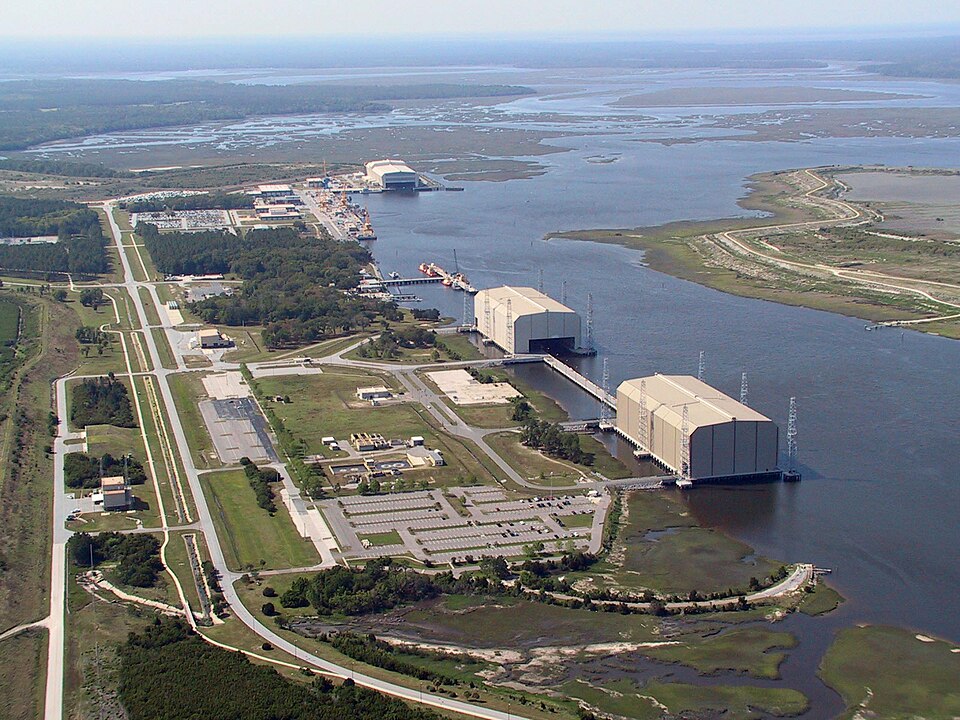
NSB Kings Bay: Home of the Atlantic Ballistic-Missile Submarines
On the south Georgia coast at St. Marys, Naval Submarine Base Kings Bay is the Atlantic home port of the Ohio-class Trident submarines, the ballistic-missile boats that carry the sea leg of the nation's nuclear deterrent. The Trident Training Facility is here, the first Columbia-class boats are due at the end of the decade, and a Coast Guard force guards the submarines as they transit. The Sailors stationed here run and maintain the most sensitive ships in the fleet, in Camden County about thirty-eight miles up from Jacksonville, with the wild beaches and marsh of Cumberland Island just out the inlet, reachable by boat, including the passenger ferry. A command entrusted with the nuclear deterrent holds its people to an unforgiving standard and will make an example of a Sailor who falls short of it.
Military defense is all Bilecki Law Group does, and Sailors fly us in from around the world for these cases, to Okinawa, Germany, and Korea, because this is all we do and we are the best at it. We are not local to Kings Bay, but we are not far either, a short flight from our Tampa office.
The Captain Who Went Down with the Secret
The standard the submarine force lives by was set by Captain John P. Cromwell aboard the USS Sculpin in 1943. Cromwell carried in his head the plans for fleet movements and the coming invasion of the Gilberts, and when Sculpin was fatally damaged and forced to the surface off Truk, he understood that capture could mean those secrets were tortured out of him. He chose to ride the boat down rather than risk it, giving his own life to protect what he knew. He spent everything to keep faith with the men and the mission that depended on his silence. That willingness to bear the whole weight himself is the standard we bring to a case at Kings Bay.
Why Sailors at Kings Bay Bring Us In
We win court martial cases. Military defense is all we do, and Sailors fly us in from all over the country because of our trial record. The military justice system is not built to find the truth; it exists to preserve good order and discipline, and a command guarding the nuclear deterrent will make an example of a Sailor to prove it holds the line. A serious case is investigated by NCIS, and for sexual assault and other covered offenses the decision to refer charges to a court martial no longer belongs to your command but goes to an independent Special Trial Counsel. Your detailed counsel from the Defense Service Office may be capable but carries a heavy caseload inside the same system, which is why Sailors serious about winning bring in their own counsel.
UCMJ Charges We Defend at NSB Kings Bay
The charges below are common at NSB Kings Bay, but our practice is not confined to them. We defend service members against any UCMJ offense.
Sexual Assault and Sex Offenses (UCMJ Article 120 / Article 134). These allegations route to an independent Special Trial Counsel now, and the command treats a report as established before the investigation is finished, all the more so in a small submarine community where word of an allegation travels fast and the command wants to look decisive. These cases demand counsel who will run an independent investigation and contest the case rather than let the allegation stand in for proof, because a conviction can mean confinement and a federal record, with registration required for a covered sex offense under the applicable federal and state law.
Domestic Violence and Assault (UCMJ Articles 128b and 128). Domestic violence under Article 128b is charged as aggressively as any offense in the UCMJ since the Office of Special Trial Counsel took these cases over. It covers a spouse, an intimate partner, or a family member, and it treats strangulation or suffocation as its own charge that the government can bring even with no visible injury. A qualifying conviction also triggers the federal Lautenberg firearms bar, which can end a Navy career because a Sailor has to be able to carry a weapon. We also defend assault under Article 128, the usual charge when a night out off base ends in a fight, where self defense is a recognized defense.
Larceny and Government Property (UCMJ Articles 121 and 108). A submarine base is full of sensitive, high-value equipment, parts, and controlled material, and accountability is unforgiving. The government treats missing gear, an item that cannot be reconciled, or property that walked off as larceny under Article 121 or wrongful disposition of military property under Article 108, but a shortage on an inventory is not the same as theft, and the government still has to prove the state of mind required by the charged offense: intent for larceny or fraud, or negligence where Article 108 permits it, not just that something cannot be found.
Drugs and Off Duty Conduct (UCMJ Articles 112a and 134). Drug cases often turn on the chain of custody and the government's burden to prove any use was knowing and wrongful. A Sailor is subject to the UCMJ off duty, so an incident off base comes back to the command, and on a submarine base the stakes are higher because a positive test or a security concern can suspend you from designated Personnel Reliability Program duties and remove you from the boat before anything is proven. A positive test is evidence the government may use to argue knowing, wrongful use, not an automatic finding of guilt, so the collection, the chain of custody, and whether any use was knowing all remain the government's to prove.
A Career and a Reputation Worth Defending
We do not pretend that every Sailor who calls us from Kings Bay is innocent. What matters is how serious the case is, not your rank. If a matter is genuinely minor, your detailed defense counsel can handle it, and we will tell you so honestly. But when the case is serious, everything is on the line at once: your career, your clearance, your retirement, your good name, and your freedom. A court martial conviction is a federal criminal conviction, and the applicable military sentencing parameters set a confinement range the judge has to work within, two and a half to ten years for sexual assault and ten to twenty for rape, with any departure requiring specific facts in writing, plus any required or adjudged punitive discharge and, on a covered sex offense, sex offender registration. That is why you fight. The court’s jurisdiction and the convicted offense determine which sentencing rules apply; some offenses use separate sentencing criteria rather than these ranges.
If you are facing an investigation or court martial at NSB Kings Bay, reach out for a free defense strategy session. We will tell you exactly what you are facing and how we would defend it. The government is already building its case. The only question is whether anyone is building yours.
FAQ
NCIS wants to interview me at Kings Bay. Do I have to talk to them?
No. You are not required to sit for an NCIS interview or answer their questions. Under Article 31b of the UCMJ you have the right to remain silent and to a lawyer, and you can invoke both at any point, including before the interview begins. NCIS is collecting evidence, not giving you a chance to explain, and it takes very little to be titled as a subject, a label that follows you for years. Decline, ask for counsel, and call a defense lawyer before you give any statement.
I'm on the Personnel Reliability Program and under investigation. Can it cost me the boat even if I beat the charge?
It can, because your PRP status and the court martial run on separate tracks. A command can pull you off the program and off the submarine on a security or reliability concern before anything is proven, and that decision is administrative, made on a far lower standard than a conviction requires. But that process runs on what the criminal investigation finds, so the most important thing you can do to protect your status is to fight the underlying allegation hard from the start, which is what we do.
I'm under an Article 120 investigation. Can it be stopped before charges are preferred?
Yes. For a covered Article 120 offense an independent Special Trial Counsel, not your commander, decides whether charges are referred to a court martial, so the investigation and that decision are where the case can still be stopped. The work is to attack the evidence before that decision is made, because a covered conviction can trigger registration duties under the applicable federal and state law. The earlier we are in, the more we can do, so get your own counsel involved before you ever sit down with NCIS.