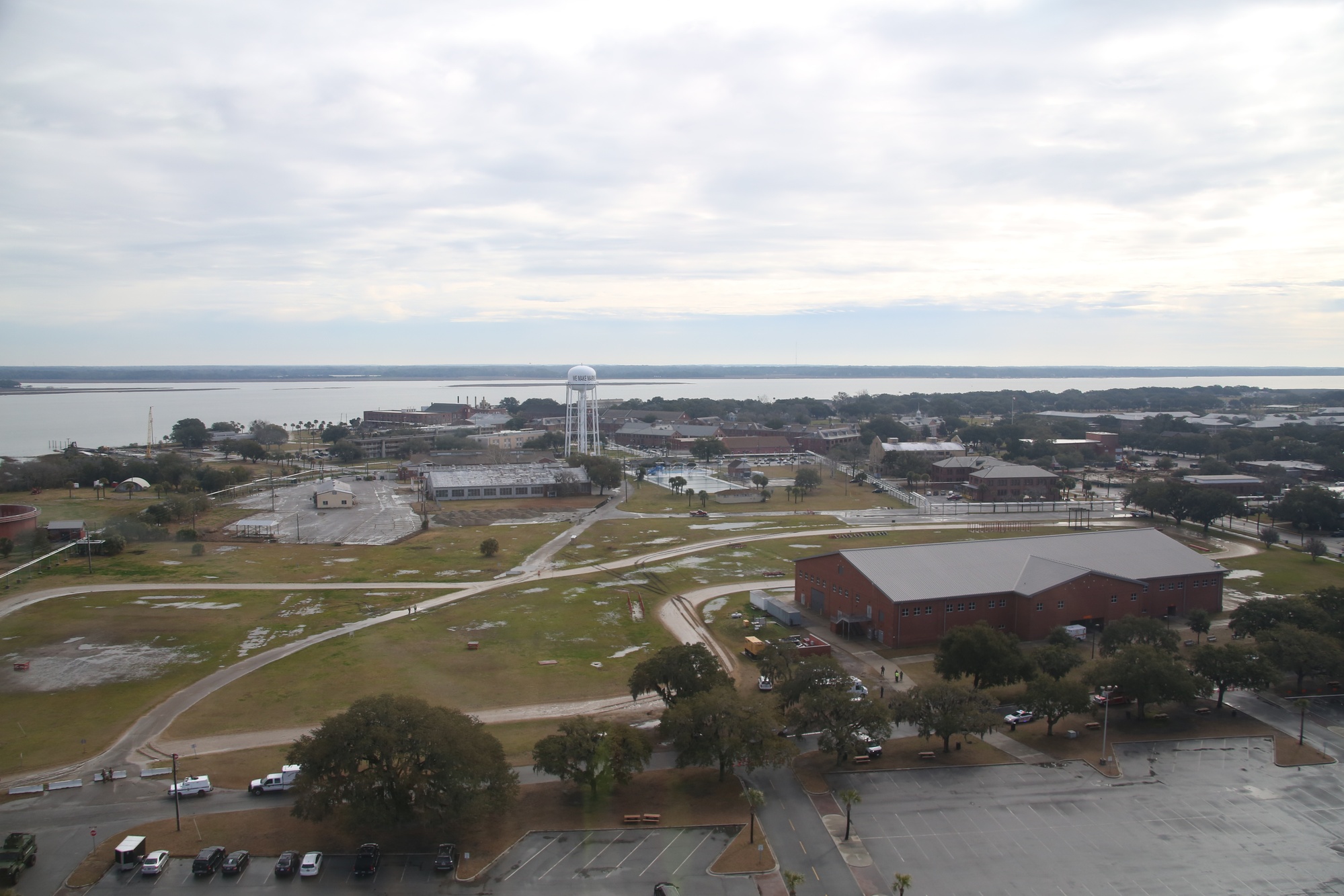
MCRD Parris Island: Where Marines Are Made
In the alligator-laced marshes of the South Carolina Lowcountry, about forty miles northeast of Savannah, Marine Corps Recruit Depot Parris Island is where the Corps makes its Marines from east of the Mississippi, roughly twenty-one thousand recruits a year through thirteen weeks of recruit training. The drill instructors who run that training and the permanent party who support it carry one of the most scrutinized jobs in the Corps. Two things every recruit remembers are the sweltering heat and the sand fleas that swarm at dawn and dusk while you stand at attention. It is one of the most visited bases in the world, and on Family Day and graduation the families flood the antebellum town of Beaufort and Port Royal; MCAS Beaufort and its F-35s are next door, with Hilton Head, Savannah, and Charleston short drives away. A depot whose mission is the recruit will move hard the moment one is said to have been mistreated.
Military defense is all Bilecki Law Group does, and Marines fly us in from our office in Tampa because a contested court martial is decided by trial experience, and we bring it wherever the case is.
The Marine Forged on This Ground
Parris Island makes Marines, and the standard was set by one made here, Gunnery Sergeant John "Manila John" Basilone, who came through recruit training on this depot. On Guadalcanal in October 1942, with his unit nearly overrun at Henderson Field, Basilone worked his machine guns through the night against wave after wave of attackers, repaired guns by hand, ran ammunition through enemy lines, and held the position when holding it seemed impossible. He later turned down a safe stateside billet to return to the fight and was killed leading Marines ashore at Iwo Jima. He would not leave his Marines to face it without him. That refusal to step back from the fight is the standard we bring to a case at Parris Island.
Why Marines at Parris Island Bring Us In
We win court martial cases. Military defense is all we do, and Marines fly us in from all over the country because of our trial record. The military justice system is not built to find the truth; it exists to preserve good order and discipline, and a depot under constant public scrutiny will make an example of a drill instructor or a Marine to protect the institution. A serious case is investigated by NCIS, and for sexual assault and other covered offenses the decision to refer charges to a court martial no longer belongs to your command but goes to an independent Special Trial Counsel. Your detailed defense counsel may be capable but carries a heavy caseload inside the same system, which is why Marines serious about winning bring in their own counsel.
UCMJ Charges We Defend at MCRD Parris Island
The cases below are the most common at MCRD Parris Island. If yours is not here, call anyway, because we defend the full spectrum of military charges.
Sexual Assault and Sex Offenses (UCMJ Article 120 / Article 134). These allegations route to an independent Special Trial Counsel now, and the command treats a report as established before the investigation is finished, all the more so in a training environment where word of an allegation travels fast and the command wants to look decisive. These cases demand counsel who will run an independent investigation and contest the case rather than let the allegation stand in for proof, because a conviction can mean confinement and a federal record, with registration required for a covered sex offense under the applicable federal and state law.
Domestic Violence and Assault (UCMJ Articles 128b and 128). Domestic violence under Article 128b is charged as aggressively as any offense in the UCMJ since the Office of Special Trial Counsel took these cases over. It covers a spouse, an intimate partner, or a family member, and it treats strangulation or suffocation as its own charge that the government can bring even with no visible injury. A qualifying conviction also triggers the federal Lautenberg firearms bar, which can end a Marine career because a Marine has to be able to carry a weapon. We also defend assault under Article 128, the usual charge when a night out in Beaufort ends in a fight, where self defense is a recognized defense.
Recruit Maltreatment and Drill Instructor Misconduct (UCMJ Articles 93 and 92). Nowhere is the line between instructor and trainee enforced harder than on a Marine recruit depot, and a drill instructor accused of maltreatment faces some of the most aggressive prosecution in the Corps. The government charges maltreatment of a recruit under Article 93 and a violation of the recruit-training and contact rules under Article 92, often on a recruit's account alone. The cases are serious, but so are the defenses, because the government still has to prove the conduct, the authority, and an actual rule violation.
Drugs and Off Duty Conduct (UCMJ Articles 112a and 134). Drug cases often turn on the chain of custody and the government's burden to prove any use was knowing and wrongful. A Marine is subject to the UCMJ off duty, so an incident off base comes back to the command, and a positive urinalysis is one of the most common ways a career comes apart. A positive test is evidence the government may use to argue knowing, wrongful use, not an automatic finding of guilt, so the collection, the chain of custody, and whether any use was knowing all remain the government's to prove.
A Career and a Reputation Worth Defending
We do not pretend that every Marine who calls us from Parris Island is innocent. What matters is how serious the case is, not your rank. If a matter is genuinely minor, your detailed defense counsel can handle it, and we will tell you so honestly. But when the case is serious, everything is on the line at once: your career, your retirement, your good name, and your freedom. A court martial conviction is a federal criminal conviction, and where the sentencing parameters apply the confinement range is set by the offense, two and a half to ten years for sexual assault and ten to twenty for rape, with a departure requiring specific facts in writing, on top of a possible punitive discharge and, for a covered sex offense, sex offender registration. That is why you fight. The court’s jurisdiction and the convicted offense determine which sentencing rules apply; some offenses use separate sentencing criteria rather than these ranges.
If you are facing an investigation or court martial at MCRD Parris Island, reach out for a free defense strategy session. We will tell you exactly what you are facing and how we would defend it. The government is already building its case. The only question is whether anyone is building yours.
FAQ
NCIS wants to interview me at Parris Island. Do I have to talk to them?
No. You are not required to sit for an NCIS interview or answer their questions. Under Article 31b of the UCMJ you have the right to remain silent and to a lawyer, and you can invoke both at any point, including before the interview begins. NCIS is collecting evidence, not giving you a chance to explain, and it takes very little to be titled as a subject, a label that follows you for years. Decline, ask for counsel, and call a defense lawyer before you give any statement.
I'm a drill instructor under investigation for maltreating a recruit. What am I facing?
An Article 93 maltreatment charge, and Parris Island is the most scrutinized place in the Corps for these cases, so the command and the public attention push toward an aggressive charge before the facts are settled. The government still has to prove the elements: that the recruit was subject to your orders, and that your conduct was objectively cruel, abusive, or unwarranted, not the lawful, demanding training recruit training is designed to be. These cases are won on the specific conduct, the orders and standards in place, and the full context, none of which an early, one-sided account captures, so do not give a statement without your own counsel.
I'm under an Article 120 investigation. Can it be beaten, and will I have to register as a sex offender?
Yes, it can be fought, because a conviction for a covered Article 120 offense triggers registration duties under the applicable federal and state law, with requirements and duration determined by the covered conviction and jurisdiction. The goal is to defeat the charge or reduce it to an offense that carries no registration, and the investigation and the charging decision are where these cases are most often turned. Get your own counsel involved before you ever sit down with NCIS.