Drug Useand Possession
At Bilecki Law Group, we know that there is always more to the story than the prosecution lets on. Tim Bilecki and Ben Gold fly anywhere in the world to fight for those who stand on the front lines of freedom.

Drug Use in the Military: What You’re Up Against
You’ve been accused of possession or use of a controlled substance by military law enforcement.
- Your rank, pay and military career could be at risk.
- A court-martial conviction could result in a punitive discharge, depending on the offense and forum.
- You could face confinement if convicted at court-martial.
With your future under fire and your freedom at stake, your next move will be one of the most important you’ll ever make. Do you put your fate into the hands of an inexperienced defense attorney? Or do you get experienced counsel retained and fight the charge? You need to know what the government can prove before you decide how to respond.
The military has a zero-tolerance policy when it comes to drug use. Whether it was a one-time mistake, a misunderstanding or something completely out of your control, an allegation can threaten your career. A positive urinalysis can trigger action against you, including disciplinary proceedings or administrative separation. Zero tolerance does not relieve the government of its burden to prove a criminal charge.
Military prosecutors love these cases because they assume you’ll just roll over and take the punishment. But drug testing isn’t perfect. Labs make mistakes. Chain of custody can be challenged. A preliminary screening result and a confirmed result are different things, and a possible explanation has to be checked against the testing actually performed. There are ways to fight back.
If the military is coming after you for drug use, don’t assume the case is a done deal. You can fight back and you can win.
You may invoke your rights and consult available military defense counsel without first retaining a civilian lawyer. Preserve prescriptions, packaging, receipts, messages and other potential evidence. Do not delete or alter material, coordinate accounts with other suspects or violate a lawful order. Get advice before answering more questions about the allegation.
Fighting Your Drug Charges
You’re probably wondering if fighting your charges is worth the effort. Haven’t they caught you red handed? If you’ve been charged after a urinalysis, how can you deny that controlled substances were found in your body?
Service members accused of possession or use can become easy prey for military prosecutors when they assume that they’ve already been found guilty. What they do not account for is that the right defense in court can make it extremely difficult for the prosecution to prove beyond a reasonable doubt that you are guilty of misconduct under Article 112a.
Tim Bilecki and Ben Gold examine the proof before you make a decision about a plea or separation. We look for the facts that challenge knowing use, knowing possession or an intent to distribute:
What You Knew and What You Controlled
First, what is the prosecution’s proof about the substance itself and your knowledge? Was it a mistake? Was there a prescription? Did you know the substance was present and what it was?
For possession, we examine the search photographs, seizure records and the testing that identifies the substance. In a shared barracks room, we want to know precisely where it was found, who could reach it and what connects you to it. We compare that with messages, witness accounts and any statement attributed to you. The government must prove knowing control; your name on a room roster does not answer that question.
The Sample and the Laboratory Findings
Second, in cases involving urinalysis, was the sample collected and handled properly? Did the lab perform its job correctly? What do the testing records actually establish?
We obtain the collection paperwork and laboratory packet, then compare the specimen identifiers, handling history, instrument results and the laboratory's quality controls. When the science needs independent review, we can retain a forensic toxicologist with private funds or seek military funding. The question is whether the testing reliably supports the government's conclusion, whether a defect affects admissibility or weight, and what the scientist can actually say about knowing use. A clerical mistake does not automatically get a case dismissed.
Prescriptions and Other Explanations
Third, what medications, foods or other products could matter? Poppy products can contain codeine or morphine contamination and can affect an opiate test; the actual result and testing procedures matter. Benzedrex contains propylhexedrine, not methamphetamine. Any claim that it explains a result has to be examined against the screening and confirmatory tests.
We compare your account with prescription records, receipts, original packaging, the timing of the test and people who can verify what happened. A possible explanation earns its place in the defense only if the facts and science support it. Even reliable testing does not, by itself, resolve every question about what you knew.
Searches, Statements and Sting Operations
If you were caught in a sting, we need to examine the government’s approach, inducement and what you were already willing to do. Calling it a sting does not resolve whether it crossed the legal line.
We review what authorized the search or test, what you consented to, and whether investigators stayed within that authority. We examine interview recordings and rights advisements before deciding whether there is a supported motion to exclude evidence or a statement. If someone implicated you to protect themselves, we obtain the complete account and compare it with messages, recordings and any benefit they expected from cooperating. Their accusation has to survive examination.
Using the Findings Before Charges and at Trial
Tim Bilecki and Ben Gold use that work to challenge the case while the command and military lawyers are still deciding what to do. At trial, it supplies the questions for the collector, investigator, laboratory witness or cooperating suspect. It can support a motion, expose a gap in the government's proof, or give the judge or panel a supported reason to doubt knowing, wrongful conduct. If the evidence calls for negotiation, the same work helps us assess the charge, confinement exposure and discharge consequences. Avoiding a court-martial does not necessarily end an administrative separation threat.
Assuming you have no options is exactly what the government wants you to think. Taking steps to defend yourself can give you the resources you need to fight for an acquittal.
Drug Possession Charges Under the UCMJ
Possession charges take things a step further. A positive urinalysis is one thing, but if investigators find drugs in your room, vehicle or belongings, the military will try to paint you as a criminal. Maybe you had no idea the drugs were there. Maybe they belonged to someone else. Maybe they were placed there to set you up.
Those circumstances matter. Possession requires knowing, conscious control. Being near drugs or sharing a room with someone who has them does not automatically establish possession. More than one person can possess the same substance, but the government still has to prove your control and knowledge.
Not automatically possession
- Being near drugs
- Sharing a room with someone who has them
- Your name on a room roster
Possession
Knowing, conscious control, proved by the government
What Article 112a Requires
Just to give you some background on how you may be charged and what the government has to establish:
- Article 112a of the UCMJ prohibits wrongful use and possession of the controlled substances it covers. It also addresses distribution, introduction, manufacture, importation and exportation.
- The covered substances include cocaine, heroin, marijuana, amphetamines and other substances listed by the statute or applicable schedules of controlled substances.
- Controlled prescription medications can fall under Article 112a. A prescription drug is not exempt merely because a doctor can prescribe it. A valid prescription, authorized use and what you actually took can matter to whether your conduct was wrongful.
Use requires knowledge of the substance’s presence. Wrongfulness concerns the absence of legal justification or authorization. The government can rely on circumstantial evidence, including a properly supported inference from a drug test. It does not get an automatic conviction because someone points to a positive result.
Bilecki Law Group has been fighting and winning drug cases in the military for years. A single call can put experienced court-martial defense counsel in your corner. Call 813-669-3500.
State Marijuana Laws, CBD and Hemp Products
Do not assume that civilian legalization, a store receipt or a “THC-free” label authorizes military use. The military’s rules can reach hemp and cannabinoid products that are sold legally to civilians, including products marketed as CBD or Delta-8.
We have to distinguish an Article 112a controlled-substance allegation from an Article 92 allegation that you violated a service order. The product, its ingredients, your knowledge and the applicable rule all matter. The hemp policy also contains stated exceptions, including specified official duties, reasonable lack of knowledge that a product was derived from hemp, durable goods such as clothing, and FDA-approved cannabinoid medication used under a valid prescription. A consumer product’s label is not a substitute for that analysis.
ARTICLE 112a
A controlled-substance allegation
ARTICLE 92
Violating a service order
Stated exceptions in the hemp policy
- Specified official duties
- Reasonable lack of knowledge it was hemp-derived
- Durable goods such as clothing
- FDA-approved cannabinoid medication under a valid prescription
Drug Possession With Intent to Distribute
Intent is a hell of a thing to prove because no one can read your mind. However, for a service member facing drug charges under the UCMJ, intent can be the difference between a slap on the wrist and a life destroyed. It doesn’t help that anytime military prosecutors get the chance to prosecute a drug crime they’ll act like they just caught Pablo Escobar with a plane full of cocaine. The military aggressively prosecutes drug distribution cases, and investigators look for other service members involved. Your friends will rat you out to save themselves from the UCMJ and you’ll be standing there alone with nothing but the big green weenie of the military justice system to keep you company.
Pleading guilty to intent without first consulting with an experienced military court-martial defense attorney can expose you to years of confinement that a simple possession charge would not. You can fight drug charges and you can win. Even if you were caught with drugs you cannot assume that they can prove your intent. Don’t let them scare you into admitting guilt.
Do not plead guilty without first talking with experienced court-martial defense counsel.
Your Military Friends Will Turn On You to Save Themselves
Military service bonds one another in a manner that few can truly understand. You’ll go through hell together and if need be, you’d even jump on a grenade in a combat zone to save your buddy. Unless that grenade is a drug charge under the UCMJ. Then they’ll hand you over to save themselves.
Drug prosecutions have helped bring down Mafia members, and you need to be prepared for the fact that your friends will turn on you if you are charged with intent to distribute. Sure they asked you to pick up the drugs and LCpl Garcia in 2nd platoon was going to help you spread it around. Unfortunately, you got caught with it and it’s your problem now.
The UCMJ is an excellent vehicle to destroy someone’s life and military prosecutors know it. They will put the screws to your buddies and with the prospect of having their lives destroyed they will save themselves. You have to get ready to prepare your own military court-martial defense with only you in mind. Just like they say a Marine on duty has no friends, so it will be with you and drug charges.
If that seems like dirty play to you by military investigators that’s because it is. They are propping up flimsy intent cases because they need to destroy someone in a public fashion in order to scare everyone else into compliance.
You cannot coexist with a military justice system that is trying to destroy you.
Why You Need to Put Up a Fight
Even a drug allegation that looks minor can threaten your military career and benefits. This is not the time for rose-colored glasses. A court-martial conviction can carry a punitive discharge when authorized. Nonjudicial punishment and administrative separation create their own consequences, even when the case never goes to trial.
Your civilian career can also suffer. A punitive discharge, conviction or administrative discharge under other than honorable conditions can affect employment opportunities and other decisions long after you leave the military.
Winning your drug case should be a top priority if you want to advance or remain in the military. Do not assume that a lesser disciplinary disposition prevents a later separation proceeding. You need a strategy for the criminal allegation and the effect on your service. A drug charge can close doors, end careers and cost you rank.
Military Sting Operations and Drug Intent Cases
When military investigators can’t find a drug dealer to charge, they may create the opportunity themselves through sting operations. This is where investigators bait service members into selling drugs and then pounce on them when they commit a crime they wouldn’t have otherwise. In a case alleging possession with intent to distribute, you can be charged even if no drugs have actually been distributed. The government still has to prove that additional intent.
However, it is possible that the sting operation itself crossed the legal line. Where there is a valid basis, evidence can be challenged before trial. An undercover opportunity alone does not establish entrapment, and an investigative mistake does not automatically require suppression. We examine what the agents did and make the government answer for it. We don’t let incompetence go unchallenged.
The Manual for Courts-Martial explains that intent to distribute may be inferred from circumstantial evidence. Examples include possession of a quantity beyond what someone would likely have for personal use, the substance’s market value, the way it is packaged, or evidence that the accused is not a user. On the other hand, evidence that the accused is addicted to or is a heavy user of the substance may tend to negate an inference of intent to distribute.
MAY SUPPORT AN INFERENCE
- Quantity beyond likely personal use
- Market value
- Packaging
- Evidence the accused is not a user
MAY TEND TO NEGATE IT
- Addiction to the substance
- Heavy use of the substance
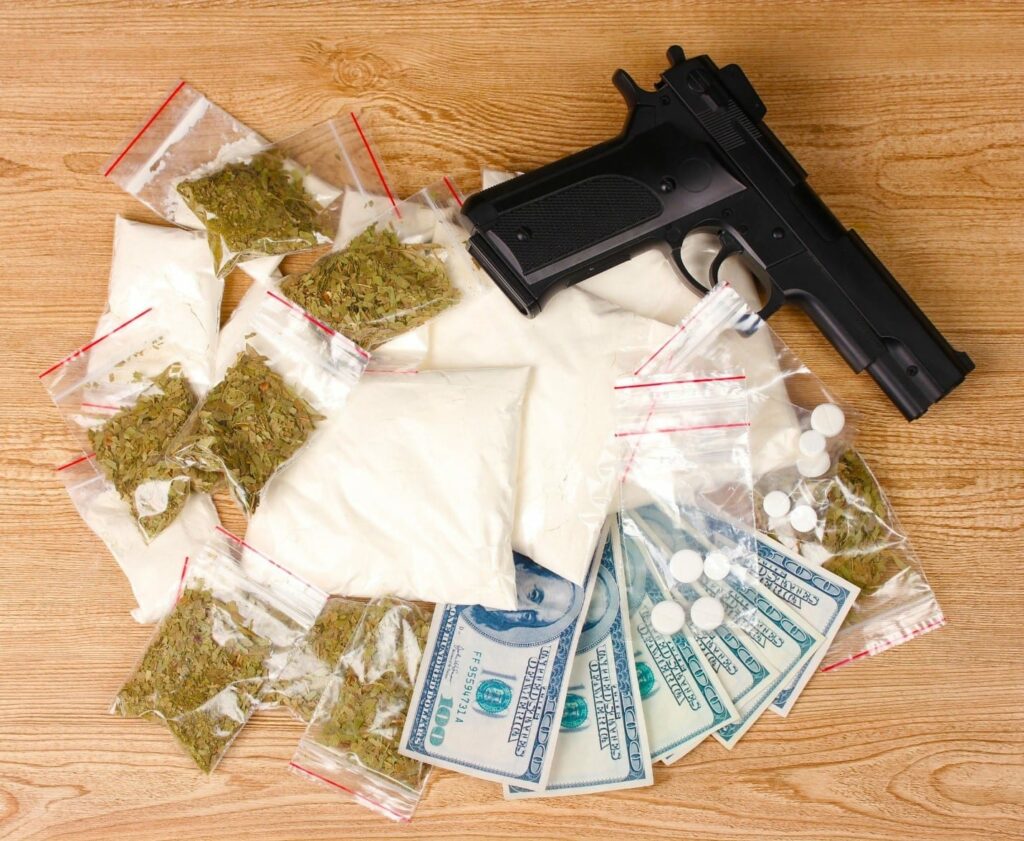
Fighting Drug Cases Before a Military Trial
Tim Bilecki has taken more than 250 courts-martial to verdict. We know how the prosecution operates. We know their weaknesses. We hit them hard and fast.
Camp Humphreys: No Military Prosecution and an Honorable Discharge
- CID investigationImportation allegations in Korea
- Korean prosecutionSuspended sentence; we did not appear in Korean court
- Army still intends to prosecuteDelay, unavailable witnesses challenged
- Army agrees not to prosecute
- Misconduct separation stoppedEnlistment expired; no valid authority to retain
- Honorable discharge
An Army Specialist at Camp Humphreys retained Bilecki Law Group during a CID investigation into allegations that he had imported substantial quantities of drugs, including synthetic substances, into Korea. We investigated the allegations and reviewed the digital forensics. When Korean authorities took over the prosecution, we worked alongside his Korean civilian defense attorney. We represented him as civilian military defense counsel. We did not represent him in Korean court. The Korean court convicted him of possession and use of a synthetic cannabinoid and imposed a suspended prison sentence.
Then the case came back to the Army, which still intended to prosecute him. Tim Bilecki took the fight to trial counsel, the Staff Judge Advocate’s office and the command. A considerable amount of time had passed, and witnesses were no longer available. We challenged the Government’s ability to prosecute under those circumstances. The Army agreed not to prosecute.
That still was not the end of the fight. The command pursued misconduct separation with a General discharge. We repeatedly challenged failures in its separation paperwork. His enlistment expired before the command completed the action. Bilecki put the argument in writing: the unfinished separation did not itself authorize the Army to keep him, and the command had identified no valid authority to retain him. The command stopped pursuing misconduct separation. Our client received an Honorable discharge.
The Korean conviction remained. Our result in the military system was no prosecution and an Honorable Army discharge.
Bilecki has won drug intent cases that the prosecution thought were a lock. We’ve secured honorable discharges and separation in lieu of trial for guys who were looking at over a decade in military prison. Reach out to us and let us use our experience to help. We know you didn’t see this coming and this wasn’t how you thought your military career would go. Just know that you can fight back and you can win. Get us into the fight on your behalf.
Maximum Punishments for Drug Use and Possession
Just take a look at the difference in maximum punishments from a simple drug possession charge to a charge with intent. These are general maximums for an enlisted accused, not predictions of the sentence. The actual authorized punishment depends on the charged offense, its date, the forum and any applicable plea agreement.
Wrongful Use
- Amphetamine, cocaine, heroin, lysergic acid diethylamide, methamphetamine, opium, phencyclidine, secobarbital, and Schedule I, II and III controlled substances other than marijuana: dishonorable discharge, forfeiture of all pay and allowances, and confinement for five years. For an enlisted member, reduction to E-1 may also be adjudged.
- Marijuana, phenobarbital, and Schedule IV and V controlled substances: dishonorable discharge, forfeiture of all pay and allowances, and confinement for two years. For an enlisted member, reduction to E-1 may also be adjudged.
Wrongful Possession
- Amphetamine, cocaine, heroin, lysergic acid diethylamide, marijuana other than possession of less than 30 grams, methamphetamine, opium, phencyclidine, secobarbital, and Schedule I, II and III controlled substances: dishonorable discharge, forfeiture of all pay and allowances, and confinement for five years. For an enlisted member, reduction to E-1 may also be adjudged.
- Marijuana possession of less than 30 grams, phenobarbital, and Schedule IV and V controlled substances: dishonorable discharge, forfeiture of all pay and allowances, and confinement for two years. For an enlisted member, reduction to E-1 may also be adjudged.
Possession With Intent to Distribute
- Amphetamine, cocaine, heroin, lysergic acid diethylamide, marijuana, methamphetamine, opium, phencyclidine, secobarbital, and Schedule I, II and III controlled substances: dishonorable discharge, forfeiture of all pay and allowances, and confinement for fifteen years. For an enlisted member, reduction to E-1 may also be adjudged.
- Phenobarbital and Schedule IV and V controlled substances: dishonorable discharge, forfeiture of all pay and allowances, and confinement for ten years. For an enlisted member, reduction to E-1 may also be adjudged.
Certain specified circumstances can increase the maximum confinement by five years. They include an offense committed while on duty as a sentinel or lookout; aboard a military vessel or aircraft; at a military missile launch facility; while receiving hostile fire or imminent danger pay; in time of war; or in a military confinement facility. A qualifying circumstance must be alleged and proved.
FAQs About Military Drug Use and Possession
My Urine Tested Positive. How Could I Not Be Found Guilty?
A positive result does not automatically establish guilt. The government must prove knowing, wrongful use. A properly admitted and explained urinalysis can support an inference of that knowledge and wrongfulness. We need to examine the scientific foundation, the collection and handling of the sample, your medications and products, and the facts supporting an explanation of innocent ingestion. The burden of proving the charge remains with the government.
The worst thing a service member can do is panic and accept the government’s initial verdict of guilt. Get advice before you make that decision.
How Are Simple Use or Possession Cases Handled by the Military?
Commands may pursue nonjudicial punishment, administrative separation or court-martial, depending on the case. NJP is disciplinary punishment. Administrative separation is a separate process and can follow NJP. A smaller drug allegation does not rule out court-martial. We need to address both the alleged offense and the possible effect on your career.
What If They Caught Me Buying Drugs on the Dark Web?
An accusation about the dark web still has to be tied to you. If the arrest happened when a shipment arrived, we need to examine who ordered it, who controlled it and what you knew. If investigators rely on digital forensics, we examine the accounts, devices, messages and other material they say connects you to the drugs. Give us a call, as we’ve worked multiple drug cases involving the dark web and secured positive outcomes for our clients.
What If the Drugs Were for My Own Personal Use?
Evidence that you suffer from addiction or heavy use of the drug may negate an inference that you intended to distribute it. Maybe you were just storing up weed for a six-month deployment? Perhaps it was given to you before deploying to a combat zone by your Vietnam Vet uncle because it’s what got him through the war? The point is that you cannot let them infer intent upon you without a fight. Personal use does not make wrongful possession or use lawful, but it can matter to the additional distribution allegation.
Will You Really Fly Anywhere in the World to Defend Me for Military Drug Crimes?
Tim Bilecki and Ben Gold absolutely will fly anywhere in the world, and because South Korea and Japan take drug crimes seriously, we are there often. One has to understand the various civilian and military regulations at play when charged overseas. Experience matters in knowing how to fight back overseas. When military prosecutors see that you’ve retained experienced civilian defense counsel who will travel from the United States to defend you, they know that they now have a fight on their hands.
What If I’ve Already Admitted Wrongdoing?
Well, that’s not a helpful position to be in, but stop talking to anyone about the allegation and give us a call. You wouldn’t be the first one they scared into admitting guilt when they had a shitty case to begin with. Reach out to us and we’ll shoot you straight on what you are facing. There is still time to fight back. We need to examine whether they made mistakes during the investigation. There is still time to secure for yourself the best possible outcome. Don’t let them take everything from you.