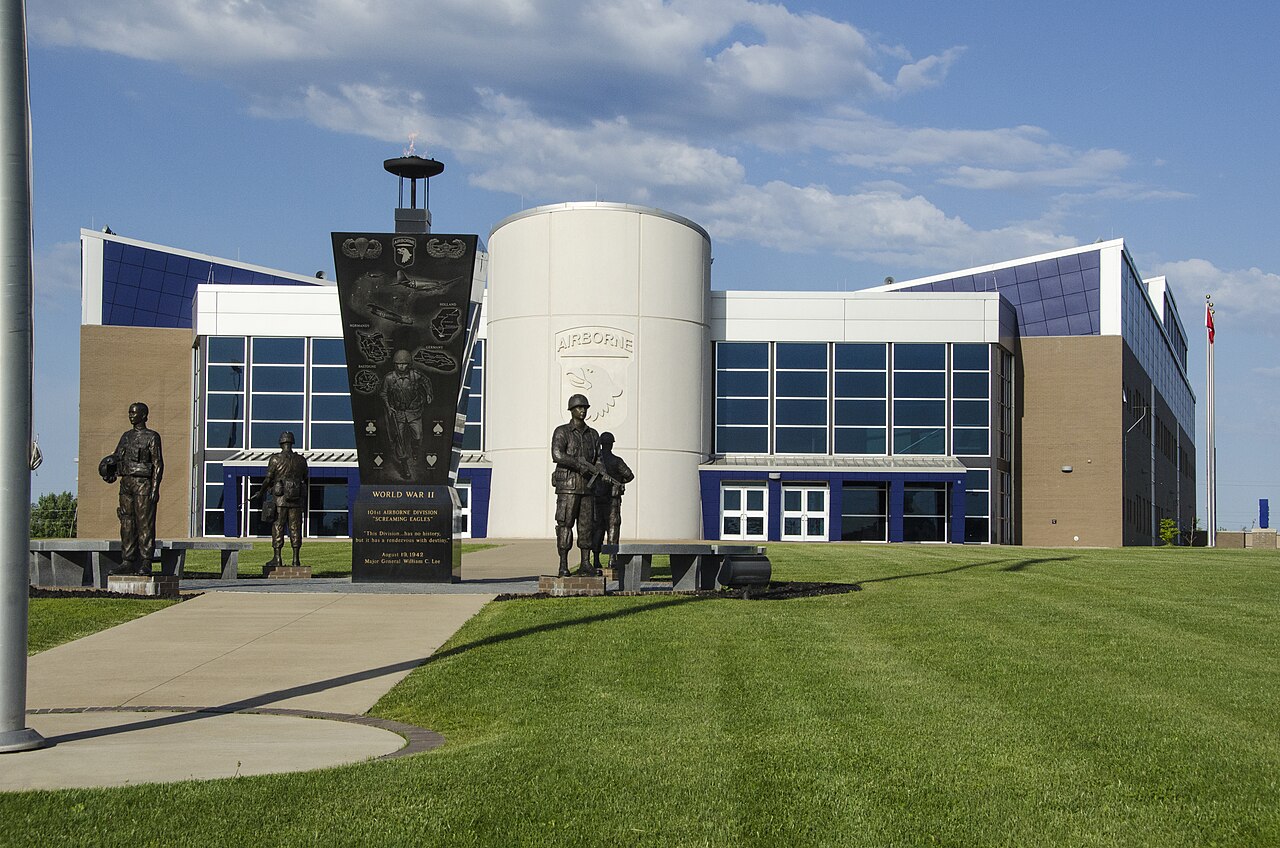
Fort Campbell: Home of the 101st Airborne and the Army's Special Operators
On the Kentucky and Tennessee line, Fort Campbell is the home of the 101st Airborne Division, the Screaming Eagles, the Army's air assault division, along with the 5th Special Forces Group and the 160th Special Operations Aviation Regiment, the Night Stalkers. It is one of the most deployed posts in the Army and one of its most decorated, and most of its Soldiers land in Clarksville, the Tennessee gate town where many families settle. Tennessee has no individual income tax, while Kentucky exempts qualifying active-duty military pay; the member’s domicile and applicable military tax rules matter. Fort Campbell Boulevard runs on the bars, the clubs, and the car lots that serve a young and hard charging force, with Nashville and its honky tonks an hour south, and a command with this much pride in its units has every reason to make an example of a Soldier who embarrasses the division.
A serious court martial is won at trial, so the real question about any lawyer is not whether he knows Campbell or the people in the legal office, but what he has actually done in a contested case. Military defense is all Bilecki Law Group does, and Soldiers and special operators bring us in from our office in Tampa for our record, not our address. They fly us in from around the world for these cases, to Okinawa, Germany, and Korea, and while we are not across the street from Campbell, we are close, a short flight from Tampa.
The Officer Who Fixed Bayonets and Led the Charge
The 101st Airborne's standard was set in the hedgerows of Normandy by Lieutenant Colonel Robert G. Cole. On June 11, 1944, near Carentan, his battalion of paratroopers was pinned in the open along a causeway, cut down by German fire from a farm across the field and unable to go forward or back. Cole did the one thing no one expects. He ordered fixed bayonets, stood up in front of his men, and led them at a dead run across the open ground and into the German positions. Enough of them followed, and they took the farm. He was killed by a sniper in Holland that fall, before the Medal of Honor he had earned could be put in his hands. He led from the very front, where it cost the most. That willingness to be the first one up is the standard we bring to a case at Campbell.
Why Soldiers at Campbell Bring Us In
We win court martial cases. Military defense is all we do, and Soldiers fly us in from all over the country because of our trial record. The military justice system is not built to find the truth; it exists to preserve good order and discipline, and a command that prizes its reputation the way Campbell does will make an example of a Soldier to keep the standard sharp. A serious case is investigated by Army CID, and for sexual assault and other covered offenses the decision to refer charges to a court martial no longer belongs to your command but goes to an independent Special Trial Counsel. Your Trial Defense Service counsel may be capable but carries a heavy caseload inside the same system, which is why Soldiers serious about winning bring in their own counsel.
UCMJ Charges We Defend at Fort Campbell
These are the most common cases at Fort Campbell. They are examples, not limits, and we defend service members against the full range of UCMJ offenses.
Sexual Assault and Sex Offenses (UCMJ Article 120 / Article 134). These allegations route to an independent Special Trial Counsel now, and the command treats a report as established before the investigation is finished, all the more so in a tight unit where word of an allegation travels fast and the command wants to look decisive. These cases demand counsel who will run an independent investigation and contest the case rather than let the allegation stand in for proof, because a conviction can mean confinement and a federal record, with registration required for a covered sex offense under the applicable federal and state law.
Domestic Violence and Assault (UCMJ Articles 128b and 128). Domestic violence under Article 128b is charged as aggressively as any offense in the UCMJ since the Office of Special Trial Counsel took these cases over. It covers a spouse, an intimate partner, or a family member, and it treats strangulation or suffocation as its own charge that the government can bring even with no visible injury. A qualifying conviction also triggers the federal Lautenberg firearms bar, which can end an Army career because a Soldier has to be able to carry a weapon. We also defend assault under Article 128, the usual charge when a night out in Clarksville ends in a fight, where self defense is a recognized defense.
Larceny and Government Property (UCMJ Articles 121 and 108). An air assault and special operations force is issued a great deal of sensitive equipment, from weapons and optics to aviation and communications gear, and accountability is taken seriously. The government treats missing gear, an item that cannot be reconciled, or property that walked off as larceny under Article 121 or wrongful disposition of military property under Article 108, but a shortage on a hand receipt is not the same as theft, and the government still has to prove the state of mind required by the charged offense: intent for larceny or fraud, or negligence where Article 108 permits it, not just that something cannot be found.
Drugs and Off Duty Conduct (UCMJ Articles 112a and 134). Drug cases often turn on the chain of custody and the government's burden to prove any use was knowing and wrongful. A Soldier is subject to the UCMJ off duty, so a night out in Clarksville or down in Nashville that ends badly comes back to the command, which even keeps a list of off limits bars and clubs in town where simply being caught is its own violation of a lawful order. An off base matter can also be charged by the civilian authorities, so the same night can become both a court martial and a county case at once, which is one more reason to get counsel involved before you talk to anyone.
A Career and a Reputation Worth Defending
We do not pretend that every Soldier who calls us from Campbell is innocent. What matters is how serious the case is, not your rank. If a matter is genuinely minor, your Trial Defense Service counsel can handle it, and we will tell you so honestly. But when the case is serious, everything is on the line at once: your career, your clearance, your retirement, your good name, and your freedom. A court martial conviction is a federal criminal conviction, and the applicable military sentencing parameters set a confinement range the judge has to work within, two and a half to ten years for sexual assault and ten to twenty for rape, with a departure requiring specific facts in writing, plus any required or adjudged punitive discharge and, on a covered sex offense, sex offender registration. That is why you fight. The court’s jurisdiction and the convicted offense determine which sentencing rules apply; some offenses use separate sentencing criteria rather than these ranges.
If you are facing an investigation or court martial at Fort Campbell, reach out for a free defense strategy session. We will tell you exactly what you are facing and how we would defend it. The government is already building its case. The only question is whether anyone is building yours.
Cases Connected to Fort Campbell
These cases include trials, hearings, investigations, and administrative matters. A connection to this location does not necessarily mean that the trial occurred here.
- Case connected to this location: Bilecki Rebuts GOMOR for Army Captain’s Adultery with Civilian
- Case connected to this location: Army SGM Faces Sex Assault Claims After Funeral, Bilecki Rebuts Allegations
- Case connected to this location: 5th Special Forces Group Officer's GOMOR Rescinded in Full
- Case connected to this location: Bilecki Walks Five-Charge GCM at Camp Humphreys to 150 Days, No Punitive Discharge After Government Stacks Resurrected Fort Campbell GOMOR Onto Yongsan Bar-Fight Charge Sheet
- Case connected to this location: Bilecki Wins Dismissal of All Seven Article 120b Sexual Abuse of a Child Specifications at Fort Campbell General Court Martial; Plea Limited to Article 128 Battery and Article 134 Possession, Bad Conduct Discharge in Lieu of Mandatory Dishonorable Discharge
FAQ
Army CID wants to interview me at Campbell. Do I have to talk to them?
No. You are not required to sit for a CID interview or answer their questions. Under Article 31b of the UCMJ you have the right to remain silent and to a lawyer, and you can invoke both at any point, including before the interview begins. CID is collecting evidence, not giving you a chance to explain, and it takes very little to be titled as a subject, a label that follows you for years. Decline, ask for counsel, and call a defense lawyer before you give any statement.
I'm under an Article 120 investigation. Can it really be beaten, and will I have to register as a sex offender?
Yes, it can be fought, and it has to be, because a court martial conviction for a covered Article 120 offense triggers registration duties under the applicable federal and state law, with requirements and duration determined by the covered conviction and jurisdiction. The fight is to defeat the charge outright or strip it down to something that carries no registration. At Campbell, we secured dismissal of seven Article 120b specifications, with a plea limited to battery and possession of child pornography. A conviction for possession of child pornography can still require sex offender registration. The earlier we are in, the more we can do, so get your own counsel involved before you ever sit down with CID.
I'm in a Special Forces or 160th unit and the command is going after my clearance and my career over an allegation. What can be done?
The criminal charge, any GOMOR, and your clearance all come from the same accusation, so the most important thing you can do for all three is defeat the underlying charge. Revoking a clearance is a separate administrative process that we do not handle, but it feeds on what the investigation finds, which is why we fight the charge hard from the start. That approach works: we got a 5th Special Forces Group officer's GOMOR rescinded in full, with no adverse filing and the career preserved. Get counsel in before you give a statement, because in the special operations community a single misstep on the record can cost the access the job depends on.
Something happened off base. Can Tennessee or Kentucky and the Army both come after me for it?
Yes. Campbell sits on the state line, so an off post incident falls under Montgomery County, Tennessee on the Clarksville side or Christian County, Kentucky on the Hopkinsville side, and either way the state and the military are separate sovereigns. That means the same incident can be prosecuted by the county and by a court martial, and double jeopardy does not bar one after the other. The command does not wait for the county, and a county dismissal or acquittal does not end the UCMJ exposure. A statement to one system can be used by the other, so do not talk to the local police, the sheriff, or CID until you have a defense lawyer.