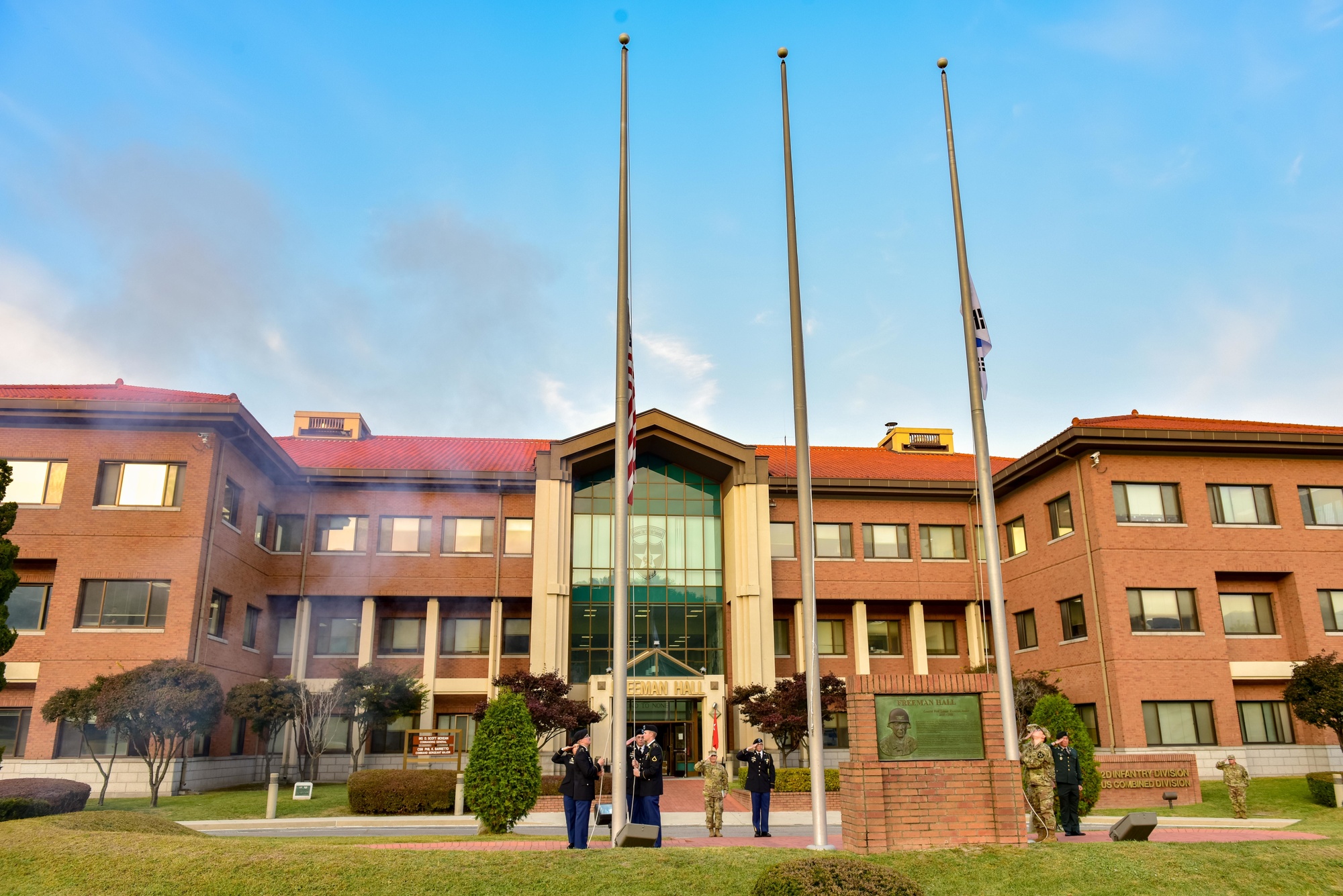
Camp Red Cloud: The Old Home of the 2nd Infantry Division, Now Returned to Korea
For decades Camp Red Cloud in Uijeongbu, about twenty miles north of Seoul, was the headquarters of the 2nd Infantry Division and the nerve center of Area I, the Army's forward presence below the DMZ. That era has ended. The division cased its colors at Camp Red Cloud and moved its headquarters south to Camp Humphreys in 2018, and the installation was returned to the Korean government in February 2022. The name still draws Soldiers and families searching for help, because careers were built here and because the northern camps the division left behind, Casey and Hovey among them, are still very much in operation.
If your case is tied to Camp Red Cloud or the old Area I, the closure does not make the problem go away; it just changes where the fight happens. A court martial connected to this ground is still a fight for a career, a retirement, and sometimes freedom, and the military justice system that handles it is the same one that runs the entire peninsula. The only way to win is to deny the prosecution the easy conviction it expects and make it prove every element of what it has charged.
The Corporal Who Would Not Leave His Post
Camp Red Cloud was named for Corporal Mitchell Red Cloud Jr., a Ho-Chunk Soldier from Wisconsin who had already fought as a Marine Raider in the Pacific before he went to Korea with Company E, 19th Infantry, 24th Infantry Division. On the night of November 5, 1950, near Chonghyon, he was on the point of a ridge in front of his company when he was the first to spot a massed Chinese assault coming out of the brush. He sprang up and opened fire at point-blank range, his automatic rifle breaking the charge and buying his company the time it needed to organize. Gravely wounded, he refused evacuation, pulled himself upright against a tree so he could keep standing, and kept firing until he was killed, covering his comrades to the end. He was posthumously awarded the Medal of Honor, and the post was renamed in his honor in 1957. He would not leave the position he was holding, and that is the standard we bring to a fight for a Soldier in northern Korea.
Why Soldiers Connected to Camp Red Cloud Fly Us In
Korea has been central to this firm's work for the better part of two decades. Tim Bilecki's last tour in uniform was as the Army's Senior Defense Counsel for the Trial Defense Service across the Pacific Rim, and since going civilian he has returned more than sixty times to try contested courts martial in front of these commands, winning repeated full acquittals in contested Korea cases from sexual assault and domestic violence to BAH fraud. With the 2nd Infantry Division now headquartered at Camp Humphreys, a serious case once tied to Area I is investigated by Army CID and, for sexual assault, domestic violence, and other covered offenses, charged by an independent Special Trial Counsel in the Army's Office of Special Trial Counsel, whose Korea field office sits at Camp Humphreys, where Eighth Army's military justice now runs. When prosecutors see counsel with that kind of Korea record fly in, the easy win is gone. The actual entitlement depends on the orders, dependent status, authorized location, and applicable housing rule; an address discrepancy alone does not establish an overpayment or criminal intent.
UCMJ Charges We Defend for Soldiers in Northern Korea
Sexual Assault and Sex Offenses (UCMJ Article 120 / Article 134). The Army's SHARP program drives these cases as hard in Korea as anywhere, treating the allegation as established before the investigation is finished and reaching for administrative separation when the evidence will not support a charge. They route to an independent Special Trial Counsel now and demand counsel who will investigate independently and fight it early, before charges are preferred.
Fraud and Larceny (UCMJ Article 121 / Article 107). Korea has some of the highest housing allowance fraud rates in the military, and a Soldier drawing BAH against a dependent's stateside address or OHA against a local lease can be accused of theft when an auditor decides the paperwork was deliberate. Charged as larceny under Article 121 and a false official statement under Article 107, these cases turn on intent, which a finance error or a family that genuinely moved will not establish. The actual entitlement depends on the orders, dependent status, authorized location, and applicable housing rule; an address discrepancy alone does not establish an overpayment or criminal intent.
Domestic Violence and Assault (UCMJ Articles 128b and 128). Domestic violence under Article 128b is one of the largest parts of our caseload, prosecuted by the Office of Special Trial Counsel as hard as any offense. It covers a spouse, an intimate partner, or a family member, makes strangulation or suffocation a separate, serious charge even with no visible injury, and a qualifying conviction triggers the federal Lautenberg firearms bar that can end a Soldier's career. We also defend assault under Article 128, where self defense is a recognized defense.
Drug Offenses (UCMJ Article 112a). In Korea the drug cases that worry the command are less about a positive marijuana test and more about synthetic drugs and substances bought on the economy or shipped in. A positive urinalysis is not the end of the fight, because the chain of custody can be challenged, innocent ingestion is recognized, and the government still has to prove any use was knowing and wrongful.
Military Specific Offenses (UCMJ Articles 92, 134, and more). Failure to obey, unauthorized absence, dereliction, false official statement, and conduct unbecoming get stacked onto a charge sheet to inflate the punishment and the pressure to plead, and overseas commands file charges that would never surface stateside. Every specification still has to be proven beyond a reasonable doubt on its own.
The Closure Doesn't End the Case, So Don't Face It Alone
Not every Soldier who calls us from Korea is innocent, and we do not pretend otherwise. Some made a mistake and know it. That does not mean accepting the worst the system can hand out, and if a matter is genuinely minor your free Trial Defense Service counsel can handle it, which we will tell you honestly.
But when the case is serious, all of it is on the line at once: your career, your retirement, your good name, and your freedom, with a host nation in Korea that can prosecute on top of the court martial. A conviction is a federal criminal conviction that can carry confinement, a punitive discharge, and on a sex offense a place on a registry, no matter your rank. If you are facing an investigation or court martial connected to Camp Red Cloud or the northern camps, reach out for a free defense strategy session, and we will fly to Korea and tell you exactly what you are facing.
FAQ
Camp Red Cloud has closed and the 2nd Infantry Division moved to Camp Humphreys. Where does my case actually go now?
Through the same Eighth Army military justice system that runs the rest of the peninsula. With the division headquartered at Camp Humphreys, that is where the Army's Office of Special Trial Counsel keeps its Korea field office and where the military justice for this part of Korea is administered, while the northern camps that remain in operation, like Casey and Hovey, still handle Soldiers in the field. The closure of Camp Red Cloud changes the address, not the exposure: the investigators, the charging authority, and the rules are the same, and the case is just as serious. Because the convening authority and the OSTC field office now sit at Camp Humphreys, our Camp Humphreys page covers that side in depth. Getting counsel engaged early, before charges are preferred, is still where the most valuable work gets done.
Army CID wants to interview me about an allegation in the old Area I. Do I have to talk?
No, and get counsel before you do. Under Article 31b of the UCMJ you have the right to stay silent and to a lawyer, and you should invoke both, because a CID interview is evidence collection, not your chance to explain. CID will also title you, listing you as the subject of the investigation in its files at a low threshold, which can follow you in background and clearance checks even if the case is later dropped. For covered offenses the charging decision belongs to an independent Special Trial Counsel, not your command. Decline, ask for counsel, and call a lawyer before the first word.
My BAH or OHA in Korea is being questioned. When does a housing allowance problem become a larceny charge?
When the government decides you knew the claim was false. A Soldier on an unaccompanied tour has to report a dependent's actual residence rather than the address that pays the most, and an accompanied Soldier's OHA is tied to a lease an auditor can question. When a payment turns out wrong, a finance review or a CID financial investigation can recast it as larceny under Article 121 plus a false official statement under Article 107, because the housing form is treated as both the theft and the lie. Intent is the element the government has to prove, though, and a finance office error or a family that really moved is not a scheme.