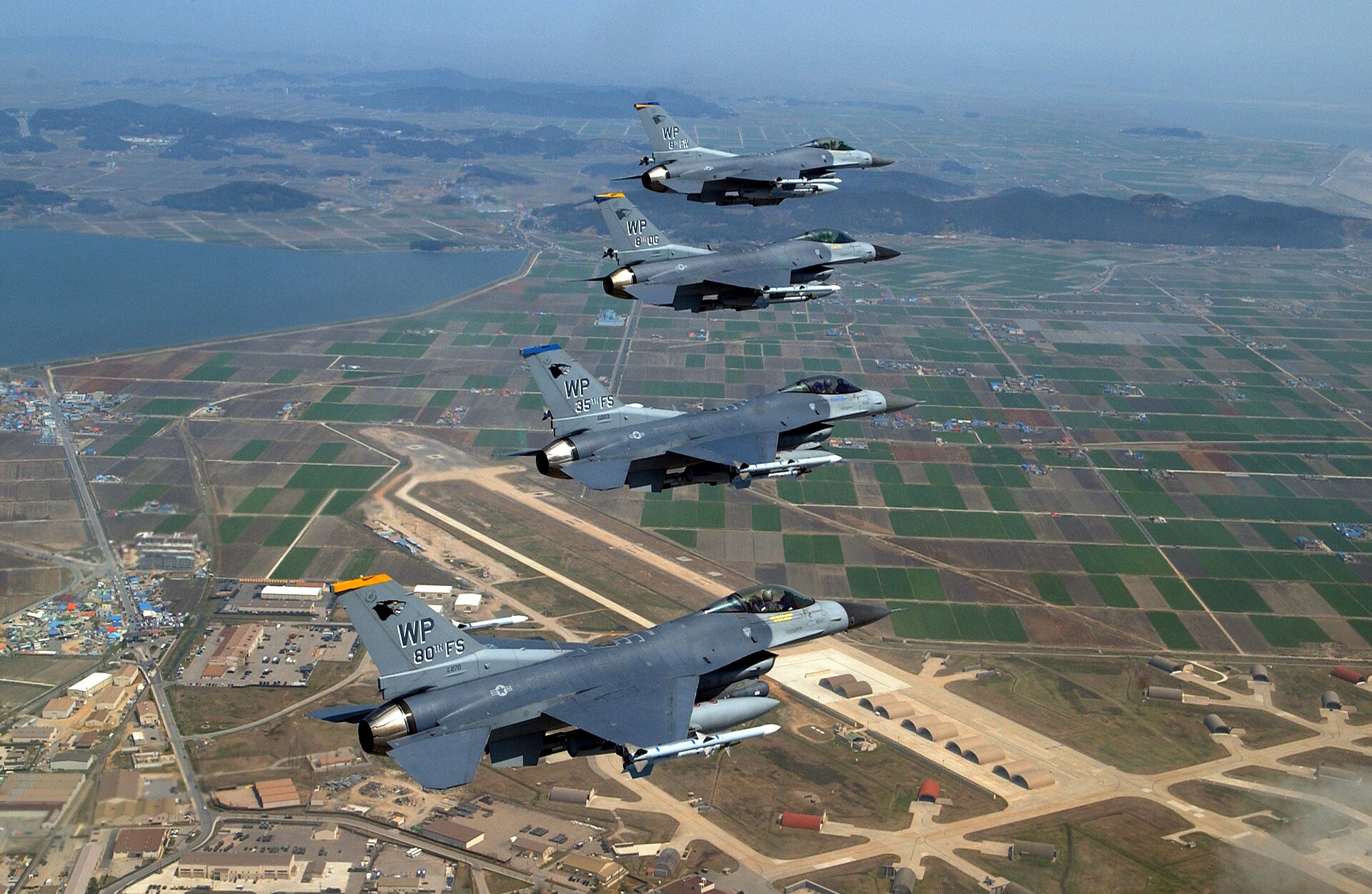
Kunsan Air Base: Home of the Wolf Pack, and a Hard Place to Fight the UCMJ Alone
Kunsan sits on the Yellow Sea coast a few miles west of Gunsan City, and for generations an assignment here meant the same thing: a remote, one-year unaccompanied tour, no family, and a life built around the 8th Fighter Wing, the Wolf Pack, and its F-16s. A tour like that runs on its own customs. Each fighter squadron keeps a Heritage Room, the squadron bar known as the hooch, where the rival Pantons and Juvats hang their nametags on the wall and the Friday night Roll Call carries on a fighter pilot tradition that runs back a century. With almost nothing else off duty, that world was the center of gravity at Kunsan, and it was often where a long night turned into a UCMJ case.
That world is changing fast. The Air Force’s Super Squadron test moved F-16s and Airmen from Kunsan to Osan, but the test concluded in April 2026 and the Air Force announced a phased return to three squadrons across the two bases. The 8th Fighter Wing remains the host wing, and the base, its Security Forces, and the Korean legal system around it are all still very much in operation. An Airman who lands in trouble at Kunsan is still facing the full weight of the military justice system far from home, and as units move between the two bases, that fight may follow their squadrons to Osan, where this firm is constantly. We defend Airmen on both ends of the move; if your unit and your case have shifted to Osan, our Osan Air Base coverage picks up there.
That same isolation is what the military justice system uses against you. A year away from home, a small base where everyone knows everyone, and a command that cannot afford an incident make for a place where a single bad night turns into a career ending case fast. An Airman facing an investigation or court martial at Kunsan is fighting for a career, a retirement, and sometimes freedom, and in Korea there is a second layer most never think about until it lands on them: the Korean legal system, which can reach an off base incident at the same time the Air Force does. The only way to win that fight is to deny the prosecution the easy conviction it expects and make it prove every element of what it has charged.
The General Who Walked Out of Korea Alone
When the North Koreans poured across the border in 1950, Major General William F. Dean and his 24th Infantry Division were ordered to hold the city of Taejon long enough for the Pusan Perimeter to take shape. Dean held it, and when the fighting reached the streets he went after enemy tanks himself, moving house to house with a bazooka team in the middle of a two-star general's war. During the withdrawal his jeep took a wrong turn, and while searching for water that night he fell down a ravine and was knocked unconscious. He woke alone behind enemy lines and spent the next thirty-six days walking south toward friendly lines, losing some sixty pounds, before South Korean civilians who posed as friendly turned him over to the North Koreans. He spent the rest of the war as the highest-ranking American prisoner, never knowing he had been awarded the Medal of Honor for the stand at Taejon. Isolated and alone is exactly how the prosecution wants you to feel at Kunsan, and Dean's story is a reminder that the fight is not over just because you cannot see a way out of it.
Why Airmen at Kunsan Fly Us In
Korea is home ground for this firm, not an occasional trip. Tim Bilecki served his last active duty tour as the Army's Senior Defense Counsel for the Trial Defense Service across the Pacific Rim, and in the years since going civilian he has flown back to the peninsula more than sixty times to try contested courts martial in front of these commands. The record runs the length of Korea, including repeated full acquittals in contested cases from sexual assault and domestic violence to BAH fraud. When prosecutors see counsel with that kind of Korea experience fly in, the easy win they were counting on is gone.
The reason it matters is that the military justice system was not built to find the truth. It exists to preserve good order and discipline, and overseas it does that by making a public example, because a destroyed career in Korea keeps the rest of the force in line and reassures the headquarters back home. A serious case at Kunsan is investigated by the Air Force Office of Special Investigations, and for sexual assault, domestic violence, and other covered offenses the decision to refer charges to a court martial no longer belongs to your wing commander; it goes to an independent Special Trial Counsel in the Air Force's Office of Special Trial Counsel, with the wing's military justice running up through Seventh Air Force at Osan. Your free Area Defense Counsel is often capable and genuinely on your side, but carries a heavy caseload and works inside the same system, which is why Airmen who are serious about the fight bring in their own counsel.
UCMJ Charges We Defend at Kunsan Air Base
Think of the list below as the most common cases at Kunsan Air Base, not the limit of what we handle under the UCMJ.
Sexual Assault and Sex Offenses (UCMJ Article 120 / Article 134). The Air Force runs its SAPR program at Kunsan under the same pressure that drives these prosecutions everywhere, and the compressed social world of a remote, dry-on-paper base makes them more volatile, not less. Relationships form fast in a year-long tour with few outlets, and when one ends badly the fallout plays out in a community with no anonymity. An allegation is treated as established before the investigation is finished, and even where the evidence will not support a charge the command reaches for administrative separation. Airmen have also learned that a complaint can redirect an investigation or buy a transfer out of Kunsan, and a command focused on showing it takes every report seriously is in no position to weigh motive. These cases now route to an independent Special Trial Counsel, and they demand counsel who will investigate hard and contest the case early, before charges are preferred.
Fraud and Larceny (UCMJ Article 121 / Article 107). Korea has long had some of the highest rates of housing allowance fraud in the military, and Kunsan's unaccompanied population is exactly where these cases get built. An Airman with a family back in the States draws BAH set by the dependents' stateside address, and the government alleges the claimed address, often one of the three highest rate areas in the country, New York, San Francisco, or Honolulu, is not where the family actually lives, treating the inflated difference as the theft. Because the housing form is what authorizes the rate, the government charges it twice, as larceny of government funds under Article 121 and as a false official statement under Article 107. What decides these cases is intent: the government has to prove you knowingly claimed an address you knew was false, not that a confusing entitlement was wrong or that you did what the finance office told you to do. We defend BAH and OHA fraud, larceny, wrongful appropriation, and conspiracy to defraud, and we win them on the paper trail and the intent the government would rather assume.
Domestic Violence and Assault (UCMJ Articles 128b and 128). Domestic violence under Article 128b has become one of the largest parts of our caseload, and since the Office of Special Trial Counsel took these cases over it is charged as aggressively as any offense in the UCMJ. It covers violence against a spouse, an intimate partner, or a family member, and makes strangulation or suffocation a separate, serious charge even when there is little or no visible injury. A qualifying conviction also carries a consequence many Airmen never see coming: under the federal Lautenberg Amendment it bars you from possessing a firearm or ammunition, which can end an Air Force career because the uniform requires it. We also defend assault under Article 128, including the off base confrontations that become a host nation matter when a local is involved. Self defense is a recognized defense, and what actually happened often looks different from the first report once the evidence comes in.
Drug Offenses (UCMJ Article 112a). The drug problem the command worries about most in Korea is not a positive test for marijuana; it is synthetic drugs and other substances bought off the local economy or shipped into the country, which the command treats as a serious crime and an embarrassment in front of the host nation. A positive urinalysis or a possession allegation is serious but not the end of the fight. The chain of custody can be challenged, innocent ingestion is a recognized defense, and the government still has to prove that any use or possession was knowing and wrongful. Korean drug enforcement is severe and can run alongside the Air Force case, which is one more reason to get counsel involved before you say a word.
Military Specific Offenses (UCMJ Articles 92, 134, and more). A lot of these charges begin in A-Town, the bar district just outside the gate that is the main off base world for the Airmen stationed here. The 8th Security Forces Squadron patrols it as actual law enforcement, so resisting them can be charged as resisting apprehension under Article 87a and ignoring a lawful order as a violation of Article 92, while a drunk and disorderly comes in under Article 134. Stack those on top of dereliction, a curfew violation, false official statement, and conduct unbecoming, and a single night becomes a charge sheet built to inflate the punishment and the pressure to plead. Every specification still has to be proven beyond a reasonable doubt on its own, and the weak ones on an inflated charge sheet are the first to fall.
A Bad Night at Kunsan Doesn't Have to End the Tour
Not every Airman who calls us from Korea is innocent, and we do not pretend otherwise. Some made a bad decision and know it. That does not mean they have to accept the worst the system can hand out, prosecuted by an institution eager to turn one case into a warning for everyone else. Rank does not decide whether you need a firm like ours; the seriousness of the case does. If a matter is genuinely minor, your Area Defense Counsel can handle it, and we will tell you so honestly, because we do not take every case and we will not take an Airman's money for one that does not need us.
But when the case is serious, everything is on the line at once: your career, your retirement, your good name, and your freedom. A conviction is a federal criminal conviction. Under the sentencing rules now in force, it can mean confinement a judge has little discretion to avoid, a punitive discharge that follows you for life, and on a sex offense a place on a registry, no matter your rank. That is why you fight, and the system is counting on you not to.
If you are facing an investigation or court martial at Kunsan Air Base, reach out for a free defense strategy session. We will fly to Korea, tell you exactly what you are facing, and lay out how we would defend it. The government is already building its case. The only question is whether anyone is building yours.
Cases Connected to Kunsan Air Base
These cases include trials, hearings, investigations, and administrative matters. A connection to this location does not necessarily mean that the trial occurred here.
- Board of inquiry: Case Result: Air Force Officer Defense
- Case connected to this location: Major’s Dance and Courtesy Lead to Sex Assault Claim, Honorable Discharge
- Case connected to this location: Bilecki Holds Article 128 Disposition to Letter of Reprimand for Air Force A1C at Kunsan; No Article 15 NJP, No Administrative Separation, No UIF Filing
FAQ
My squadron moved to Osan under the Super Squadron realignment. If I get into trouble, is this a Kunsan case or an Osan case?
An Osan case, if that is where you are now physically assigned. Wherever your squadron sits is where the case gets built, so after the move north your investigation and any court martial will most likely run out of Osan and the 51st Fighter Wing rather than Kunsan. The law does not change with the address: the Air Force Office of Special Investigations investigates, an independent Special Trial Counsel makes the charging decision for covered offenses, and Seventh Air Force at Osan oversees the wing's military justice. What matters is counsel who knows the Osan commands and the courtroom where most Wolf Pack cases are now heard. If your case is tied to Osan, our Osan Air Base page covers it in depth, and either way, call us before you talk to anyone.
OSI wants to interview me at Kunsan. Do I have to talk to them?
No, and not without counsel. The interview is not your chance to clear things up; it is evidence collection, and Article 31b of the UCMJ gives you the right to stay silent and to a lawyer before a single question. For covered offenses like sexual assault, the decision to refer charges to a court martial no longer belongs to your wing commander but to an independent Special Trial Counsel in the Air Force's Office of Special Trial Counsel, with the wing's justice running through Seventh Air Force at Osan. An off base incident involving a Korean national can also draw Korean authorities under the Status of Forces Agreement, and a statement to one system can surface in the other. Decline the interview, ask for counsel, and call a lawyer before you say anything.
A night in A-Town or the squadron bar ended in a fight or a SHARP complaint. How serious is that at Kunsan?
More serious than the same night would be stateside. On a remote tour the off duty world is small, A-Town just outside the gate and the squadron hooches, the fighter pilots' Heritage Rooms, on base, and when a night in either ends in a scuffle with a Korean national or a complaint the next morning, the command treats it as a problem to be solved decisively, because it does not want the diplomatic fallout and cannot afford to look soft. Security Forces patrol the district as law enforcement, the Korean National Police can be involved, and a consensual encounter can be reported as assault after the fact. What actually happened usually looks different once the night is reconstructed from witnesses and any video instead of from whoever reached the authorities first, which is exactly the work a prepared defense does.
My BAH is being questioned at Kunsan. When does a housing allowance problem become a larceny charge?
When the government decides you knew the claim was false. On a remote unaccompanied tour your housing allowance is set by where your dependents actually live back in the States, and these cases are built when a finance auditor or OSI compares the claimed address, often a high rate city like New York, San Francisco, or Honolulu, against where the family really resides, treating the inflated difference as theft over months or years. It is charged as larceny under Article 121 and as a false official statement under Article 107, because the housing form is both the lie and the means of the theft. The government still has to prove intent, though: a finance office error, bad guidance, or a family that genuinely moved is not a scheme, and owing money back is not the same as setting out to steal it.
If my case is deferred or I beat it, can the Air Force still end my career with a Letter of Reprimand?
Yes, and it is how many of these cases actually end. When the Special Trial Counsel defers the case, or after an acquittal, the command can act on the same allegation administratively at the preponderance standard, more likely than not, instead of beyond a reasonable doubt. The usual instrument is a Letter of Reprimand, and once it is paired with an Unfavorable Information File or a control roster it can stall promotion, support an administrative demotion, and trigger separation, all without a trial. Your rebuttal, due in a short window, is the real fight, because it is what the commander weighs before deciding how far the action goes, up to a separation board for an enlisted Airman or a show cause board for an officer. We contest the reprimand with the same intensity as the criminal case, because winning the court martial means little if the paperwork ends your career anyway.