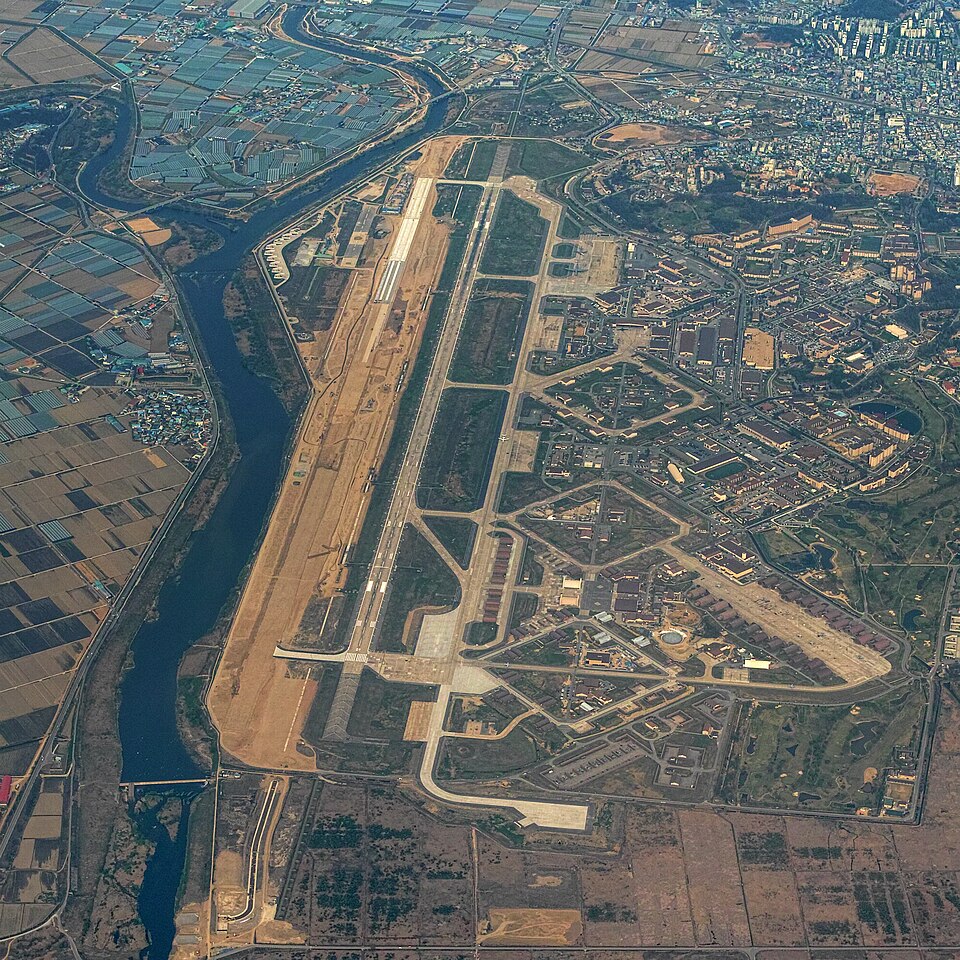
Osan Air Base: Fifty Miles from the DMZ, on the Base That Fights Tonight
Osan Air Base, in Songtan in the city of Pyeongtaek, is one of the most forward deployed flying bases the United States operates, close enough to the DMZ that the 51st Fighter Wing lives by the motto "fight tonight." It is home to the 51st Fighter Wing and to Seventh Air Force, the air component for the defense of the entire peninsula. Osan’s flying mission has been changing: the Air Force’s Super Squadron test concentrated F-16s here, but the test concluded in April 2026 and the Air Force announced a phased reset to three squadrons across Osan and Kunsan. The A-10 Warthogs long flown at Osan have been retired from the theater. Outside the gate, the Songtan Entertainment District, the SED, draws Airmen for the same reasons strips outside every base do, and a night there can turn into a UCMJ case before the sun comes up. For the Airmen who keep this base ready to fight on no notice, an investigation or a court martial is a threat to a career built on the front line, and it has to be treated that way from the first contact.
A case out of Osan is a fight for a career, a clearance, a flying status, and sometimes your freedom, prosecuted by a command that cannot be seen tolerating misconduct so close to the enemy and so visible to the host nation. The only way to win it is to deny the prosecution the easy conviction it expects and force it to prove every element of what it has charged.
"I'm Going Back to Get That Bastard"
When we say take the fight to the heart of the military justice system, this is the spirit we mean. Major Louis Sebille was already a decorated World War II pilot when he flew into the Korean War with the newly formed Air Force. On August 5, 1950, leading a flight of F-51 Mustangs against enemy positions, Sebille made pass after pass even after one of his 500-pound bombs hung up on the rack and his aircraft took heavy anti-aircraft fire. His wingman told him to break off. Sebille answered, "I'll never be able to make it back. I'm going back to get that bastard," and dove his crippled, still-armed Mustang straight into the enemy. He became the first Airman to receive the Medal of Honor. He refused to leave the fight while he still had a fight left in him, and that is exactly the standard we bring against the prosecution.
Why Airmen at Osan Fly Us In
Korea is home ground for this firm. Tim Bilecki's last assignment on active duty was a two-year tour in Korea, from 2008 to 2010, as the Senior Defense Counsel for the Army's Trial Defense Service across the Pacific Rim, responsible for the defense of service members throughout Korea, Okinawa, and mainland Japan, and since going civilian he has been back to Korea more than sixty times to try the cases other lawyers talk their clients out of. The record on the peninsula is recent and real, including multiple full acquittals won in contested Korea courts martial within the last few years. When prosecutors see that kind of counsel fly in, the easy win disappears.
The reason that matters is that the military justice system is not built to find the truth. It exists to preserve good order and discipline, and on a front line base it does that by making an example, because a destroyed career keeps the rest of the force in line and reassures the host nation and the headquarters watching. A serious case at Osan is investigated by the Air Force Office of Special Investigations, and for sexual assault, domestic violence, and other covered offenses the decision to refer charges to a court martial no longer belongs to your commander; it goes to an independent Special Trial Counsel in the Department of the Air Force. Your free Area Defense Counsel can advise you, but when the case is serious you want experienced counsel who tries these cases for a living.
UCMJ Charges We Defend at Osan Air Base
We defend the full range of UCMJ charges. The ones below are the most common at Osan Air Base, not the boundary of what we will fight.
Sexual Assault and Sex Offenses (UCMJ Article 120 / Article 134). The pressure on commands to show results on sexual misconduct has made the accusation itself do the work of proof, treated as settled before the investigation is finished, and when the evidence will not support a charge the command falls back on administrative action. A consensual encounter, or even a brush in a crowded SED club, can be reported as abusive sexual contact or assault later, and a command focused on demonstrating compliance is in no position to weigh motive or credibility. These cases run through an independent Special Trial Counsel now, and they demand counsel who will investigate hard and contest the case early, before charges are preferred.
Fraud and Larceny (UCMJ Article 121 / Article 107). BAH and OHA fraud is pursued hard across Korea, and Osan is no exception. The common version has an Airman on an unaccompanied tour drawing an allowance based on a dependent's address back home, and a finance audit or OSI alleging the claimed high cost location is not where the family actually lives, charging the inflated amount as larceny under Article 121 and the form as a false official statement under Article 107. These accumulate quietly over months before anyone flags them, and they live or die on intent: whether you knew the claim was false, or simply followed confusing rules and the guidance finance gave you. We have handled many of these, and we make the government prove the intent instead of inferring it from an overpayment. The actual entitlement depends on the orders, dependent status, authorized location, and applicable housing rule; an address discrepancy alone does not establish an overpayment or criminal intent.
Domestic Violence and Assault (UCMJ Articles 128b and 128). Domestic violence has become one of the largest parts of our caseload, and since the Office of Special Trial Counsel took it over it is charged as hard as any offense in the UCMJ. Article 128b covers violence against a spouse, an intimate partner, or a family member, and makes assault by strangulation or suffocation its own serious charge even with little or no visible injury, and a qualifying conviction triggers the federal Lautenberg firearms bar, which can end Air Force careers because the job requires carrying a weapon. Osan also sees the other end of Article 128 constantly: the SED is where a night out turns into a fight, and a confrontation there, especially one involving a Korean national or the town patrol, becomes a serious matter fast. Self defense is a recognized defense, and the real sequence of who started it usually looks different once the evidence comes in.
Drug Offenses (UCMJ Article 112a). The drug cases the command treats most seriously in Korea are not marijuana positives; they are the synthetic drugs and other substances Airmen buy off the local economy or have shipped into the country, which the command pursues hard as both a crime and an embarrassment in front of the host nation. A positive urinalysis or a possession allegation is serious, but it is not the end of the fight. The chain of custody can be challenged, innocent ingestion is a recognized defense, and the government still has to prove that any use or possession was knowing and wrongful.
Military Specific Offenses (UCMJ Articles 87a, 92, 134, and more). A night in the SED produces a particular cluster of charges a front line command does not let slide, and the Town Patrol, the 51st Security Forces Squadron detail that works the Songtan strip alongside the Korean National Police, is usually where it starts. Resisting their apprehension is charged under Article 87a, disobeying their lawful order under Article 92, and a drunk and disorderly under Article 134, often stacked alongside failure to obey, dereliction, and false official statement to inflate the maximum punishment and the pressure to plead. Every specification still has to be proven beyond a reasonable doubt on its own, and the weak ones on an inflated charge sheet are the first to fall.
Even If You Made a Mistake, Fight Anyway
Not every Airman who calls us is innocent, and we do not pretend otherwise. Some made a bad decision and know it. That does not mean accepting the worst the system can hand out, prosecuted by an institution eager to make their case a warning to everyone else. Whether you need a firm like ours turns on how serious the case is, not on your rank. If it is genuinely minor and does not call for a civilian trial lawyer, your free Area Defense Counsel can handle it, and we will tell you so plainly, because we do not take every case and we will not take an Airman's money for one that does not need us.
But when the case is serious, all of it is on the line at once: your career, your retirement, your good name, your flying status, and your freedom. A court martial conviction is a federal criminal conviction. Under the sentencing rules now in force, a military judge sentences within set confinement parameters, with mandatory minimum punishments for the most serious offenses, so it can mean real confinement, a punitive discharge that follows you for life, and on a sex offense a place on a registry, no matter how junior you are. That is why you fight, and they are counting on you to fold.
If you are facing an investigation or court martial at Osan Air Base, reach out for a free defense strategy session. We will get to Korea, tell you exactly what you are facing, and show you how we would defend it. The investigation is already moving. The only question is whether someone will be building yours.
Cases Connected to Osan Air Base
These cases include trials, hearings, investigations, and administrative matters. A connection to this location does not necessarily mean that the trial occurred here.
- Case connected to this location: Airman Found in Possession of Narcotics in Her Dorm Room Avoids Court Martial
- Case connected to this location: NCO’s Wife Suspects Infidelity, Claims Sex Assault, Bilecki Gets Charges Dropped
- Case connected to this location: Airman’s Night Out Ends in Sex Assault Case, Bilecki Gets Charges Dismissed
- Case connected to this location: Intoxicated Airman Punches Female Prosecutor, Assaults Nurse, Serves 30 Days
- Case connected to this location: Army CW2 Accused for Raping Wife and Lewd Act Retires with Full Benefits
- Case connected to this location: Air Force TSgt Faces Sex Assault After Drinking with Airman, Charges Dismissed
- Case connected to this location: Socializing Ends in Sex Assault Allegations for Air Force SSG, Charges Dropped
- Case connected to this location: Major’s Dance and Courtesy Lead to Sex Assault Claim, Honorable Discharge
- Case connected to this location: Bilecki Suppresses M.R.E. 404(b) Propensity Evidence and Wins Article 134 Acquittal at Osan OSTC SPCM for Air Force MSgt; No Punitive Discharge, Retained on Active Duty
- Case connected to this location: Bilecki Defeats Every Charged Sexual and Sentinel Offense at Osan Trial; One Battery Lesser Offense, 15 Days, No Punitive Discharge
- Case connected to this location: 1st Amendment Exonerates E-5 for Explicit Anime, Sentence Reduced
FAQ
OSI wants to interview me at Osan. Do I have to talk to them?
No, and not without counsel. Under Article 31b of the UCMJ you have the right to remain silent and to a lawyer, and an Office of Special Investigations interview is evidence collection, not your chance to explain; the first contact usually shapes the whole case. For covered offenses like sexual assault, the charging decision no longer belongs to your commander but to an independent Special Trial Counsel in the Department of the Air Force. Your free Area Defense Counsel can advise you, and for a serious case you want experienced counsel engaged before you say a word. Decline the interview, ask for a lawyer, and call one first.
A night in the Songtan SED turned into trouble: a fight, a run-in with the Town Patrol, drunk and disorderly, or an abusive sexual contact accusation in a club. How serious is that?
More serious than it feels the next morning, because a front line command cannot be seen letting misconduct in the SED slide in front of the host nation. The Town Patrol working the strip is the 51st Security Forces Squadron, patrolling the bars with the Korean National Police, and one encounter can generate a stack of charges: an Article 128 assault from a fight, resisting apprehension under Article 87a, failure to obey their lawful order under Article 92, drunk and disorderly under Article 134, and on a club encounter, abusive sexual contact under Article 120, each added to raise the maximum punishment and the pressure to plead. None of it is a foregone conclusion. For an assault, self defense is a complete defense when your force was reasonable and you were not the aggressor; for an abusive sexual contact report, the fight is credibility and what the messages, video, and witnesses actually show; and the stacked minor charges often fall away once someone makes the government prove each one. Say nothing to the patrol or to OSI and call counsel before you give a statement.
The Special Trial Counsel deferred my case, but now I'm getting a Letter of Reprimand. Can I fight it?
Yes, and it is worth fighting hard, because the administrative track is where a case the prosecutor would not take to trial can still end an Air Force career. When the Special Trial Counsel defers the case, the command often pursues the same allegation administratively under a much lower standard of proof, and a Letter of Reprimand filed in an Unfavorable Information File is the usual vehicle. You get a window to respond before the filing decision, and that rebuttal is the real fight, because an LOR in your record can stall promotion and become the basis for an administrative separation board that ends the career. We handle a great many of these, and the time to fight is at the reprimand, before it turns into a board, not after.