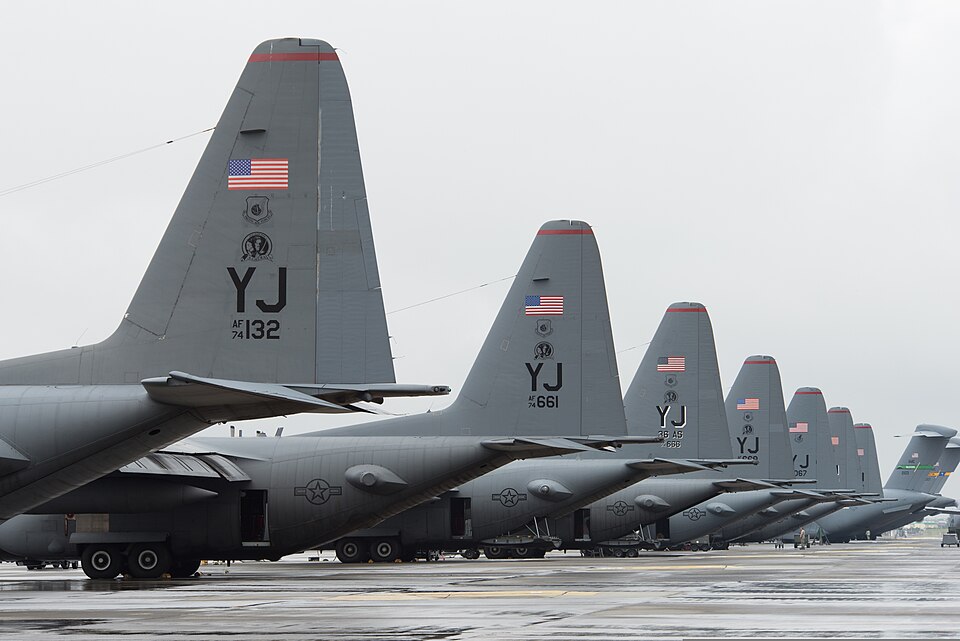
Yokota Air Base: The Home of U.S. Forces Japan and Fifth Air Force, on the Western Edge of Tokyo
In Fussa, on the western edge of the Tokyo metropolitan area, Yokota Air Base is the headquarters of United States Forces Japan and Fifth Air Force, the command that coordinates every American service in the country. It is also an airlift hub, home to the 374th Airlift Wing and its C-130J Super Hercules that move people and cargo across the theater. The senior commanders, the joint staff, and the legal offices that run Air Force justice in Japan are concentrated here, which means that for an Airman in trouble, the machinery deciding the case is close at hand and watching.
That proximity to the headquarters cuts against you. A command this visible, answerable to the host nation and to Washington at once, has every reason to charge hard and resolve a case cleanly, and in Japan there is a second danger most Airmen never think about until it lands on them: under the Status of Forces Agreement, the Japanese authorities can pursue the same off base incident at the same time the Air Force does, and the Japanese criminal system works nothing like ours. A case connected to Yokota is a fight for a career, a retirement, and sometimes freedom, and the only way to win it is to deny the prosecution the easy conviction it expects and make it prove every element of what it has charged. The SOFA allocates primary jurisdiction and limits a second trial for the same offense; overlapping investigations do not mean that both countries may freely try the same charge.
The Loadmaster Who Caught a Burning Flare
Yokota is an airlift base, and the airman who best captures what its crews do was a loadmaster, the same enlisted job that flies on the aircraft out of here. On February 24, 1969, Airman First Class John L. Levitow was the loadmaster aboard an AC-47, the gunship built on the old C-47 transport, circling over Long Binh when a mortar round tore through the aircraft and wounded most of the crew. A live magnesium flare, already armed, broke loose and began rolling among thousands of rounds of ammunition in the cargo bay, seconds from igniting and burning the plane out of the sky. Bleeding from more than forty shrapnel wounds and unable to grip it, Levitow threw his own body onto the flare, dragged it the length of the compartment, and hurled it out the cargo door an instant before it went off. He saved every man aboard, and he became the first enlisted airman in the Air Force to receive the Medal of Honor. He put himself on top of the thing that was about to kill everyone, and that refusal to let his crew go down is the standard we bring to a fight at Yokota.
Why Airmen at Yokota Fly Us In
This firm did not find Japan on a map; it has worked the country for years. Tim Bilecki's last tour in uniform was as the Army's Senior Defense Counsel for the Trial Defense Service across the Pacific Rim, with the defense of service members across Korea, Okinawa, and mainland Japan on his plate, and the firm has kept that footing ever since, flying into Japan constantly for the cases other lawyers steer their clients away from. When prosecutors at Yokota see counsel arrive with that record, the conviction they assumed was coming stops looking certain.
It matters because the military justice system is not built to find the truth. It exists to keep order, and overseas it keeps order by making an example, because a wrecked career reassures the host nation and the brass watching from home. A serious case at Yokota is investigated by the Air Force Office of Special Investigations, and for sexual assault, domestic violence, and other covered offenses the decision to refer charges to a court martial no longer belongs to your commander; it goes to an independent Special Trial Counsel in the Air Force's Office of Special Trial Counsel. Your free Area Defense Counsel can advise you, but works a heavy caseload inside that same system, which is why Airmen who are serious about the fight bring in their own counsel.
UCMJ Charges We Defend at Yokota Air Base
These are among the most common allegations at Yokota Air Base. The list is not exhaustive, and we defend the full range of UCMJ charges.
Sexual Assault and Sex Offenses (UCMJ Article 120 / Article 134). The Air Force runs its SAPR program at Yokota under intense institutional pressure. An allegation is often treated as established before the investigation is finished, and where the evidence will not support a charge, the command falls back on administrative separation. Airmen have also learned that a complaint can redirect an investigation or buy a transfer off the assignment, and a command focused on showing it takes every report seriously is in no position to weigh motive. These cases route to an independent Special Trial Counsel now, and they demand counsel who will investigate independently and contest the case early, before charges are preferred.
Fraud and Larceny (UCMJ Article 121 / Article 107). Housing allowance fraud is common at overseas bases, and at Yokota it usually starts with an Airman drawing OHA against a lease in the expensive Tokyo housing market, or BAH set by a dependent's stateside address, where an auditor later decides the rent, the residence, or the dependent's location does not match the paperwork. Because the housing form is what authorizes the rate, the government charges it as larceny under Article 121 and as a false official statement under Article 107, the same paperwork serving as both the theft and the lie. The government still has to prove intent, and a finance office error, bad guidance, or a family that genuinely moved is not a scheme. We defend BAH and OHA fraud, larceny, wrongful appropriation, and conspiracy to defraud.
Domestic Violence and Assault (UCMJ Articles 128b and 128). Domestic violence under Article 128b has become one of the largest parts of our caseload, and with so many families stationed at a headquarters base the command sees a great deal of it. Since the Office of Special Trial Counsel took these cases over it is charged as aggressively as any offense in the UCMJ. It covers a spouse, an intimate partner, or a family member, and makes strangulation or suffocation a separate, serious charge even when there is little or no visible injury. A qualifying conviction also triggers the federal Lautenberg firearms bar, which can end an Air Force career because the uniform requires it. We also defend assault under Article 128. Self defense is a recognized defense, and what actually happened often looks different from the first report once the evidence comes in.
Drug Offenses (UCMJ Article 112a). Japan enforces some of the strictest drug laws in the developed world, and a substance bought off the local economy or shipped into the country can bring both a court martial and a Japanese prosecution that is far harsher than anything stateside. A positive urinalysis or a possession allegation is serious but not the end of the fight. The chain of custody can be challenged, innocent ingestion is a recognized defense, and the government still has to prove that any use or possession was knowing and wrongful. The overlap of military and Japanese jurisdiction is exactly why you want counsel involved before you say a word.
Military Specific Offenses (UCMJ Articles 87a, 92, 134, and more). With Tokyo at the end of the train line, a lot of these charges begin on liberty in Roppongi or the clubs of Shibuya and Shinjuku, or closer to home in the bar district outside the Fussa gate. Security Forces patrol the local area and can apprehend, so resisting them can be charged as resisting apprehension under Article 87a and ignoring a lawful order as a violation of Article 92, while an off base incident with a Japanese national draws the Japanese police. Add a curfew or off limits violation under a USFJ general order, a drunk and disorderly under Article 134, and conduct unbecoming on top, and a single night becomes a charge sheet built to inflate the punishment and the pressure to plead. Every specification still has to be proven beyond a reasonable doubt on its own, and the weak ones on an inflated charge sheet are the first to fall.
A Mistake at Yokota Doesn't Have to End a Career
Not every Airman who calls us from Japan is innocent, and we do not pretend otherwise. Some made a bad decision and know it. That does not mean they have to accept the worst the system can hand out, prosecuted by an institution eager to turn one case into a warning for everyone at the headquarters. Rank does not decide whether you need a firm like ours; the seriousness of the case does. If a matter is genuinely minor, your Area Defense Counsel can handle it, and we will tell you so honestly.
But when the case is serious, everything is on the line at once: your career, your retirement, your good name, and your freedom. A court martial conviction is a federal criminal conviction. Under the sentencing rules now in force it can mean confinement a judge has little discretion to avoid, a punitive discharge that follows you for life, and on a sex offense a place on a registry, no matter your rank. That is why you fight, and the system is counting on you not to.
If you are facing an investigation or court martial connected to Yokota Air Base, reach out for a free defense strategy session. We will fly to Japan, tell you exactly what you are facing, and lay out how we would defend it. The government is already building its case. The only question is whether anyone is building yours.
Cases Connected to Yokota Air Base
These cases include trials, hearings, investigations, and administrative matters. A connection to this location does not necessarily mean that the trial occurred here.
- Case connected to this location: Bilecki Gets Full Acquittal for E-7 in Hazing Case Involving Suicide
- Case connected to this location: E-6 Accused of BAH Fraud After Moving Wife to Japan Gets No Punitive Discharge
FAQ
OSI wants to interview me at Yokota. Do I have to talk to them?
No, and not without counsel. An OSI interview is evidence collection, not your chance to explain, and under Article 31b of the UCMJ you have the right to remain silent and to ask for a lawyer. For covered offenses like sexual assault, the decision to refer charges to a court martial no longer belongs to your commander but to an independent Special Trial Counsel in the Air Force's Office of Special Trial Counsel. An off base incident involving a Japanese national can also draw the Japanese authorities under the Status of Forces Agreement, and a statement to one system can surface in the other. Decline the interview, ask for counsel, and call a lawyer before you say anything.
I was detained by the Japanese police off base. What happens now?
It is both, and the Japanese side is the one most Airmen are not prepared for. Under the Status of Forces Agreement the Japanese authorities hold the primary right to prosecute most off base offenses against Japanese nationals, and their system is very different from ours: police and prosecutors can hold and interrogate a suspect for up to roughly twenty three days before any charge is filed, often without a lawyer in the room, with heavy pressure to produce a confession. If the service member is already in U.S. custody, the SOFA generally permits the United States to retain custody until Japanese indictment, subject to arrangements for earlier transfer, but that is exactly the window where the damage is done. You can be facing the Japanese process and a court martial over the same night, and a statement to either one can sink both, so get experienced counsel and command and consular help involved immediately, before you talk to anyone.
A night in Tokyo, in Roppongi or Shibuya, turned into a problem. Why is that worse here than back home?
Because in Japan an off base incident, especially one involving a Japanese national, stops being a bad night and becomes a problem the command feels it has to answer for in front of the host nation. Leadership worries about the diplomatic fallout, so it charges hard and assumes the worst about the Airman, and a curfew or an off limits district adds its own Article 92 charge on top. Tokyo also runs on a train system that stops around midnight, which strands people and turns a missed last train into a long night and sometimes a curfew violation. What actually happened usually looks different once the witnesses and any video come in, which is the work a prepared defense does early.
If my case is deferred or I beat it, can the Air Force still end my career with a Letter of Reprimand?
Yes, and it is how many of these cases actually end. When the Special Trial Counsel defers the case, or after an acquittal, the command can act on the same allegation administratively at the preponderance standard, more likely than not, instead of beyond a reasonable doubt. The usual instrument is a Letter of Reprimand, and once it is paired with an Unfavorable Information File or a control roster it can stall promotion, support an administrative demotion, and trigger separation, all without a trial. Your rebuttal, due in a short window, is the real fight, because the commander weighs it before deciding how far the action goes, up to a separation board for an enlisted Airman or a show cause board for an officer. We contest the reprimand with the same intensity as the criminal case, because winning the court martial means little if the paperwork ends your career anyway.