
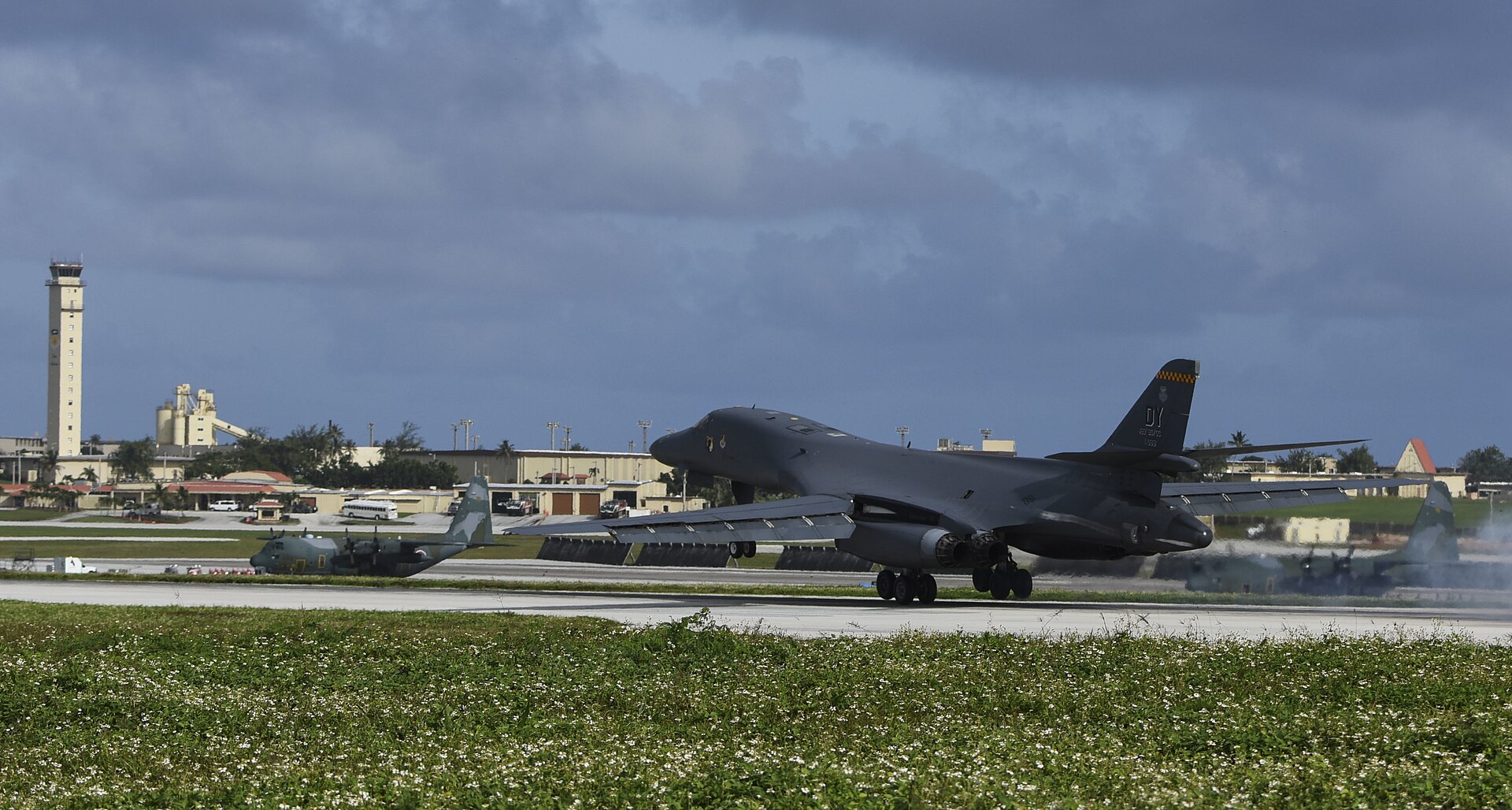
Andersen Air Force Base: America's Power Projection Platform in the Pacific
On the northern tip of Guam, Andersen Air Force Base is one of the most strategically important airfields in the world, the forward platform from which the United States projects air power across the Pacific. Its long runways host the rotating Bomber Task Force deployments of B-1s, B-2s, and B-52s, the tankers that keep them flying, and the high altitude ISR aircraft that watch the theater, and its permanent 36th Wing keeps the base ready to surge. The Airmen here are a mix of permanent party and crews rotated in from stateside bombing wings, all of them a long way from home at the island's far north end in Yigo, a long drive down Marine Corps Drive from Tumon and everything else, on a small island where the command is acutely aware of how it looks.
Guam is United States soil, so the UCMJ reaches an Airman here the same as anywhere, and a serious case deserves counsel who knows the Pacific. Military defense is all Bilecki Law Group does, the firm has deep experience across the Pacific theater, and Airmen fly it in from wherever they are stationed. A case at Andersen does not have to be handled by whoever happens to be nearest.
The Bomber Pilot Who Would Not Leave His Crew
Andersen's mission is strategic bombing, and the tradition runs back to pilots like Major Horace S. Carswell Jr., who flew a B-24 in the Pacific. On the night of October 26, 1944, Carswell took his bomber alone against a Japanese convoy in the South China Sea, diving to six hundred feet to attack and scoring direct hits on a tanker on his second run. Enemy fire tore the aircraft apart, knocking out engines and crippling the controls. He ordered the crew to bail out, but when he learned that one man's parachute had been destroyed, Carswell stayed at the controls with him and another crewman and tried to fly the dying bomber to safety rather than leave anyone behind. The plane crashed into a mountainside. He earned the Medal of Honor for refusing to abandon his crew. That is the standard we bring to a case at Andersen: you do not leave your people behind.
Why Airmen at Andersen Bring Us In
We win court martial cases. Military defense is all we do, and Airmen fly us in from all over the world because of our trial record and our experience across the Pacific. The military justice system is not built to find the truth; it exists to preserve good order and discipline, and a high visibility command will make an example of an Airman to keep standards in view. A serious case is investigated by the Air Force Office of Special Investigations, and for sexual assault and other covered offenses the decision to refer charges to a court martial no longer belongs to the command but goes to an independent Special Trial Counsel. Your Area Defense Counsel may be sharp but carries a heavy caseload inside the same system, which is why Airmen serious about winning bring in their own counsel.
UCMJ Charges We Defend at Andersen Air Force Base
The charges below are the ones we see most often at Andersen Air Force Base, not the only ones we defend. If you are facing a different UCMJ allegation, we handle that too.
Flight Status, Sensitive Missions, and Dereliction (UCMJ Article 92). For a rated officer or career enlisted aviator, an allegation can ground you before it ever reaches a courtroom. A flight discipline matter, a safety incident, a positive test, or any serious charge can pull you off flying status and send your aviation service to a Flying Evaluation Board, which can end your flying career on a standard far below what a court martial requires. For the ISR and command crews whose access is the job, the same investigation can suspend the security clearance or quals the assignment depends on. We defend the criminal charge and the Flying Evaluation Board together, and because the clearance and quals turn on what the investigation finds, a hard defense of the underlying allegation is the best protection for those too.
Sexual Assault and Sex Offenses (UCMJ Article 120 / Article 134). These allegations route to an independent Special Trial Counsel now, and the command treats a report as established before the investigation is finished, all the more so on a small island where word travels fast. These cases demand counsel who will run an independent investigation and contest the case rather than let the allegation stand in for proof, because a conviction means confinement, a federal record, and a place on a sex offender registry.
Domestic Violence and Assault (UCMJ Articles 128b and 128). Domestic violence under Article 128b is charged as aggressively as any offense in the UCMJ since the Office of Special Trial Counsel took these cases over. It covers a spouse, an intimate partner, or a family member, and it treats strangulation or suffocation as its own charge that the government can bring even with no visible injury. A qualifying conviction also triggers the federal Lautenberg firearms bar, which can end an Air Force career because an Airman has to be able to carry a weapon. We also defend assault under Article 128, where self defense is a recognized defense.
Larceny, Drugs, and Off Duty Conduct (UCMJ Articles 121, 112a, and 134). Property cases turn on the intent the government has to prove rather than assume, and drug cases turn on the chain of custody and the government's burden to prove any use was knowing and wrongful. An Airman is subject to the UCMJ off base, so a night out on the Tumon hotel strip or anywhere on island that goes wrong comes back to the command, and because Guam is a United States territory, the Guam police and the federal court here can pursue the civilian side of the same incident at the same time. A bad night can mean a court martial and a civilian case at once, so get counsel involved before you talk to anyone.
A Career and a Reputation Worth Defending
Not every Airman who calls us from Andersen is innocent, and we do not pretend otherwise. What matters is how serious the case is, not your rank. If a matter is genuinely minor, your Area Defense Counsel can handle it, and we will tell you so honestly. But when the case is serious, everything is on the line at once: your career, your flying status, your retirement, your good name, and your freedom. A court martial conviction is a federal criminal conviction, and where the sentencing parameters apply the judge sentences within confinement ranges fixed by the offense, two and a half to ten years for sexual assault and ten to twenty for rape, with specific facts in writing required to support a departure, on top of any required or adjudged punitive discharge and, on a covered sex offense, sex offender registration. That is why you fight. The court’s jurisdiction and the convicted offense determine which sentencing rules apply; some offenses use separate sentencing criteria rather than these ranges.
If you are facing an investigation or court martial at Andersen Air Force Base, reach out for a free defense strategy session. We will tell you exactly what you are facing and how we would defend it. The government is already building its case. The only question is whether anyone is building yours.
Cases Connected to Andersen Air Force Base
These cases include trials, hearings, investigations, and administrative matters. A connection to this location does not necessarily mean that the trial occurred here.
- Case connected to this location: Prosecution Stacks Evidence Against Airman for Spice, Bilecki Act Undaunted
- Case connected to this location: Airman Accused of Sexually Assaulting Minor at Guam Party Not Criminally Charged
- Case connected to this location: Air Force Major’s Passes Out in Teen’s Bed, Issued Letter of Reprimand
- Case connected to this location: Bilecki Wins Full Acquittal on AF TSgt at Malmstrom in Article 80 Attempted CSAM ICAC Sting Court Martial
FAQ
I'm aircrew on a Bomber Task Force rotation and I've been pulled off flying status over an investigation. Can I lose my flying status even if I beat the charge?
Yes, because the Flying Evaluation Board and the court martial are separate tracks with separate standards. For a rated officer or career enlisted aviator, that board can act on the same allegation on a standard far below what a conviction requires, so you can win the criminal case and still lose your flying career if the board side is not fought. That is why the underlying allegation has to be defended on both fronts from the start, and we handle the criminal charge and the board together.
OSI wants to interview me at Andersen. Do I have to talk to them?
No. You are not required to sit for an OSI interview or answer their questions. Under Article 31b of the UCMJ you have the right to remain silent and to a lawyer, and you can invoke both at any point, including before the interview begins. OSI is collecting evidence, not giving you a chance to explain. Decline, ask for counsel, and call a defense lawyer before you give any statement.
Andersen is on a remote island. Can the firm really defend a case out here?
Yes, and we already have. Military defense is all we do, and we have flown to Guam before to defend court martial cases here and win them. A remote island is just where the case happens to be.