
Military Jury Trials: How Court-Martial Panels Work and How We Fight
Yes, military courts have juries. At a general or special court martial, the jury is called a panel of members: eight members in a noncapital general court martial and four in a special court martial, with at least one third enlisted if an enlisted accused asks. At least three quarters of the members must agree to convict; if fewer do, the finding is not guilty. You can instead request trial by military judge alone, and the judge decides whether to approve the request. When every offense of conviction occurred after 27 December 2023 and the case is not capital, the military judge decides the sentence either way.
To talk with our firm about an upcoming court martial trial, call 813-669-3500 or book a free consultation.
Tim Bilecki and Ben Gold work your defense together. Tim is a former Army judge advocate who has taken more than 250 courts-martial to verdict; Ben is a former Navy Surface Warfare Officer.
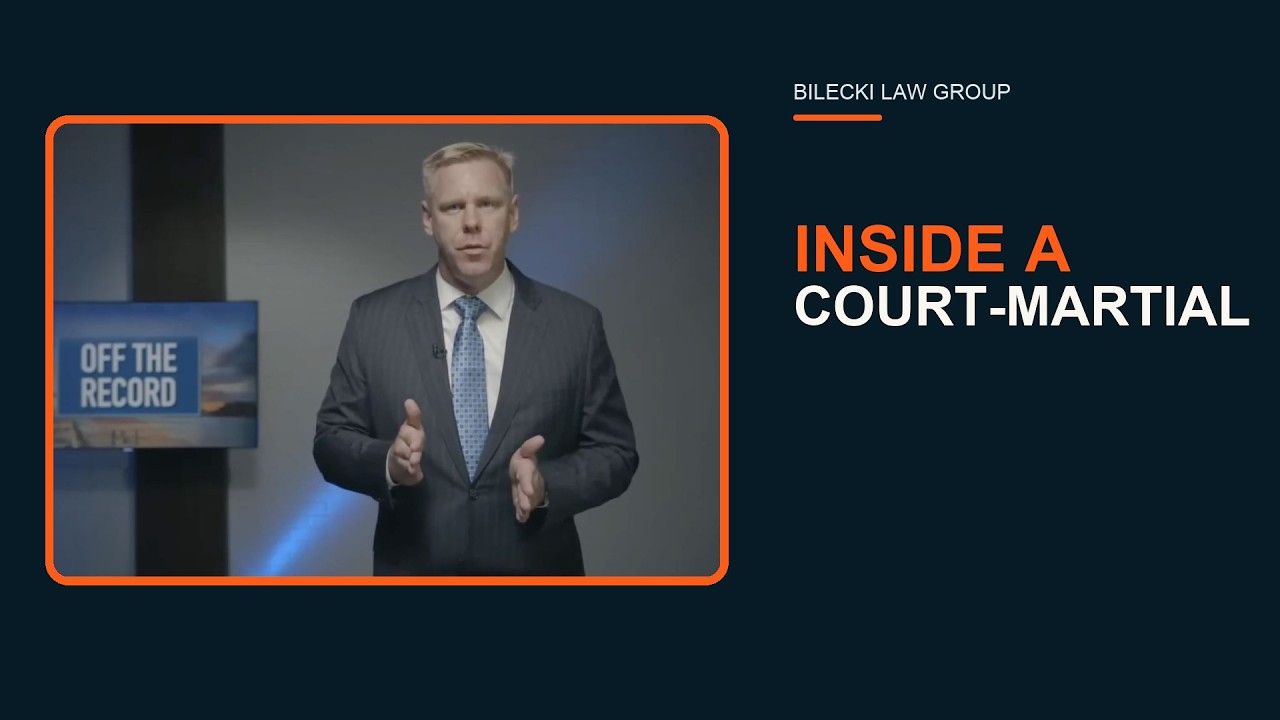
Watch our Off the Record episode on military jury trials. It includes some older descriptions of procedure; the explanation on this page reflects the current rules.
It’s judgment day. The process might have taken six months, it might have taken a year, but this is where the rubber meets the road: the actual court-martial trial. Everything you have been preparing for comes into the courtroom with you.
What We Do at Trial
We investigate the facts, test the government’s witnesses, and fight for the instructions the panel needs to decide the case fairly. We do not wait for closing argument to begin thinking about how the members should understand the evidence. Every witness, exhibit, motion, and instruction has a place in that work.
Why Hire Bilecki Law Group?
Tim Bilecki spent years inside the military justice system as a senior defense counsel for the Army. He knows the pressure a service member faces when the government has already built its case and expects the defense to fall in line.
As civilian defense counsel, we do not have our own military careers riding on the prosecution’s approval. We can bring independent investigators and experts into the defense when the case calls for them. We challenge a witness’s account regardless of how many stars are on the collar. What matters is whether the testimony stands up.
The reality is that not every case is a full acquittal. We cannot control the facts or promise what a panel will do. What we can control is putting on the best case we can and continuing to fight for you through every stage.
Members or a Military Judge: Who Decides Your Case
At a general or special court martial, the accused can be tried by a panel of members or can ask to be tried by a military judge alone; the judge decides whether to approve that request. A general court martial panel has eight members and a special court martial panel has four. An enlisted accused can ask for a panel that is at least one third enlisted. With members, three quarters must agree to convict. If every offense was committed after 27 December 2023, the military judge decides the sentence either way.
PANEL OF MEMBERS
8 · 4
Eight members in a general court martial · four in a special court martial · at least one third enlisted if an enlisted accused asks
MILITARY JUDGE ALONE
On request
You can request trial by military judge alone, and the judge decides whether to approve the request
We make the forum decision with each client, based on the evidence, the judge and the likely panel. Tim Bilecki has taken 250+ courts martial to verdict.
At trial, we cross-examine the CID, NCIS or OSI agents who built the case: what they collected, what they did not collect, and how the account changed as the investigation went on.
What Happens During a Military Jury Trial?
SELECTING THE PANEL
Voir dire and challenges
OPENING STATEMENT
A roadmap for the trial
CROSS-EXAMINATION
The government’s witnesses
THE DEFENSE CASE
The defense decides what to present
JURY INSTRUCTIONS
The weapon you cannot forget
CLOSING ARGUMENTS
Evidence and instructions come together
THE VERDICT
And what comes next
Selecting the Panel
The military calls its jury a panel. A noncapital general court-martial with members ordinarily has eight members, and a special court-martial with members has four. Capital cases and trial before a military judge alone have different rules. An eligible enlisted accused may request a panel with at least one-third enlisted members.
The convening authority details qualified members under Article 25. For courts-martial convened on or after 23 December 2024, the law requires randomized selection to the maximum extent practicable under presidential regulations. The current rules provide a larger group of detailed members for the judge’s randomization process. A member need not outrank you; Article 25 directs that junior members be avoided when that can be done. Members of the same rank or grade are not excluded for that reason alone.
Voir dire is where counsel asks questions to uncover bias and determine whether a member can give you a fair trial. The military judge controls the examination. A challenge for cause asks the judge to remove a member on a recognized ground, such as bias. A peremptory challenge is different and generally does not require proof of bias, although it cannot rest on an unlawful discriminatory basis.
CHALLENGE FOR CAUSE
Asks the judge to remove a member on a recognized ground, such as bias
PEREMPTORY CHALLENGE
Generally does not require proof of bias · cannot rest on an unlawful discriminatory basis
Telling Your Story and Cross-Examining the Government’s Witnesses
In the opening statement, we lay out the theme of the case, the theory of the defense, and the evidence the panel is going to see. What actually happened? What does the government’s account leave out? We give the members a roadmap for the trial. The burden remains on the prosecution to prove guilt beyond a reasonable doubt.
Then the government calls its witnesses. After direct examination, we have the opportunity to cross-examine. This is where you need to know exactly what you are doing. You have to be on your feet, expose inconsistencies, test a witness’s motive, and get the pieces you will need in closing argument.
Panel members may also submit questions for witnesses. The judge reviews those questions and resolves objections before putting proper questions to the witness. That is one more reason preparation has to reach beyond a script.
The Government Rests, and the Defense Decides What to Present
Sometimes calling no witnesses is the best strategy. Cross-examination may already have exposed the government’s failure to prove the charge beyond a reasonable doubt. In other cases, the defense may call fact witnesses or experts and offer exhibits. The accused has the right to testify and the right to remain silent.
After the defense rests, the government may offer proper rebuttal, and the defense may respond within the rules. Those decisions depend on the evidence and the defense strategy. Presenting more evidence is not automatically better.
Jury Instructions: The Weapon You Cannot Forget
In Fallujah on 10 November 2004, SSG David Bellavia fought inside a house where insurgents had trapped members of his platoon. The Army’s account describes a struggle with an armed insurgent who bit him. Bellavia remembered the folding knife in his pocket, drew it, and killed the man. His actions that night earned the Medal of Honor.
What does this have to do with jury instructions? Well, jury instructions are the knife many defense attorneys forget they have and the hand to hand brawl is a military court martial. The jury instructions may come out in the end, but they can be a powerful weapon to put away your foe for good.
The Military Judges’ Benchbook Is the Battle Plan Blueprint
Jury instructions guide the panel on the legal principles it must apply. The military judge provides them. They explain the charged offenses, the defenses raised by the evidence, the government’s burden, and how the members must reach their findings.
The Military Judges’ Benchbook provides model instructions. We use it with the governing statutes, rules, and decisions, then work through what fits the facts of your case. In order to effectively suggest to the judge that certain instructions are given to the jury, one must master the knowledge within this benchbook. You don’t need to commit it to memory as it is exhaustive, but you have to know where to look and which definitions are in play during the trial.
Before the trial, we’re going to read through the relevant sections more times than we like to count. Each read through provides new information and options to fight back. As the trial progresses, we keep assessing how the evidence and testimony line up with the instructions that will come at the end. If the prosecution suggests an instruction that the law does not support, we are going to call them on it.
Now, we are known to be fairly aggressive in court and what we do to some of the prosecution’s witnesses could be called a massacre. However, we realize that we are living in the military judge’s universe and when it comes to suggesting or challenging the judge with regard to jury instructions it takes a more nuanced approach. Namely, be aggressive without alienating the judge.
A judge does not have to use our exact wording if the instructions adequately cover the issue. Our job is to show why the law and the evidence require the instruction we seek.
Fighting Over the Instructions
Requests and objections are ordinarily addressed in an Article 39(a) session outside the members’ presence. This is a critical moment to advocate for or against certain instructions that could determine the case’s outcome. This is the moment that you remember you’ve had a knife by your side this entire time. It’s been a brawl up to this point and we’ve hit the prosecution with every piece of evidence, testimony, and motion within reach. This is the moment we draw our knives and put them to the throat of the prosecution’s case.
In a sexual assault case, for example, a mistake-of-fact instruction may matter if the charged offense and the evidence support it. It is not interchangeable with lack of mental responsibility. The defense, its legal requirements, and any burden of proof have to fit the actual charge and the law applicable to the alleged conduct.
We make the request and preserve the objection when it matters. An instruction error may provide an appellate issue, but a denied request does not automatically produce a reversal. The judge can also give additional instructions when appropriate. The fight over the law does not become irrelevant just because closing argument is near.
Like Bellavia, we’ve been through hell and back fighting this case so far and we’re not giving up until one of us is out for the count. A military court martial is a bloody brawl to the bitter end. It may not be on the streets of Fallujah, but a brawl by another name is still a brawl.
Closing Arguments
Closing argument is where the evidence and the legal instructions come together. You have to be an advocate and a storyteller. You have to explain why the government has not proved its case, connect the testimony to the defense, and give the members a reasoned path to an acquittal. Passion matters. Preparation is what gives it force.
The Verdict and What Comes Next
When we hear, “We have a verdict,” all the hours and all the long nights come down to that moment. We gather the client and the family, return to the courtroom, and stand together to hear the findings. As Tim puts it: “I always say the moment my heart stops beating out of my chest and I don’t get nervous when they’re reading a verdict is the day I’m gonna just do something else.”
In an ordinary contested noncapital case tried by members, conviction requires at least three-fourths of the members’ votes. The prosecution still must prove guilt beyond a reasonable doubt. A sentence of death has separate unanimity requirements.
If fewer do, the finding is not guilty · there is no hung jury in a court martial
You may receive a full acquittal, mixed findings, or a conviction. If you are acquitted of every offense, there is no sentencing punishment. If there is a conviction, sentencing follows under the rules that apply to the case. It does not always begin immediately after the verdict. Either way, we do not stop fighting for you.
Military Trial Results
- Bilecki Wins Full Acquittal in Malmstrom Internet Sting Trial: a fully contested general court martial to members; the defense built the case on entrapment and mistake of fact as to age, and under the military judge’s instructions a mistake as to age was a complete defense (2026).
- Bilecki Wins Full Acquittal in Camp Zama Child Abuse Trial: voir dire mattered with a panel that included members with legal, law enforcement and medical backgrounds; not guilty of all charges (2024).
- Bilecki Wins Full Acquittal in Camp Humphreys Abusive Sexual Contact Trial: not guilty of all charges and specifications after a fully contested members trial (2026).
- Bilecki Wins Full Acquittal in Army Captain’s Domestic Violence and Strangulation Trial: an officer panel returned not guilty of all charges and specifications (2025).
- Bilecki Defeats Alleged Fatal Hit and Run Case: Negligent Homicide Dismissed and Full Acquittal at Trial (2026).
- Bilecki Wins Full Acquittal in Camp Humphreys Sexual Assault and Domestic Violence Trial (2024).
Past results do not guarantee a similar outcome.
Frequently Asked Questions About Military Jury Trials
Do military courts have juries?
Yes. The military jury is called a panel of members. A noncapital general court martial has eight members and a special court martial has four. An enlisted accused can ask for a panel that is at least one third enlisted.
How is a court-martial panel selected?
The convening authority details members it considers best qualified by age, education, training, experience, length of service and judicial temperament. For courts-martial convened on or after 23 December 2024, members are selected at random to the maximum extent practicable under presidential regulations. The military judge and counsel then question the members in voir dire, and challenges remove members who should not sit.
Does the defense get to pick the jury?
Not directly. The convening authority details the members. The defense questions them in voir dire, can challenge any member for cause, such as bias, and has one peremptory challenge, as does the government.
Can I choose a military judge instead of a jury?
Yes. You can request trial by military judge alone, and the judge decides whether to approve the request. We make that choice with you based on the evidence, the judge and the likely panel.
How many members have to agree to convict?
At least three quarters of the members must vote for a finding of guilty. If fewer do, the finding is not guilty. There is no hung jury in a court martial. A death sentence has separate unanimity requirements.
Can panel members ask witnesses questions?
Yes. Members submit their questions to the military judge in writing. Both parties can review them, the judge rules on any objection and the judge asks proper questions on the members’ behalf.
How long does a court-martial trial last?
It depends on the charges, the witnesses and the forum. A contested members trial commonly runs from a few days to a week or more, including panel selection.
Do I have to testify at my court martial?
No. You have the right to remain silent, and the government must prove every element beyond a reasonable doubt whether or not you testify. If you do testify, you can be cross-examined. We make that decision with you based on the evidence at trial.
Get Us Into the Fight
Facing a court martial? See how our court martial defense lawyers handle these cases.
If you are facing an investigation or military court-martial right now, reach out to us. We’ll tell you the truth as to what you are facing and as long as you are willing to fight like hell, so are we. This is true even if you did mess up and violate the UCMJ. You don’t have to accept the worst the prosecution can give you. You can fight back and you can win. Reach out and get us into that fight.
Related Pages
- Motions and Litigation
- Sentencing Hearing
- Article 32 Preliminary Hearing
- Why Hire Civilian Counsel
- Court-Martial Defense
- UCMJ Investigations
To talk with our firm about an upcoming court martial trial, call 813-669-3500 or book a free consultation.
Court-Martial Process: Step 6 of 7
Previous step: Motions and Litigation. Next step: Sentencing Hearing. See every step in UCMJ 101: Basic Training.