Okinawa’s New Liberty Rules: What Changed After the Period of Reflection
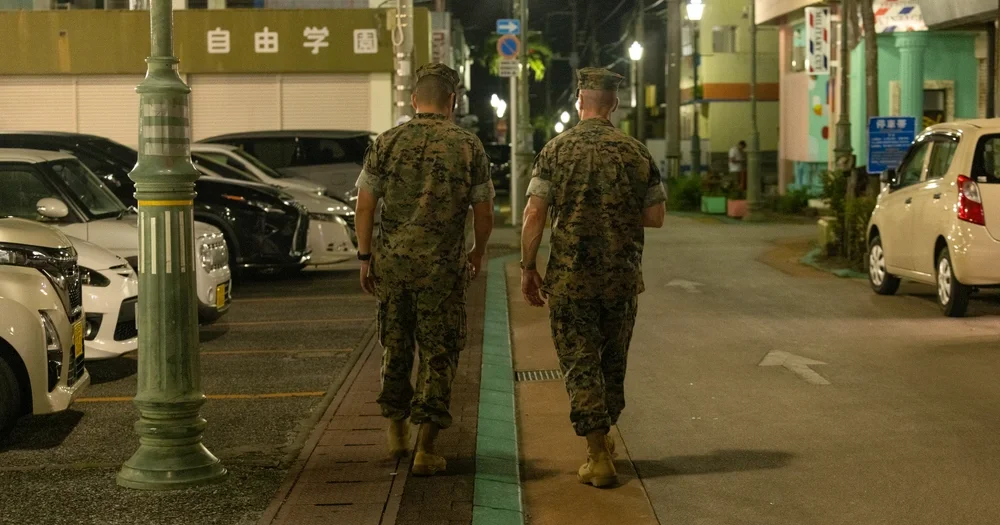
The Period of Reflection on Okinawa ends at noon on Sunday, 8 November 2026. A narrower order takes effect at 12:01 p.m. that day and runs to noon on 7 December 2026. Service members in ranks E-1 through E-4 stay under the midnight to 5 a.m. curfew. Stars and Stripes reports that it applies in all services. All service members, regardless of rank, may not buy or drink alcohol outside their primary residence after midnight.
The restrictions began after a Marine was arrested in a homicide case in Naha. He was indicted on 25 October 2026, has denied the allegations according to police, and is presumed innocent. Another Marine, arrested by Okinawa police on 31 October 2026 on suspicion of drunk driving during curfew hours, is also presumed innocent. This post does not discuss either case. It explains the new rules, Article 92 and what to do on the military side.
Key facts
- Lt. Gen. Benjamin Watson, commander of III Marine Expeditionary Force, issued the order. III MEF announced it in a readout dated 5 November 2026, with U.S. Forces Japan's concurrence. A memorandum followed (Stars and Stripes, 6 November 2026).
- The 18th Wing said in an email that its own Kadena restrictions end at noon on 8 November 2026 and that the wing "will then adhere to the new order" (Stars and Stripes, 6 November 2026).
- The liberty review is not finished. The readout says the Okinawa Area Coordinator will forward the results to U.S. Forces Japan "for consideration" in the coming weeks (III MEF readout, 5 November 2026).
What changes on 8 November 2026
| Rule | Through noon, 8 November 2026 | 12:01 p.m., 8 November 2026, to noon, 7 December 2026 |
|---|---|---|
| Curfew, midnight to 5 a.m. | All service members on Okinawa | E-1 through E-4 |
| Where you must be during curfew hours | Assigned quarters on base or an off base home | Assigned quarters on an installation, a private off base residence or a hotel; moving between an airport and your residence or hotel; going to a hospital for emergency care |
| Alcohol after midnight | No alcohol ban in the 30 day curfew order. Kadena set its own rule for E-1 through E-4 | All ranks: no "purchasing or consuming alcohol outside their primary residence" |
Rank decides the curfew. It does not decide the alcohol rule.
- A hotel is one of the places an E-4 can be during curfew hours. A hotel is not, on its face, a primary residence, so the alcohol rule as quoted still applies there.
- An E-6 has no curfew under this order. The alcohol rule still applies.
- Neither the III MEF readout nor the news reports say whether a barracks room counts as a primary residence. None describes an exception for official duty. The memorandum controls, so read it.
Your commander can go further. The readout says commanders "retain the ability to establish more restrictive liberty policies within their respective commands when conditions warrant." A stricter lawful unit rule is a separate order. It can bind you even when the III MEF order does not.
How Article 92 reaches a liberty order
Article 92 has three clauses. Two matter here.
- The first covers anyone who "violates or fails to obey any lawful general order or regulation."
- The second covers anyone who, "having knowledge of any other lawful order issued by a member of the armed forces, which it is his duty to obey, fails to obey the order."
The general order clause. The Manual for Courts-Martial says a general order can be issued for a command, or part of one, by an officer with general court martial jurisdiction, a general or flag officer in command, or a commander superior to either. Knowledge is not an element. The Manual says "a lack of knowledge does not constitute a defense." Not every provision counts. Regulations "which only supply general guidelines or advice" may not be enforceable under this clause.
The other lawful order clause. This clause reaches lawful orders that are not general orders, including written regulations that are not general regulations. Here the government must prove actual knowledge of the order. It may prove that with circumstantial evidence.
Lawfulness. A general order is lawful unless it is contrary to the Constitution, the laws of the United States or lawful superior orders, or is beyond the issuing official's authority. An order requiring a military duty or act may be inferred to be lawful, and the military judge decides the question. The order must relate to military duty, which includes safeguarding or promoting the morale, discipline and usefulness of a command. Without a valid military purpose, it may not "interfere with private rights or personal affairs."
Which clause fits depends on the document, who issued it and whom it reaches. The readout and the reports do not say how a violation of the new order would be charged.
A standing order also applies. The U.S. Forces Japan liberty order of 8 October 2026 covers all military personnel in Japan and calls itself "a lawful general order, violations of which are punishable under Article 92." From 1 a.m. to 5 a.m., it bars every rank from drinking in public off base and from being in an off base bar, and it puts personnel 19 and under on curfew.
What a violation can cost
A commander does not need a court martial to act. Under Article 15, a commanding officer may impose nonjudicial punishment for minor offenses, in addition to or in place of an admonition or reprimand.
For enlisted members, the statute sets these ceilings when the officer imposing punishment is a major, a lieutenant commander or above:
- correctional custody for up to 30 days
- forfeiture of up to half of one month's pay per month for two months
- reduction in grade, within the limits in the statute
- extra duties for up to 45 days
- restriction for up to 60 days
The statute limits combining these punishments, and regulations can narrow them further. Except for a member attached to or embarked in a vessel, punishment may not be imposed if the member has first demanded trial by court martial in place of it.
If the case goes to court martial, the Manual sets the maximums. A general order violation carries a dishonorable discharge, forfeiture of all pay and allowances and 2 years of confinement. Failure to obey another lawful order carries a bad-conduct discharge, forfeiture of all pay and allowances and 6 months of confinement. These are maximums, not predictions.
A lower maximum controls if, without the order, the same facts would support another specific offense with a lesser punishment, or if the violation is a breach of restraint. For offenses after 27 December 2023, the sentencing parameters put both Article 92 offenses in Category 1, which runs 0 to 12 months, with the 6 month maximum controlling for the second.
Other conduct is charged on its own terms. Drunken operation of a vehicle, for example, falls under a separate article, Article 113.
The Japanese track: SOFA jurisdiction
The liberty order is a U.S. military order. An arrest by Japanese police is a separate matter.
Article XVII of the U.S.-Japan Status of Forces Agreement gives the United States the primary right over offenses solely against U.S. property or security, offenses solely against the person or property of another member of the force, the civilian component or a dependent, and offenses arising out of official duty. Japan has the primary right over any other offense. That can include an off duty offense like drunk driving off base.
A Japanese case does not always end the military one. Article XVII, paragraph 8, bars a second trial for the same offense within Japan by the other state. The same paragraph says this does not "prevent the military authorities of the United States from trying a member of its armed forces for any violation of rules of discipline" arising from the same act. See our post on a Fukuoka case: Tried in Japan: What a Japanese Verdict Does Not End for a Marine.
The Japanese case is separate. Bilecki Law Group advises on the UCMJ and military administrative action. We do not advise on Japanese law, and we cannot tell you whether to speak with Japanese police or prosecutors. For advice on the Japanese case, talk to a lawyer licensed in Japan.
If CID, NCIS or OSI contacts you
This list covers U.S. investigators, U.S. military police and your command only.
Under Article 31b of the UCMJ you have the right to remain silent. The Military Rules of Evidence also give you the right to a lawyer before and during questioning in custody.
You cannot talk your way out of an investigation, only into charges, so the time to get a lawyer is before you sit down.
- Tell U.S. investigators you want a lawyer and will not answer questions. Then stop talking.
- Do not sign a written statement for U.S. investigators until a lawyer has reviewed it.
- Keep a copy of the memorandum and your unit's policy.
- Keep proof of any exception: a flight itinerary, a hotel receipt, a hospital record.
- Do not delete texts, photos or location data.
- Do not discuss what happened with your chain of command or your friends until you have talked to a lawyer.
- Follow your command's lawful orders.
Article 31 says a statement obtained in violation of the article may not be received in evidence against you in a trial by court martial. Get the lawyer before charges are preferred.
The firm
Military defense is all we do, and Okinawa is one of the busiest parts of our Pacific practice. From 2008 to 2010, Tim Bilecki served as the Senior Defense Counsel for the Army's Trial Defense Service across the Pacific Rim, responsible for the defense of service members throughout Korea, Okinawa and mainland Japan. For the better part of two decades he has defended service members up and down the island, from Kadena to the Marine camps.
In one of our past Okinawa cases, an Army staff sergeant in a fight after curfew stayed in the Army after his administrative separation board. Past results do not guarantee a similar outcome.
Tim Bilecki travels to Okinawa to defend the court martial and the administrative case. Flat fees, travel billed separately. Call 813-669-3500.
FAQs
Who is under the Okinawa curfew after 8 November 2026?
Ranks E-1 through E-4. Stars and Stripes reports that this covers all services. The curfew runs from midnight to 5 a.m., through noon on 7 December 2026. E-5 and above are not under this curfew, but a commander can set a stricter rule.
Can an E-5 or above drink off base on Okinawa after midnight?
Not outside a primary residence. After midnight, all ranks are barred from buying or drinking alcohol outside their primary residence, through noon on 7 December 2026.
Can you be charged under Article 92 for breaking a curfew?
Yes, if the order is lawful. Article 92 covers a lawful general order and any other lawful order you knew about and had a duty to obey.
Sources
- III MEF readout, 5 November 2026 (new order)
- Stars and Stripes, 6 November 2026 (new order)
- Ryukyu Shimpo, 6 November 2026 (new order, in Japanese)
- Stars and Stripes, 8 October 2026 (30 day curfew)
- Ryukyu Shimpo, 31 October 2026 (arrest during curfew, in Japanese)
- 10 U.S.C. 892 (Article 92)
- Manual for Courts-Martial, Part IV, paragraphs 16 and 18; Appendix 12B and 12C
- 10 U.S.C. 815 (Article 15)
- 10 U.S.C. 831 (Article 31)
- 10 U.S.C. 913 (Article 113)
- U.S.-Japan Status of Forces Agreement, Article XVII (Ministry of Foreign Affairs of Japan)
- U.S. Forces Japan, Liberty Order for All U.S. Military Forces Present in Japan, 8 October 2026