Kadena Gate 2 Street Raid: What Customers Face Under the UCMJ
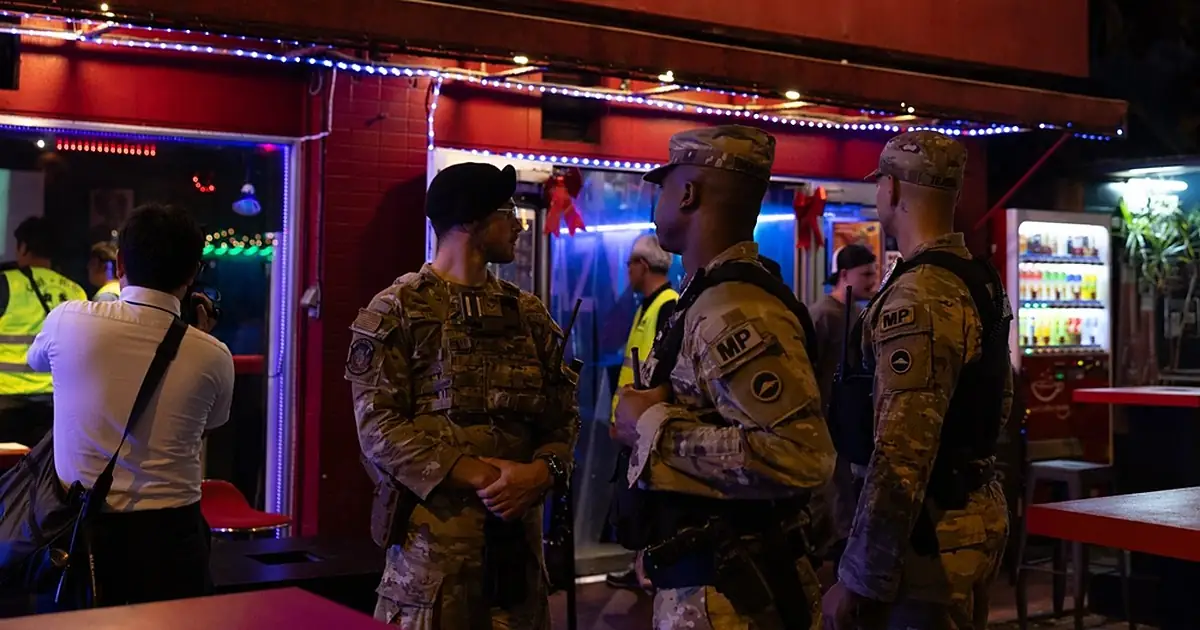
Okinawa police have arrested nine people for running an illegal sex business on Gate 2 Street, the bar strip outside Kadena Air Base. Police say the shop catered mainly to U.S. military personnel and other foreigners, and that they shared information with U.S. military investigators while they built the case.
The people arrested are the operators, not the customers. Japanese law sets no criminal penalty for paying an adult for sex. The UCMJ does. For a service member who walked through that door, the question is what the command does with what Japanese police found.
Key facts
- What: arrests for running an illegal sex business at "New York Terminal 2," a shop on Gate 2 Street in the Chuo area of Okinawa City.
- Who was arrested: nine men and women in their 30s and 40s, six of them Chinese nationals. Police describe a 34-year-old Chinese company head who lives in Kobe as the real operator.
- When: police received a tip in April 2025, searched about 20 locations in and outside Okinawa starting the night of 30 October 2026, and announced the arrests on 1 November.
- Seized: more than 100 million yen in cash, plus U.S. dollars.
- Customers: police say the shop targeted U.S. military personnel and other foreigners, and that they shared information with U.S. military investigative agencies during the investigation.
- Off limits: Stars and Stripes reported on 9 November 2026 that U.S. Forces Japan added the shop to its off limits list on 31 October 2026. The late September designations covered five other Gate 2 Street bars. See Off Limits on Okinawa: Nine Gate 2 Street Bars and Article 92.
The people arrested are presumed innocent. In Japan, prosecutors, not police, decide whether to indict.
What police say the shop did
The shop was registered with Okinawa's Public Safety Commission as an outcall service, the kind that sends workers out to customers. Police say it operated as a storefront instead, in an area where prefectural ordinance bans storefront sex businesses.
Police arrested them on suspicion of two offenses. The first is providing a place for prostitution as a business, under Japan's Anti-Prostitution Act, around April 2025. The second is operating in a prohibited area, under Japan's adult entertainment business law, from about April to June 2026. Police are also looking at whether a loose, anonymous criminal network, the kind Japanese police call tokuryu, stands behind the operation.
The raid came during the 30-day Period of Reflection that U.S. forces on Okinawa began on 9 October, after a Marine was arrested in a Naha homicide. It includes a midnight to 5 a.m. curfew for every service member on the island. Commands on Okinawa are already under pressure from Tokyo and the prefecture to show discipline.
Is buying sex legal in Japan?
It is prohibited, but the customer is not punished. Japan's Anti-Prostitution Act says no one may sell sex or be a customer, and then sets no criminal penalty for the customer. The penalties fall on soliciting, procuring and providing a place, which is what the Gate 2 Street operators are accused of. A Ministry of Justice expert panel recommended in September 2026 that Japan start punishing buyers. The law has not changed.
For a service member, that is the wrong question. The UCMJ goes with you. Under Article XVII of the U.S.-Japan Status of Forces Agreement, the U.S. military has exclusive jurisdiction over an offense that U.S. law punishes and Japanese law does not. Paying an adult for sex is that kind of offense. Japanese police have no customer offense to charge. The command has several.
The UCMJ charges a customer can face
Patronizing a prostitute, Article 134. The government must prove four things: that you engaged in a sexual act with someone who is not your spouse; that you compelled, induced, enticed or procured that person to do it in exchange for money or other compensation; that it was wrongful; and that it was prejudicial to good order and discipline or of a nature to bring discredit on the armed forces. "Sexual act" carries the Article 120 definition, so the charge is not limited to intercourse. Oral sex counts. The maximum punishment is a dishonorable discharge, forfeiture of all pay and allowances, and one year of confinement. More on the elements: Article 134 pandering and prostitution.
Entering an off limits establishment, Article 92. Service members are prohibited from entering a business the military has declared off limits, and a violation is charged under Article 92. That charge reaches only visits after the declaration took effect, which Stars and Stripes reports was 31 October 2026. Earlier visits raise the Article 134 question, not this one. A visit during curfew hours adds a liberty order violation, also under Article 92. The curfew rules change on 8 November 2026. See Okinawa’s New Liberty Rules: What Changed After the Period of Reflection.
Extramarital sexual conduct, Article 134. If you are married, or the other person is, the command can add this charge. See Article 134 adultery and extramarital sexual conduct.
Charges you create afterward. Lying to investigators is a false official statement under Article 107. Deleting messages, or asking a friend to keep quiet, once you have reason to believe an investigation is coming can be charged as obstructing justice under Article 131b.
Not every case goes to a court martial. A commander can also use nonjudicial punishment under Article 15, a letter of reprimand (in the Army, often a GOMOR), or administrative separation. Being titled is its own consequence: OSI, NCIS or CID names you as the subject of its investigation in the Defense Central Index of Investigations on credible information, and that entry can surface in background checks even if no charge is ever preferred.
How investigators connect a customer to the shop
Police have not said what they passed to U.S. investigators. In a case like this, anything that ties a person to the shop can become evidence: payment records, phone numbers and messages on seized phones, booking apps, camera footage, and statements from employees who decide to cooperate.
A record of a visit is not proof of a sexual act. The government has to prove every element beyond a reasonable doubt, starting with who you are and what actually happened inside. A statement U.S. investigators take in violation of your rights, or evidence from an unlawful U.S. search, can be suppressed. Evidence Japanese police gathered on their own is generally admissible in a court martial even if the search would not meet U.S. standards. The rule changes if U.S. personnel instigated or took part in the search.
If OSI, NCIS or CID contacts you
- Do not answer questions. Under Article 31b of the UCMJ you have the right to remain silent. The Military Rules of Evidence also give you the right to a lawyer before and during questioning in custody. Use both. You cannot talk your way out of an investigation, only into charges, so the time to get a lawyer is before you sit down. More: does your chain of command need to read you your rights.
- Do not consent to a search of your phone. Say plainly that you do not consent. If agents have a search authorization, do not physically resist.
- Do not delete anything. Deleting messages, photos or apps now can become a separate charge.
- Do not discuss it with the people who went with you. They may become witnesses, and what you say can be repeated.
- Do not lie. A false statement is its own charge.
Japanese police are a separate matter. Bilecki Law Group advises on the UCMJ and military administrative action. We do not advise on Japanese law, and we cannot tell you whether to speak with Japanese police or prosecutors. For advice on that, talk to a lawyer licensed in Japan.
The earlier we are in, the more we can do. Many of these cases can be stopped during the investigation, before charges are preferred. See what to expect when you are under investigation.
How Bilecki Law Group defends Okinawa cases
Military defense is all we do. Tim Bilecki served as Senior Defense Counsel for Trial Defense Service Pacific Rim, which covered Okinawa, mainland Japan, Korea and the Philippines. He has traveled to Japan more than 75 times for client cases and has taken more than 250 courts martial to verdict. Tim Bilecki travels to Okinawa to defend these cases. The firm charges flat fees, with travel billed separately.
If you are under investigation at Kadena Air Base or anywhere on Okinawa, contact Bilecki Law Group for a confidential consultation before you speak with military investigators: 813-669-3500.
Frequently asked questions
Can I get in trouble for paying for sex in Japan if Japanese law does not punish customers?
Yes. Patronizing a prostitute is a crime under Article 134 of the UCMJ wherever you are stationed. Japanese law does not decide whether your command can charge you.
Is it a crime to enter an off limits establishment on Okinawa?
Yes, once the military has declared it off limits. Entering is charged under Article 92 of the UCMJ, separate from anything that happened inside.
Will Japanese police charge the customers of the Gate 2 Street shop?
Not for buying sex. Japanese law sets no criminal penalty for paying an adult for sex, and the arrests so far are of the people police say ran the shop. Under the Status of Forces Agreement, a customer's exposure for the purchase sits with the U.S. military.
Sources
- Ryukyu Shimpo, 1 November 2026 (Japanese)
- Okinawa Times, 1 November 2026 (Japanese) and its follow-up on the operator and the off limits designation
- QAB Okinawa, 2 November 2026 (Japanese)
- Stars and Stripes, 9 November 2026, on the off limits additions
- Stars and Stripes, 8 October 2026, on the Period of Reflection
- The Star, 17 September 2026, on the Ministry of Justice panel
- Manual for Courts-Martial, Part IV, Article 134, prostitution and patronizing a prostitute
- U.S.-Japan Status of Forces Agreement, Article XVII, paragraph 2(a); Military Rules of Evidence 305 and 311