Drunk Driving Overseas: What Happens After an Arrest in Japan or Germany
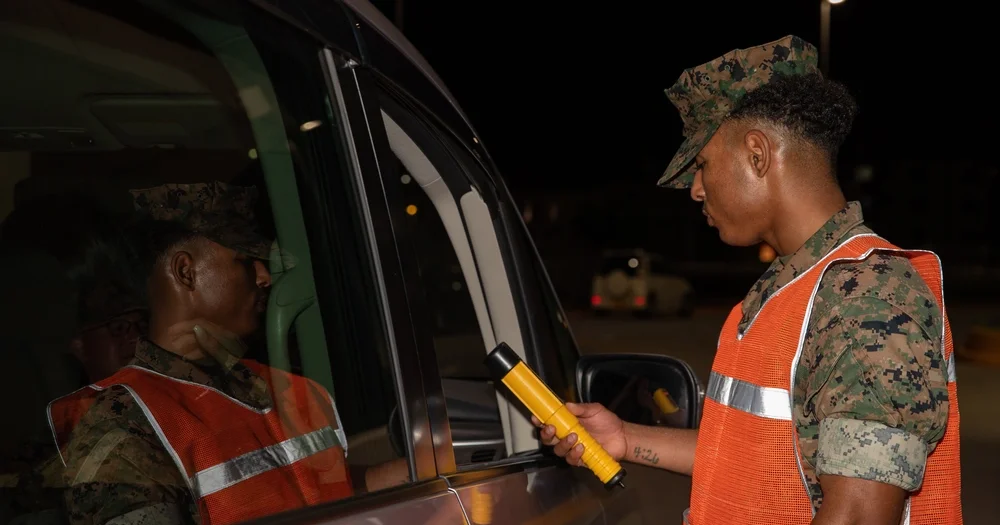
Two U.S. service members were arrested for drunk driving overseas in the same week. On Okinawa, police arrested a Marine from Camp Hansen early on 31 October, during the curfew U.S. forces put in place after a homicide case in Naha. In Bavaria, a soldier crashed into an oncoming semitrailer near Ansbach on 30 October with a preliminary breath reading of nearly 0.2 percent.
An overseas drunk driving arrest is never one case. It runs on three tracks at once: the host nation's criminal law, the UCMJ, and administrative action by the command. Each track has its own rules and its own clock.
Key facts
- Okinawa: Okinawa Prefectural Police arrested a Marine corporal assigned to Camp Hansen on suspicion of drunk driving on a national road in Okinawa City around 12:25 a.m. on 31 October. Police say his blood alcohol was more than twice Japan's legal limit and that he admitted the allegation. Police will also investigate him over a hit and run reported minutes earlier.
- Curfew: the arrest came during the midnight to 5 a.m. curfew of the Period of Reflection that began 9 October. Japan's defense minister asked the U.S. side to take the incident seriously.
- Ansbach: about 12:25 a.m. on 30 October, a 29-year-old soldier lost control of his car on the B14 highway near Katterbach and struck an oncoming semitrailer. A preliminary breath test showed nearly 0.2 percent, which police say is nearly five times Germany's legal limit. He broke his arm. The truck driver was not hurt.
- Who prosecutes Ansbach: German police say they will decide soon whether to keep the investigation or hand the case to the U.S. military.
Both service members are presumed innocent.
Track one: the host nation
Japan. Japan's limit is 0.03 percent blood alcohol, or 0.15 milligrams of alcohol per liter of breath. Driving at or above that level carries up to three years in prison or a fine of up to 500,000 yen. Driving while intoxicated carries up to five years or 1,000,000 yen. A driver whose driving kills or injures someone and who fails to help the injured faces up to ten years. Japan also punishes the passenger who rides with a drunk driver and the person who supplied the car or the alcohol.
Under the U.S.-Japan Status of Forces Agreement, Japan has the primary right to prosecute an off duty offense like this one. Japanese police arrest and question. Japanese prosecutors decide whether to indict.
Japan's Constitution says no one can be compelled to testify against himself, but the protection is narrower than in the United States. An arrested suspect must sit through questioning even after refusing to answer, no lawyer is allowed in the room, and a suspect can be held for up to 23 days before prosecutors decide whether to indict.
If Japan prosecutes, Article XVII of the Status of Forces Agreement entitles the service member to a prompt and speedy trial, to be told the charges in advance, to confront the witnesses, to compel favorable witnesses, to a lawyer of his choice, to a competent interpreter, and to communicate with a U.S. government representative and have one present at trial. Those guarantees attach to the prosecution. They do not put a lawyer in the room during questioning before indictment.
Germany. Under the NATO Status of Forces Agreement, Germany has the primary right to prosecute a U.S. service member for an offense like this, but it usually waives that right under the German Supplementary Agreement. Germany can withdraw the waiver in serious cases. That is the decision German authorities are making now in the Ansbach case.
Track two: the UCMJ
Article 113 makes it a crime to drive, or to be in actual physical control of a vehicle, while drunk or at or above the blood alcohol limit. Outside the United States the UCMJ limit is 0.08 percent, unless the Secretary of Defense sets a lower one. Japan's limit is lower, so a driver can be over the Japanese line and under the UCMJ number. Article 113 still reaches that driver if the government proves the driver was drunk, which the Manual for Courts-Martial defines as intoxication that impairs the rational and full exercise of the driver's mental or physical faculties.
The maximum punishment without personal injury is a bad conduct discharge, forfeiture of all pay and allowances, and six months of confinement. When the drunk driving results in personal injury, the maximum rises to a dishonorable discharge and 18 months. More: the UCMJ articles and Article 111, leaving the scene of a vehicle accident.
A drunk driving arrest during curfew can add a second charge: breaking the liberty order is charged as an order violation under Article 92. The curfew rules change on 8 November 2026. See Okinawa’s New Liberty Rules: What Changed After the Period of Reflection.
Track three: the command
This track moves fastest and does the most damage to a career. In the Army, AR 190-5 requires a written general officer reprimand for an active duty soldier after a conviction or nonjudicial punishment for drunk or impaired driving, after refusing or failing to complete a lawfully requested blood alcohol test, or after driving on post at 0.08 percent or higher. A second drunk driving conviction in an Army career triggers mandatory initiation of separation.
A GOMOR is fought through the written rebuttal, and a strong one can get it rescinded or filed locally. The rebuttal window is short, so the time to get a lawyer is before the reprimand arrives, not after.
The other services run their own administrative process. Expect action on your base driving privileges and on your career no matter which uniform you wear.
What to do on the military side
- Do not answer questions from military police or military investigators. Under Article 31b of the UCMJ you have the right to remain silent. The Military Rules of Evidence also give you the right to a lawyer before and during questioning in custody. Use both.
- Do not discuss the night with the people who were with you. They can become witnesses, and what you say can be repeated to investigators.
- Call a lawyer before the command acts. You cannot talk your way out of an investigation, only into charges. Many of these cases can be stopped or reduced during the investigation, before charges are preferred.
The host nation case is separate. Bilecki Law Group advises on the UCMJ and military administrative action. We do not advise on Japanese or German law, and we cannot tell you whether to speak with Japanese or German police or prosecutors. For advice on the host nation case, talk to a lawyer licensed in that country.
How Bilecki Law Group defends overseas cases
Military defense is all we do. Tim Bilecki served as Senior Defense Counsel for Trial Defense Service Pacific Rim, which covered Okinawa, mainland Japan, Korea and the Philippines, and he has traveled to Japan more than 75 times for client cases. He has taken more than 250 courts martial to verdict. Tim Bilecki travels to Japan and Germany to defend the court martial and the administrative case, including the reprimand rebuttal. The firm charges flat fees, with travel billed separately.
If you are facing UCMJ charges or command action after a drunk driving arrest on Okinawa, anywhere in Japan or in Germany, contact Bilecki Law Group for a confidential consultation: 813-669-3500.
Frequently asked questions
What is the legal blood alcohol limit for a U.S. service member driving in Japan?
Japan's limit is 0.03 percent, or 0.15 milligrams per liter of breath, and it applies to everyone on Japanese roads. The UCMJ uses 0.08 overseas, but Article 113 also reaches a driver under 0.08 if the government proves the driver was drunk.
Who prosecutes a U.S. soldier's drunk driving case in Germany?
Usually the U.S. military. Germany has the primary right to prosecute but usually waives it, and it can take a serious case back.
Does an Army drunk driving arrest always mean a GOMOR?
Not always, but often. AR 190-5 requires one for an active duty soldier after a conviction or Article 15 for drunk or impaired driving, a refused or incomplete blood alcohol test, or driving on post at 0.08 or more. A general officer can also reprimand in other cases.
Sources
- The Japan Times, 1 November 2026, on the Okinawa arrest
- Xinhua, 2 November 2026, on Japan's request to the U.S.
- Stars and Stripes, 2 November 2026, on the Ansbach crash
- 10 U.S.C. 913, Article 113
- 32 CFR 634.12, the Army reprimand rule (AR 190-5)
- Kadena Air Base, Japan's traffic penalties and Hokkaido Prefectural Police, hit and run penalties (Japanese)
- U.S.-Japan Status of Forces Agreement, Article XVII, paragraphs 3 and 9; NATO Status of Forces Agreement, Article VII, and the German Supplementary Agreement, Article 19; Military Rule of Evidence 305