Arrested in Japan: Custody, Indictment and Trial Under the SOFA
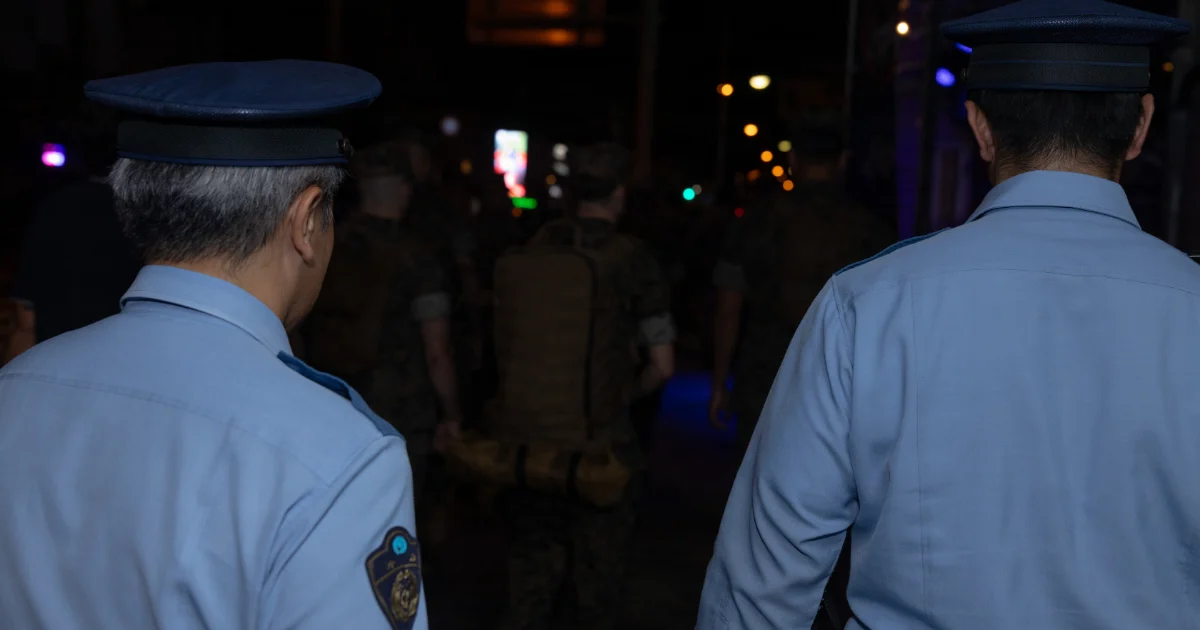
Prosecutors in Naha indicted a U.S. Marine on 25 October in a homicide case. He is presumed innocent. This post does not discuss the facts of his case. It explains the process that he, and any service member in his position, now faces in Japan.
The case has renewed calls on Okinawa to change the Status of Forces Agreement. The Okinawa Policy Council meets in Tokyo on 6 November for the first time since 2013. Whatever comes of that meeting, the rules below are the ones in force today.
Key facts
- The Naha Public Prosecutors Office indicted the Marine on 25 October 2026 (Stars and Stripes, 25 October).
- He was arrested in early October (Stars and Stripes, 25 October).
- Okinawa Governor Genta Koja called for a review of the SOFA in a 7 October letter (Stars and Stripes, 4 November).
- Chief Cabinet Secretary Minoru Kihara will chair the 6 November Okinawa Policy Council meeting. The agenda is undecided (Stars and Stripes, 4 November).
Who holds a service member after an arrest in Japan
Article XVII of the U.S.-Japan Status of Forces Agreement sets who goes first. The United States has the primary right over offenses solely against U.S. property or security, offenses solely against another member of the force, the civilian component or a dependent, and offenses arising from official duty. Japan has the primary right over any other offense.
Custody is a separate question, and it turns on who holds the service member.
- Arrested by Japanese police. The Agreed Minutes to Article XVII say Japanese authorities will release the service member to U.S. military custody unless they find adequate cause to keep him.
- Held by the United States. Article XVII, paragraph 5(c), says custody remains with the United States until Japan charges him. The Agreed Minutes add that U.S. authorities shall, on request, transfer custody to Japan at the time he is indicted.
- Murder and rape. In the 1995 Joint Committee Agreement on Criminal Procedures, the United States said it "will give sympathetic consideration to any request for the transfer of custody prior to the indictment" in specific cases of murder or rape. Japan submits those requests through the Joint Committee. The text commits the United States to consider a request. It does not require a transfer.
Questioning and the 23-day limit
Japan's Ministry of Justice says an arrest must rest on a warrant from a judge, except when a person is arrested in the act. At a prosecutor's request, a judge can order a suspect detained for up to 10 days. The judge can extend that by up to 10 more days only for unavoidable circumstances. The longest a suspect can be held from arrest until prosecutors decide whether to indict is 23 days for a single crime.
The Ministry says suspects have the right to remain silent and to consult a lawyer without government officials present. It also says lawyers are not allowed to attend the interrogation.
Indictment and trial
Once a person is indicted, a judge may grant bail unless exceptional circumstances apply.
Serious cases go to a lay judge trial. The Ministry of Justice White Paper on Crime says district courts hear two kinds of case this way: offenses punishable by death or life imprisonment, and cases in which an intentional crime caused a victim's death, where the crime carries a minimum of at least one year. The panel is normally three professional judges and six lay judges chosen from the public.
No one is regarded as guilty of a crime in Japan until a court finds him guilty at trial.
If Japan prosecutes, Article XVII of the Status of Forces Agreement entitles the service member to a prompt and speedy trial, to be told the charges in advance, to confront the witnesses, to compel favorable witnesses, to a lawyer of his choice, to a competent interpreter, and to communicate with a U.S. government representative and have one present at trial. Those guarantees attach to the prosecution. They do not put a lawyer in the room when Japanese authorities question a suspect.
The Japanese case is separate. Bilecki Law Group advises on the UCMJ and military administrative action. We do not advise on Japanese law, and we cannot tell you whether to speak with Japanese police or prosecutors. For advice on the Japanese case, talk to a lawyer licensed in Japan.
The military side
A Japanese prosecution limits the military case. It does not always end it. Article XVII, paragraph 8, says a member tried by Japan may not be tried again for the same offense within Japan by U.S. authorities. The same paragraph says this does not prevent U.S. military authorities from trying a member for any violation of rules of discipline arising from the same act.
Our post on a Fukuoka case covers what a Japanese verdict does and does not end: Tried in Japan: What a Japanese Verdict Does Not End for a Marine.
If NCIS, CID or OSI contacts you
This list covers U.S. investigators and your command only.
Under Article 31b of the UCMJ you have the right to remain silent. The Military Rules of Evidence also give you the right to a lawyer before and during questioning in custody.
You cannot talk your way out of an investigation, only into charges, so the time to get a lawyer is before you sit down.
- Tell U.S. investigators you want a lawyer and will not answer questions. Then stop talking.
- Do not sign a written statement for U.S. investigators until a lawyer has reviewed it.
- Keep your texts and social media off the subject.
- Follow your command's lawful orders.
A statement obtained in violation of Article 31 cannot be received in evidence against you at a court martial. Get the lawyer before charges are preferred.
The firm
Military defense is all we do. Bilecki Law Group has taken more than 250 courts martial to verdict and represented more than 500 clients. Tim Bilecki served as Senior Defense Counsel for Trial Defense Service Pacific Rim, covering Okinawa, mainland Japan, Korea and the Philippines, and he has made more than 75 trips to Japan. Flat fees, travel billed separately.
Tim Bilecki travels to Okinawa to defend the court martial and the administrative case. Call 813-669-3500.
FAQs
Can a U.S. service member be held in a Japanese jail before charges?
Yes, if Japanese police make the arrest and find adequate cause to keep him. A suspect can then be held for up to 23 days before prosecutors decide whether to indict.
When does the U.S. military turn a service member over to Japan?
At indictment, on Japan's request. For murder or rape, the United States has also agreed to give sympathetic consideration to a Japanese request for transfer before indictment.
Can a lawyer sit in when Japanese police question a service member?
No. Japan's Ministry of Justice says lawyers are not allowed to attend interrogations. A suspect may consult a lawyer without officials present.
Sources
- Stars and Stripes, 25 October 2026 (indictment)
- Stars and Stripes, 4 November 2026 (Okinawa Policy Council)
- U.S.-Japan Status of Forces Agreement, Article XVII, and Agreed Minutes (Ministry of Foreign Affairs of Japan)
- Japan-U.S. Joint Committee Agreement on Criminal Procedures (Ministry of Foreign Affairs of Japan)
- Ministry of Foreign Affairs of Japan, press conference, 3 July 2001
- Ministry of Justice of Japan, FAQ on the criminal justice system
- Ministry of Justice of Japan, White Paper on Crime 2021, saiban-in trials
- 10 U.S.C. 831 (Article 31)