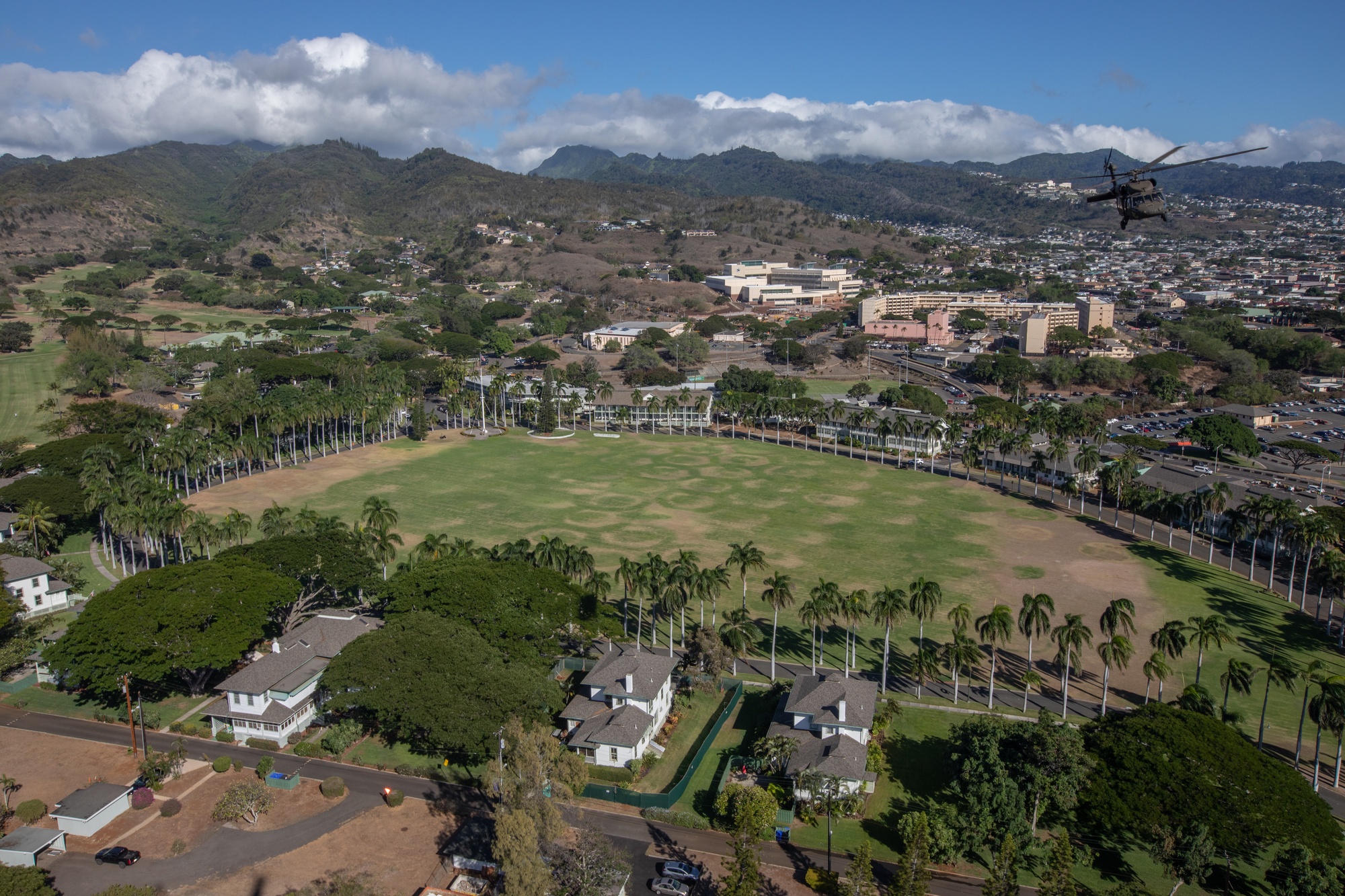
Fort Shafter: The Home of U.S. Army Pacific, Where the Stars Outnumber Everyone Else
Just inland from Honolulu Harbor, Fort Shafter is the oldest Army post in Hawaii and the headquarters of U.S. Army Pacific, the command that runs the Army's largest theater. Around historic Palm Circle you will find more senior officers and senior enlisted leaders per square foot than almost anywhere in the Army, and that concentration of brass is exactly the problem for a Soldier who runs afoul of the UCMJ here. A headquarters post is a place where careers are watched, where a single allegation against an officer or a senior NCO becomes a command priority overnight, and where the institution is quick to make an example to show the rest of the staff that no one is untouchable.
For this firm, Fort Shafter is personal ground, not a place we visit. A Soldier facing an investigation or court martial here is fighting for a career, a retirement, and sometimes freedom. The only way to win that fight is to deny the prosecution the easy conviction it expects and make it prove every element of what it has charged.
Hawaii's Own Soldier, Who Gave an Arm and Earned the Medal of Honor
No one embodies the Soldier of these islands like the local son who became its greatest hero. Daniel K. Inouye was born and raised in Honolulu, and on the morning of December 7, 1941, at seventeen, he was tending to wounded civilians while the harbor burned. He enlisted in the 442nd Regimental Combat Team, the Japanese American unit that became the most decorated of its size in the Army's history, and on April 21, 1945, near San Terenzo, Italy, he led his platoon against a fortified ridge bristling with machine guns. Shot in the stomach, he kept attacking. His right arm was shattered by a grenade, and he pried the live grenade from his own ruined hand and threw it before he fell. He came home without that arm, went on to represent Hawaii in Congress from the day it became a state, and served as one of the most respected United States Senators in the nation's history. He gave a piece of himself and never stopped serving the islands he came from, and that is the standard we bring to a fight at Fort Shafter.
Why Soldiers at Fort Shafter Fly Us In
No civilian defense counsel a Soldier can call has the tie to Fort Shafter that this firm does, because Tim Bilecki was stationed here. Early in his career he served on active duty at Fort Shafter as a judge advocate handling operational and international law for the Asia Pacific theater, and when he left the Army he founded Bilecki Law Group in Honolulu and ran it from the islands, and for nearly two decades he has won full acquittals across Oahu year after year. The firm is based in Tampa now, and that reach is the point: clients bring Tim in from across the globe for the way he tries a case. Hawaii is home, and a case here is one he comes back for gladly. When a prosecutor at Shafter learns that the counsel across from him once wore the uniform on this very post and has won cases on this ground for years, the easy conviction is gone.
The reason it matters is that the military justice system was not built to find the truth. It exists to preserve good order and discipline, and at a headquarters it does that by making a public example of someone, because a ruined career reassures the senior leadership that the standard still has teeth. A serious case at Fort Shafter is investigated by Army CID, and for sexual assault, domestic violence, and other covered offenses the decision to refer charges to a court martial no longer belongs to your command; it goes to an independent Special Trial Counsel in the Army's Office of Special Trial Counsel. Your detailed defense counsel from Trial Defense Service can be capable and committed, but carries a heavy caseload inside the same system, which is why Soldiers who are serious about the fight bring in their own counsel.
UCMJ Charges We Defend at Fort Shafter
These are among the most common allegations at Fort Shafter. The list is not exhaustive, and we defend the full range of UCMJ charges.
Sexual Assault and Sex Offenses (UCMJ Article 120 / Article 134). The Army runs its SHARP program at Fort Shafter under the same pressure that drives these prosecutions everywhere, and at a senior headquarters an allegation against an officer or a ranking NCO draws extra scrutiny and moves fast. The allegation is treated as established before the investigation is finished, and even where the evidence will not support a charge the command reaches for administrative separation or a show cause board. Soldiers have also learned that a complaint can redirect an investigation or settle a workplace or relationship dispute, and a command focused on showing it takes every report seriously is in no position to weigh motive. These cases route to an independent Special Trial Counsel now, and they demand counsel who will investigate independently and contest the case early, before charges are preferred.
A serious and growing part of our Hawaii work is defending service members swept up in the online predator stings run on this island, the Operation Keiki Shield operations. These are joint stings. Military investigators from NCIS, Army CID, and the Air Force Office of Special Investigations work alongside the State's Internet Crimes Against Children task force. An agent poses online as a fourteen or fifteen year old, steers the conversation toward sex and a meeting, and arrests whoever shows up. There is usually no actual child, which means that under the UCMJ the charge is most often an attempt under Article 80 and it requires specific intent and an act that goes beyond mere preparation. We defend the court martial that comes out of these stings, and we have won them, with numerous full acquittals over the years. In one at Schofield, Tim argued entrapment and exposed agents who had used photographs of an adult to pose as a minor. The defenses are a mistake of fact as to age, where the person reasonably believed they were dealing with an adult; entrapment, where the government planted the idea in someone who was not predisposed to it. After the arrest, agents push hard for a written statement or an apology letter, because that is the fastest way to lock in their case. Do not give one, and if you already have, a statement taken under that kind of pressure can still be challenged. We also examine compliance with Internet Crimes Against Children protocols for weaknesses in the investigation and the agents’ credibility. A protocol violation alone is not a legal defense; its significance depends on the charged offense, the evidence, and the applicable defense.
Larceny and Fraud (UCMJ Article 121 / Article 107). A headquarters full of senior personnel and constant travel is where pay, travel, and voucher fraud allegations surface. A questioned TDY voucher, a government travel card charge, or a duplicated reimbursement can lead to larceny allegations under Article 121 or false official statement allegations under Article 107, with the same paperwork used to support both charges. A discrepancy alone does not establish either offense. The government still has to prove intent, and a finance office error, bad guidance, or a clerical mistake is not a scheme. We defend travel and voucher fraud, government travel card cases, larceny, wrongful appropriation, and false official statements, and we win them on the paper trail and on the intent the government would rather assume than prove.
Domestic Violence and Assault (UCMJ Articles 128b and 128). Domestic violence under Article 128b has become one of the largest parts of our caseload, and a post with this many families stationed far from home sees a great deal of it. Since the Office of Special Trial Counsel took these cases over it is charged as aggressively as any offense in the UCMJ. It covers a spouse, an intimate partner, or a family member, and makes strangulation or suffocation a separate, serious charge even when there is little or no visible injury. A qualifying conviction also triggers the federal Lautenberg firearms bar, which can end an Army career because a Soldier has to be able to carry a weapon, and for an officer or senior NCO it is a finding that can have serious consequences for retention and retirement. We also defend assault under Article 128. Self defense is a recognized defense, and what actually happened often looks different from the first report once the evidence comes in.
Drug Offenses (UCMJ Article 112a). Hawaii has a longstanding problem with methamphetamine, and the drug cases the command worries about here are less about a single marijuana positive than about ice and other substances bought on the island. A positive urinalysis or a possession allegation is serious but not the end of the fight. The chain of custody can be challenged, innocent ingestion is a recognized defense, and the government still has to prove that any use or possession was knowing and wrongful. Get experienced counsel involved as early as you can, because the government works hardest to lock in its case at the very start.
Military Specific Offenses (UCMJ Articles 92, 133, 134, and more). A headquarters generates its own kind of charges, the ones that grow out of staff life and senior responsibility, from a failure to obey a lawful order or regulation under Article 92 to conduct unbecoming an officer under Article 133 and the broad sweep of Article 134. Add the offenses that start off duty in Waikiki, Chinatown, and Hotel Street in Honolulu, where a bar fight, a DUI, or a drunk and disorderly comes back to the command on its own, and a single incident becomes a charge sheet built to inflate the punishment and the pressure to resign or retire in lieu. Every specification still has to be proven beyond a reasonable doubt on its own, and the weak ones on an inflated charge sheet are the first to fall.
A Career Built Over Decades Shouldn't End on One Allegation
Not every Soldier who calls us from Hawaii is innocent, and we do not pretend otherwise. Some made a bad decision and know it. That does not mean they have to accept the worst the system can hand out, prosecuted by an institution eager to turn one case into a warning for the rest of the staff. Rank does not decide whether you need a firm like ours; the seriousness of the case does. If a matter is genuinely minor, your Trial Defense Service counsel can handle it, and we will tell you so honestly, because we do not take every case and we will not take a Soldier's money for one that does not need us.
But when the case is serious, everything is on the line at once: your career, your retirement, your good name, and your freedom, and at a senior level a single conviction can erase decades of service in an afternoon. A court martial conviction is a federal criminal conviction. Under the sentencing rules now in force, it can mean confinement a judge has little discretion to avoid, a punitive discharge or dismissal that follows you for life, the loss of a retirement you spent a career earning, and on a sex offense a place on a registry, no matter your rank. That is why you fight, and the system is counting on you not to.
If you are facing an investigation or court martial at Fort Shafter, reach out for a free defense strategy session. We have stood on this post, we know how these cases move in Hawaii, and we will tell you exactly what you are facing and how we would defend it. The government is already building its case. The only question is whether anyone is building yours.
Cases Connected to Fort Shafter
These cases include trials, hearings, investigations, and administrative matters. A connection to this location does not necessarily mean that the trial occurred here.
- Case connected to this location: Bilecki Defends O-3 Trying to Avoid Perjury Trap by Admitting False Statements
- Case connected to this location: Bilecki Raises Reasonable Doubt, Clears SFC of Burglary and Sex Assault Charges
- Case connected to this location: USCID Denies Request to Remove Subject Titling for Army O-3
- Case connected to this location: Allegations of Sending Nudes Against Army Lieutenant Colonel Found Unfounded
- Case connected to this location: Bilecki Negotiates Full-Benefit Retirement for Army O-6 Amid BAH and Sex Charges
- Case connected to this location: No Court Martial for Army CPT Accused of Theft of Government Funds in Hawaii
FAQ
CID wants to interview me at Fort Shafter. Do I have to talk to them?
No, and not without counsel. The interview is not your chance to clear things up; it is evidence collection, and under Article 31b of the UCMJ you have the right to remain silent and to ask for a lawyer. For covered offenses like sexual assault, the decision to refer charges to a court martial no longer belongs to your command but to an independent Special Trial Counsel in the Army's Office of Special Trial Counsel. At a headquarters the command interest in a case involving an officer or senior NCO is intense, so the smartest move is to decline the interview, ask for counsel, and call a lawyer before you say anything.
I am a senior officer or NCO and the case threatens my retirement. What is really at stake?
More than confinement. For a senior Soldier the parallel danger is the administrative track: a general officer memorandum of reprimand, a referred evaluation, a show cause or Board of Inquiry for an officer, or a QMP or separation board for an NCO, which can lead to separate retention and retirement decisions that threaten the career you spent years building, even when the criminal case never produces a conviction. The criminal case and the administrative action move on different tracks and feed each other, so they have to be fought together from the start. Protecting the retirement can matter as much as beating the charge, and waiting until the court martial is over is usually too late for the administrative side.
Why hire Bilecki Law Group instead of a local attorney already on island?
We win court martial cases. Soldiers fly us in from all over the world because military defense is all we do and our trial record proves it. We are not new to this island either: Bilecki Law Group was founded in Honolulu and defended courts martial across Oahu for more than a decade, so our national record comes with real knowledge of the local prosecutors and the Wheeler courtroom where your case will be heard.
Where will my court martial actually be held?
At the courthouse on Wheeler Army Airfield, right next to Schofield Barracks. Your free Trial Defense Service counsel works out of the same place, and a TDS lawyer can be very capable, but carries a heavy caseload inside the same system that is prosecuting you, so for a serious case Soldiers often bring in their own counsel to work alongside or in place of the detailed defense. Getting someone engaged before charges are preferred is when an investigation can still be taken apart.