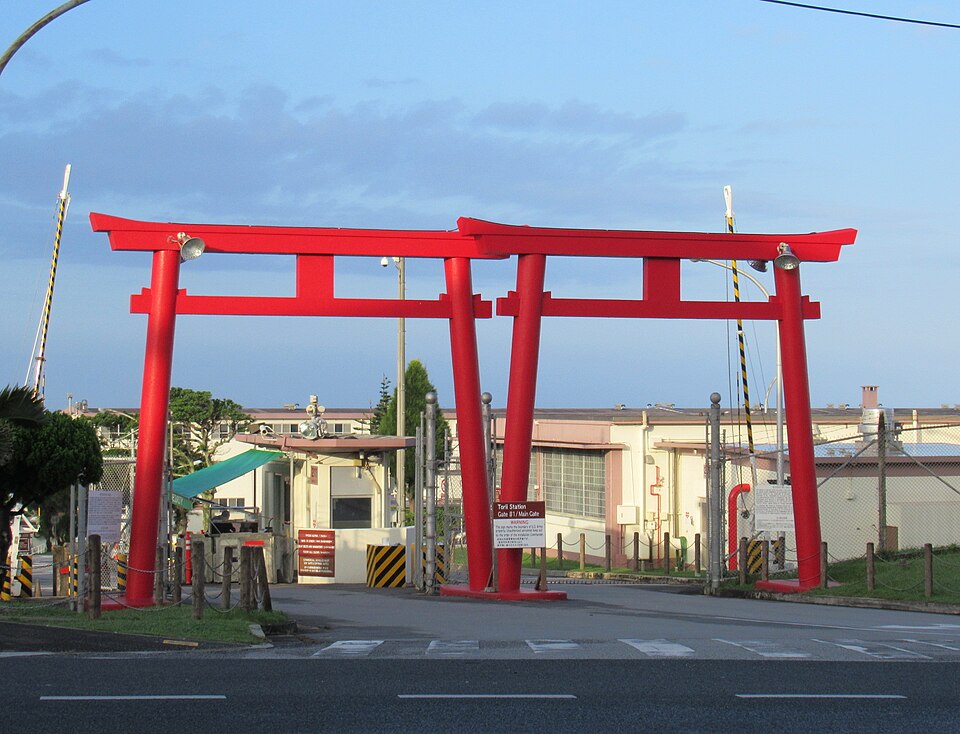
Torii Station: The Army's Foothold on a Marine and Air Force Island
Torii Station, officially U.S. Army Garrison Okinawa but known to everyone by the red torii gate at its entrance, is the Army's home on an island the Marines and the Air Force dominate. It sits in Yomitan, on the west coast above the East China Sea, where Japanese farmers still work fields inside the fence line and Torii Beach draws Soldiers on their off days. It is a small post with an outsized punch: the 10th Support Group runs Army logistics across the island from here, and the 1st Battalion of the 1st Special Forces Group, the Pacific's Green Berets, calls this ground home, alongside signal, air defense, transportation, and military police units. Because the Army population here is so small, a Soldier's whole world, from the commissary to the hospital to legal help, often runs through the larger Marine and Air Force bases nearby.
That small footprint does not make the UCMJ any smaller. Soldiers at Torii run into the military justice system like Soldiers anywhere, and on Okinawa there is a second layer most never think about until it lands: an off base incident can put you in front of the Japanese authorities at the same time the Army is building a court martial. A case out of Torii Station is a fight for a career, a clearance, and sometimes freedom, and the only way to win it is to deny the prosecution the easy conviction it expects and force it to prove every element of what it has charged.
The Medic This Island Could Not Break
The Army medical clinic on Torii Station is named for Corporal Desmond Doss, and there is no better model of refusing to quit on the people who depend on you. Doss was a conscientious objector who would not carry a weapon, and he served as a company medic with the 307th Infantry Regiment, 77th Infantry Division in the Battle of Okinawa. In late April and May of 1945, on the Maeda Escarpment, the cliff the Soldiers called Hacksaw Ridge, a Japanese counterattack tore his unit apart and drove it back off the top. Doss would not go. Alone, under fire, he went to the wounded one by one, dragged each man to the edge of the cliff, and lowered him down the rock face on a rope litter he tied himself, somewhere around seventy-five men carried off that ridge while he refused cover for himself. He became the first conscientious objector to receive the Medal of Honor. He saved life after life on this island with nothing but his hands and his refusal to leave anyone behind, and that is exactly the standard we bring to a fight with the military justice system.
Why Soldiers at Torii Station Fly Us In
For an Army Soldier on Okinawa, this firm's tie to the island is not a slogan. The free Trial Defense Service counsel that defends Okinawa Soldiers, Torii Station included, comes from the Army's Trial Defense Service Pacific Rim office, now based at Camp Humphreys in Korea, and that is the very defense region Tim Bilecki once ran. From 2008 to 2010 he served as the Senior Defense Counsel for the Army's Trial Defense Service across the Pacific Rim, responsible for the defense of Soldiers throughout Korea, Okinawa, and mainland Japan. He has been back to Okinawa many times in the years since, and the firm he built has defended service members across this island for the better part of two decades. When he founded Bilecki Law Group in Hawaii, it took cases in only three places, Hawaii, Korea, and Japan. Few civilian lawyers anywhere know the Army's military justice in the Pacific from the inside the way he does.
Finding the truth was never the military justice system's purpose. It exists to preserve order and discipline, and it does that by making a public example of someone, because a conviction keeps the rest of the force in line whether the Soldier did it or not. A serious case at Torii is investigated by the Army Criminal Investigation Division, and for sexual assault, domestic violence, and other covered offenses the decision to refer charges to a court martial no longer belongs to your command; it goes to an independent Special Trial Counsel in the Army's Office of Special Trial Counsel. Army cases on Okinawa run through U.S. Army Japan and its Staff Judge Advocate, and are tried in Japan. Under the U.S.-Japan Status of Forces Agreement the Japanese authorities also hold the primary right to prosecute most off base offenses against Japanese nationals, in a system nothing like ours, where police and prosecutors can hold and question a suspect for up to roughly twenty three days before any charge, often without a lawyer present. When prosecutors see that kind of counsel fly in, the easy conviction they were counting on is gone.
UCMJ Charges We Defend at Torii Station
The charges below are the most common at Torii Station. They are examples of what we defend, not the boundaries of it.
Sexual Assault and Sex Offenses (UCMJ Article 120 / Article 134). The Army's SHARP campaign began with a legitimate goal, but its execution has turned the accusation itself into the case, treated as established before the investigation is finished, and when the evidence will not support a charge the command falls back on administrative separation. Soldiers have learned an allegation can be wielded to retaliate or to redirect an investigation away from the accuser, and a command focused on demonstrating compliance is not positioned to weigh those motives. These cases route to an independent Special Trial Counsel now, and they demand counsel who will investigate independently and fight for every element early, before charges are preferred.
Okinawa is also where we defend the online sting cases, the "To Catch a Predator" operations that have arrested service members of every branch on the island, Soldiers among them, and made national and Japanese news. An agent posts on an adults only platform using photos of an adult woman, plays a bored young woman in the chat, and only later claims to be underage before luring the target to a meeting and an arrest on arrival. With no real child involved, the charge is almost always an attempt under Article 80, and the government has to prove what the service member actually intended. The defenses are a mistake of fact as to age and entrapment. We won the first of these ever tried on Okinawa and have defended a steady stream of them since, with the results to show for it. We also examine compliance with Internet Crimes Against Children protocols for weaknesses in the investigation and the agents’ credibility. A protocol violation alone is not a legal defense; its significance depends on the charged offense, the evidence, and the applicable defense.
Fraud and Larceny (UCMJ Article 121 / Article 107). Overseas pay and housing rules are complicated, and a housing allowance drawn against a dependent listed somewhere other than reality, or a travel claim that does not reconcile, gets written up as deliberate fraud once an investigator decides it was. The certification on the form is what sets the payment, so the government typically pairs the larceny charge under Article 121 with a false official statement under Article 107. Intent has to be proven, not assumed, which means the government showing you meant to cheat it rather than simply that a payment was off, and a finance error, bad guidance, or a family that genuinely relocated is not a scheme. Our Article 121 work covers BAH and OHA fraud, larceny, wrongful appropriation, and conspiracy to defraud, and we make the prosecution prove the intent it would rather assume.
Domestic Violence and Assault (UCMJ Articles 128b and 128). Domestic violence is now one of the heaviest parts of our practice, prosecuted by the Office of Special Trial Counsel with the force of a sexual assault. Article 128b covers a spouse, an intimate partner, or a family member, and makes strangulation or suffocation a serious standalone charge even where nothing is visible. The federal Lautenberg Amendment then bars a Soldier with a qualifying conviction from any firearm or ammunition, which can end a career. We also handle assault under Article 128. A night out in Yomitan or anywhere off the installation can turn into a confrontation in a hurry, and on Okinawa a scuffle that involves a Japanese national becomes a serious matter fast, because the command does not want the diplomatic fallout, whether or not your Soldier started it. Who actually started it tends to look very different once the evidence comes in. Self defense is a recognized defense, and we represent Soldiers on assault, aggravated assault, manslaughter, and murder charges.
Drug Offenses (UCMJ Article 112a). Japan enforces some of the strictest drug laws in the developed world, and that severity drives how the command treats any allegation on the island, where a substance brought onto Okinawa or obtained off base can carry both a UCMJ charge and exposure to the Japanese system. A positive urinalysis is serious, but it does not decide the case. The chain of custody can be challenged, innocent ingestion is a recognized defense, and the government still has to prove that any use or possession was knowing and wrongful. These cases call for counsel who grasps both the evidence and the host nation pressure that surrounds them.
Military Specific Offenses (UCMJ Articles 77 to 134). Failure to obey, unauthorized absence, dereliction, false official statement, and conduct unbecoming get stacked onto a charge sheet to inflate the maximum punishment and the pressure to plead, and overseas commands file charges that would never surface stateside. Every specification still has to be proven beyond a reasonable doubt on its own, and the weak ones on an inflated charge sheet are the first to fall.
Even If You Made a Mistake at Torii, Don't Surrender the Case
Not every Soldier who calls us is innocent, and we do not pretend otherwise. Some made a bad decision and know it. That does not mean swallowing the worst the system can impose, prosecuted by an institution eager to turn their case into a warning. Rank does not decide whether you need a firm like ours; the seriousness of the case does. If it is genuinely minor and does not call for a civilian trial lawyer, your free Trial Defense Service counsel can handle it, and we will tell you so honestly, because we do not take every case and we will not take a Soldier's money for one that does not need us.
But when the case is serious, all of it is on the line at once: your career, your retirement, your good name, and your freedom, and on Okinawa a host nation able to prosecute you in parallel with the court martial. A court martial conviction is a federal criminal conviction. Under the sentencing rules now in force, a military judge sentences within set confinement parameters, with mandatory minimum punishments for the most serious offenses, so it can mean confinement a judge has little discretion to avoid, a punitive discharge that follows you for life, and on a sex offense a place on a registry, no matter how junior you are. That is when you stand and fight, because the system assumes you will not.
If you are facing an investigation or court martial at Torii Station, reach out for a free defense strategy session. We will come to Okinawa, give you a straight read on what you are facing, and lay out how we would defend it. The investigation is already moving. The only question is whether you will have someone fighting just as hard for you.
Cases Connected to Torii Station
These cases include trials, hearings, investigations, and administrative matters. A connection to this location does not necessarily mean that the trial occurred here.
- Case connected to this location: No Court Martial Charges for Soldier Accused of Larceny and False Statements
- Case connected to this location: Soldier Acquitted of Rape Sparkling Public Outcry in the Philippines
- Case connected to this location: Army SSG Gets into Fight with Marine, Retained at AdSep
- Case connected to this location: Night Out in Okinawa Juicy Bar Results in GOMOR for Army SSG
- Case connected to this location: Army Captain Facing a Slew of Driving-Related Charges Averts Court Martial
- Case connected to this location: Bilecki Negotiates Pre-Trial Agreement for Army E-4 Charged with Cocaine
- Case connected to this location: Bilecki’s Forensic Examination Saves Army SFC from False Sex Charges
- Case connected to this location: Bilecki Wins Full Acquittal on Army SGT at Schofield in 6-Charge Article 120 / 127 / 128 / 128b / 130 / 134 GCM After M.R.E. 412 Reveals the Wife's Affair
- Case connected to this location: Bilecki Walks Army Captain's Tamiok Strike Initial Site Survey GOMOR Off the AMHRR to Local File; Prior Enlisted Captain with Six Deployments and More Than Five Hundred Combat Patrols
- Case connected to this location: Bilecki Walks Two-Specification Article 121 Larceny Charge Sheet Off the Case After Article 32 Setup at the Okinawa Law Center for Army SSG at Kadena; All Charges Withdrawn and Dismissed
- Case connected to this location: Bilecki Defends Army SSG Through SOFA Gate-1 DUI Article 15 and AMHRR-Filed GOMOR at Kadena / Torii Station; No Administrative Separation, QMP Posture Only
- Case connected to this location: Bilecki Closes BAH / OHA Fraud Investigation on Army Colonel at Torii Station with GOMOR Only; No Court Martial, Retirement Approved
- Case connected to this location: Altered Consent to Barracks Search for Spice Results in Dismissal of Charges
FAQ
Army CID wants to talk to me about a sexual assault allegation at Torii. Do I have to talk to them?
No to the interview, yes to the lawyer. Under Article 31b of the UCMJ you have the right to stay silent and to counsel, and you should invoke both plainly rather than try to talk your way clear, because a CID interview is evidence collection and the first contact often shapes the whole case. CID will also title you, listing you as the subject of the investigation in its files at a very low threshold, which can follow you in background and clearance checks even if the case is dropped, so getting counsel in early matters. The highest value phase is before charges are preferred, when a strong defense can lead the independent Special Trial Counsel, who decides covered offenses, to decline to prefer, so most of these cases are settled in the early weeks rather than at trial. Decline, ask for counsel, and call a lawyer before the first word.
I am a Green Beret with a clearance and SCI access. What does an investigation do to my clearance and my Special Forces status?
They run on a separate track from the court martial, on a lower standard of proof, and they usually move first. On a serious allegation alone, your command or security manager can suspend your access to classified information, and your Special Security Officer can pull your SCI access and file an incident report, before anything is proven and without waiting for the criminal case to finish; you can be flagged and pulled from your team and sensitive duties in the same window. Revoking the clearance itself is a separate decision, made by an adjudication facility outside your chain of command, now under the Defense Counterintelligence and Security Agency, under the National Security Adjudicative Guidelines. If it moves to revoke, you receive a Statement of Reasons spelling out the concerns and a set period to answer them in writing before anything is final. The Special Forces Tab is a further step still: it can be withdrawn only by the commander of the U.S. Army John F. Kennedy Special Warfare Center, usually on the strength of a conviction or substantiated misconduct, and is appealable to U.S. Army Special Operations Command. All of it feeds off what the investigation concludes, which is why the way to protect a clearance, SCI access, and the tab is to fight the underlying allegation early and hard, not to treat the security fallout as a separate problem for later.
As one of the few Army Soldiers on a Marine and Air Force island, where is my case actually handled?
Through the Army's own channels, not the Marine or Air Force commands that dominate Okinawa. Your case is investigated by Army CID, and it runs through U.S. Army Japan and its Staff Judge Advocate, with covered offenses going to the independent Army Special Trial Counsel, and it is tried in Japan. Your free military defense counsel comes from the Army Trial Defense Service for the Pacific region. Knowing which service's system actually has your case, and how it moves, is half the battle on an island where the Army is the smallest presence, and it is exactly the terrain this firm knows from the inside.