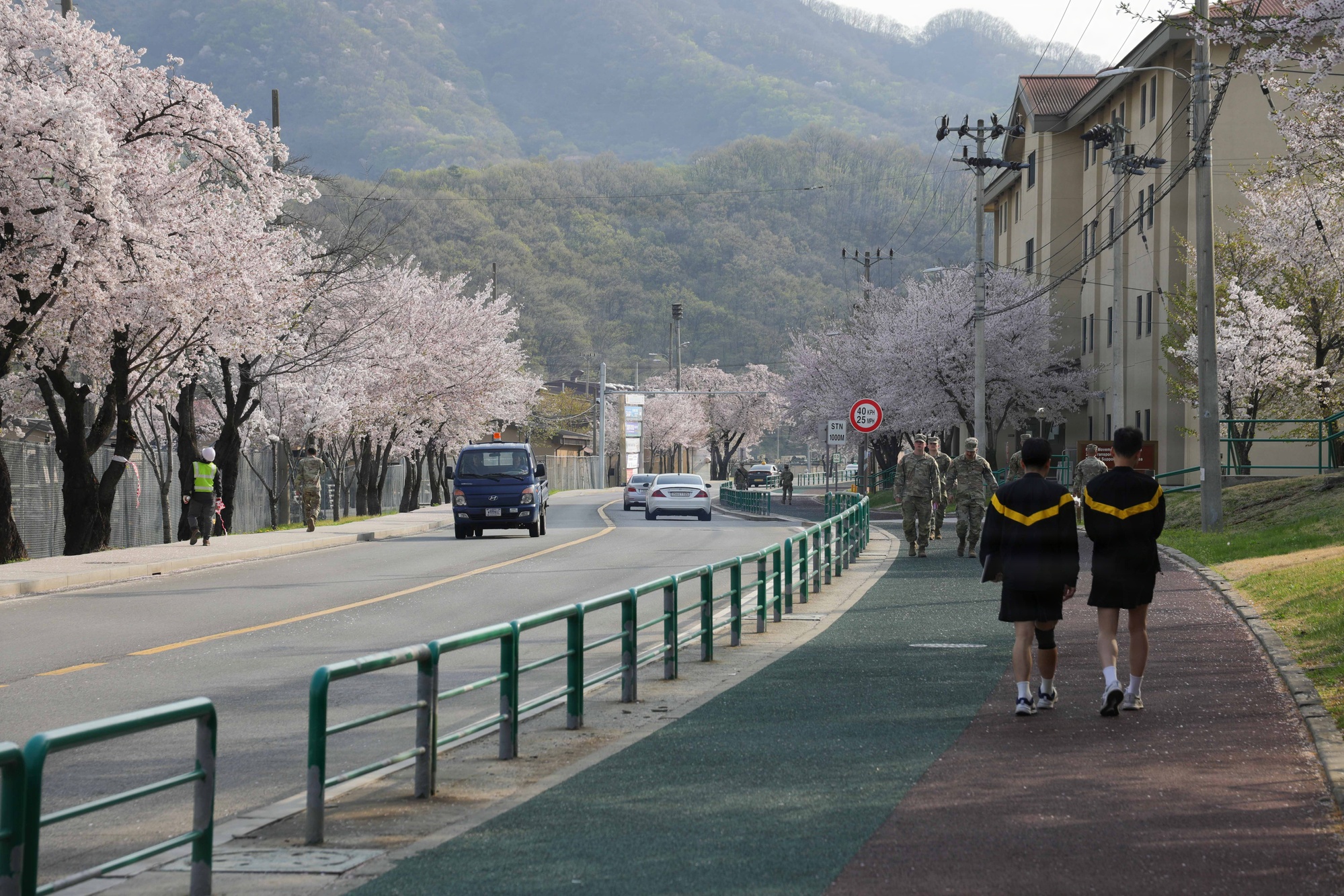
Camp Casey: The Northernmost Post in Korea, and a Fight You Didn't Come Here For
Camp Casey sits in Dongducheon, the camp town Soldiers just call TDC, up against Soyosan Mountain about forty miles north of Seoul and only a dozen or so miles south of the DMZ. It is the northernmost U.S. Army garrison in Korea, the place where the rotational brigade combat team transfers authority and stages near the border, and it shares the ground with Camp Hovey next door and Warrior Base, the forward training site pushed up past the Imjin River almost to the wire. The 210th Field Artillery Brigade, the Thunder Brigade, is permanently posted here with its rocket launchers aimed at the North Korean artillery massed within range of Seoul. If the peninsula ever goes hot, the Soldiers at Casey are the ones who go first.
That mission does not buy a Soldier any mercy from the military justice system. Soldiers on a nine-month rotation, far from home and often overseas for the first time, run into the UCMJ like Soldiers anywhere, and in Korea there is a second layer most of them never think about until it lands on them: the Korean legal system, which can reach an off post incident at the same time the Army does. A court martial connected to Camp Casey is a fight for a career, a retirement, and sometimes freedom, and the only way to win it is to deny the prosecution the easy conviction it expects and force it to prove every element of what it has charged.
Out of Grenades, He Charged Anyway
The Korean War produced few stands as stubborn as the one Private Bill Speakman made on November 4, 1951, on the slope of Hill 217 during the fighting at Maryang-san. His company was being overrun by waves of Chinese infantry, and as the position crumbled Speakman gathered up every grenade he could carry and led charge after charge into the advancing enemy to buy his comrades time to pull back. He was wounded in the leg and kept going, kept charging, kept the enemy off balance for hours so the withdrawal could hold. Legend has it that when the grenades ran out his men hurled stones, ration tins, even empty beer bottles down the hill, and Speakman became known across the Commonwealth as the soldier who fought with whatever was at hand. He was awarded the Victoria Cross, the first of the new Queen's reign. He did not have the weapons for the fight he was in, and he refused to let that decide the outcome, which is exactly the posture a Soldier needs when the military justice system comes for him.
Why Soldiers at Camp Casey Fly Us In
Tim Bilecki does not just fly into Korea; he was stationed right here. From 2008 to 2010 he served as the Senior Defense Counsel for the Army's Trial Defense Service across the Pacific Rim, stationed first at Camp Casey and then at Yongsan, personally responsible for the defense of Soldiers throughout Korea, Okinawa, and mainland Japan. He defended cases on this ground, in front of these commands, before he ever returned as a civilian, and that tour is a large part of why this firm handles so many courts martial in Korea today. When he founded Bilecki Law Group in Hawaii, it took cases in only three places, Hawaii, Korea, and Japan, and even after the firm moved its office to Tampa it never stopped defending service members across this theater.
The military justice system does not exist to pursue truth and justice. It exists to preserve good order and discipline, and it does that by making a public example of someone, because a conviction keeps the rest of the force in line whether the accused was guilty or not. Military prosecutors win at a high rate, and the system is built to keep it that way. Overseas the pressure is worse, because a command that fears an international incident will push a case it would handle quietly back home.
A serious case at Casey is investigated by Army CID, and for sexual assault, domestic violence, and other covered offenses the decision to refer charges to a court martial no longer belongs to your command; it goes to an independent Special Trial Counsel in the Army's Office of Special Trial Counsel, which keeps a field office in Korea at Camp Humphreys, where Eighth Army's military justice runs. There is also a host nation layer, because under the U.S.-Korea Status of Forces Agreement the Korean authorities have the primary right to prosecute most off post offenses against Korean nationals, which means a single bad night can draw both Korean criminal proceedings and U.S. military action. We know how cases move here, and when prosecutors see that kind of counsel fly in, the easy conviction they were counting on is gone. The SOFA allocates primary jurisdiction and limits a second trial for the same offense; overlapping investigations do not mean that both countries may freely try the same charge.
UCMJ Charges We Defend at Camp Casey
Below are the most common charges at Camp Casey. Treat them as a starting point, not a complete list, of the UCMJ cases we defend.
Sexual Assault and Sex Offenses (UCMJ Article 120 / Article 134). The Army's SHARP campaign was built on a real problem, but its execution overseas has put good Soldiers in the crosshairs. The allegation is treated as established before the investigation is done, and when the evidence will not support a charge the command falls back on administrative separation. Soldiers have learned that a complaint can be used to retaliate or to derail an investigation into the accuser's own conduct, and a command under pressure to show compliance is not positioned to weigh those motives. These cases now run through an independent Special Trial Counsel, and they demand counsel who will investigate hard and fight for every element early, before charges are preferred.
Fraud and Larceny (UCMJ Article 121 / Article 107). Overseas housing and allowance rules are complicated, and that is where these cases are built. The common Korea version is a Soldier on an unaccompanied tour drawing BAH set by a dependent's stateside address, with the family claimed to be in a high rate city like New York, San Francisco, or Honolulu when they live somewhere cheaper or somewhere else entirely. When the government alleges that knowingly false dependency or housing information was used to obtain unauthorized allowances, it may bring separate charges, as larceny under Article 121 and as a false official statement under Article 107, treating the paperwork as both the theft and the lie. The government still has to prove intent. A finance office error, bad guidance from a clerk, a confusing dependency rule, or a family that genuinely moved is not a scheme, and owing money back is not the same as setting out to steal it. We defend BAH and OHA fraud, larceny, wrongful appropriation, and conspiracy to defraud, and we force the prosecution to prove the intent it likes to assume. The actual entitlement depends on the orders, dependent status, authorized location, and applicable housing rule; an address discrepancy alone does not establish an overpayment or criminal intent.
Domestic Violence and Assault (UCMJ Articles 128b and 128). Domestic violence under Article 128b has surged into a leading part of our Korea caseload, prosecuted by an independent Special Trial Counsel with the weight of a sexual assault. It applies to a spouse, an intimate partner, or a family member, and makes strangulation or suffocation a distinct, serious charge even with no visible injury. A qualifying conviction triggers the federal Lautenberg firearms bar, potentially career ending for a Soldier who has to carry a weapon. Plain Article 128 assault is part of the docket too. Wherever there are Soldiers and liberty there are fights, and outside the Camp Casey gate that has long meant the ville, the strip of bars and clubs in Bosan-dong that Soldiers know as the TDC ville. It is a shadow of the raucous camptown it was a generation ago, thinned out by the drawdown and the Army's crackdown on the bar scene, but a night out there that ends in a scuffle with a Korean national still becomes a serious problem fast, because the command does not want the diplomatic fallout and will often charge hard to keep the host community satisfied. Who actually started it tends to look very different once the evidence comes in. Self defense is a recognized defense, and we take on assault, aggravated assault, manslaughter, and murder cases.
Drug Offenses (UCMJ Article 112a). In Korea the drug cases tend to involve what service members import or obtain in country, synthetic drugs especially, far more than a one-off positive test. The chain of custody on a sample is open to challenge, innocent ingestion is a recognized defense, and the government still has to prove that any use or possession was knowing and wrongful. Korea adds a host nation dimension, because Korean drug enforcement is severe and can run alongside the UCMJ case, which is one more reason to get counsel involved before you say a word to anyone.
Military Specific Offenses (UCMJ Articles 77 to 134). Failure to obey, unauthorized absence, dereliction, false official statement, and conduct unbecoming get stacked onto a charge sheet to raise the maximum punishment and the pressure to plead, and overseas commands file charges that would never surface stateside. Every specification still has to be proven beyond a reasonable doubt on its own, and the weak ones on an inflated charge sheet are the first to fall.
Even on Korea's Front Line, a Mistake Isn't the End
Not every Soldier who calls us from Korea is innocent, and we do not pretend otherwise. Some made a bad decision and know it. That does not mean they have to accept the worst the system can hand out, prosecuted by an institution eager to make their case a warning to everyone else. Rank does not decide whether you need a firm like ours; the seriousness of the case does. If it is genuinely minor and does not call for a civilian trial lawyer, your free counsel at the Trial Defense Service can handle it, and we will tell you so honestly, because we do not take every case and we will not take a Soldier's money for one that does not need us.
But when the case is serious, all of it is on the line at once: your career, your retirement, your good name, and your freedom. A court martial conviction is a federal criminal conviction. Under the sentencing rules now in force, a military judge sentences within set confinement parameters, with mandatory minimum punishments for the most serious offenses, so it can mean confinement a judge has little discretion to avoid, a punitive discharge that follows you for life, and on a sex offense a place on a registry, no matter how junior you are. That is why you fight, and the system is counting on you not to.
If you are facing an investigation or court martial connected to Camp Casey, reach out for a free defense strategy session. We will fly to Korea, tell you exactly what you are facing, and lay out how we would defend it. The government is already building its case. The only question is whether anyone is building yours.
Cases Connected to Camp Casey
These cases include trials, hearings, investigations, and administrative matters. A connection to this location does not necessarily mean that the trial occurred here.
- Case connected to this location: Court Martial Charges Against Army CSM Dropped in Adultery Case
- Case connected to this location: Army E-1 Cleared of Serious Charges for Assault Due to Speedy Trial Violation
- Case connected to this location: Sexual Assault Charges in Philippines Dropped After Victim Moved to the US
- Article 32 hearing: Army SSG Deceived by Scam Divorce Website, Faces Bigamy, Bilecki Intervenes
- Case connected to this location: Sexual Assault on Intoxicated Victim Ends up in 3-Year Sentence for Army SSG
- Case connected to this location: Army O-3 Prosecuted for Patronizing Filipina Prostitutes, Honorably Discharged
- Case connected to this location: Criminal Charges After Knife Assault in Korea Resolved Without Trial
- Case connected to this location: All Charges Dismissed for Army SGT Grossly Overcharged with Six False Statements
- Case connected to this location: Army SGT Assaults Wife, Holds Her Against Will, Charges Resolved At Article 15
- Case connected to this location: Army Specialist Cleared of Larceny Charges for Buying and Reselling Stolen Goods
- Case connected to this location: PTSD Veteran’s Charges for Aggravated Assault End Up with 15-Day Confinement
- Case connected to this location: Rigorous Advocacy Results in No Conviction for SSG Charged with Sexual Assault
- Case connected to this location: Army O-2 Faces Sexual Assault, Bilecki Secures Lieutenant Retained in the Army
- Case connected to this location: Soldier Charged for Multiple AWOL Administratively Separated
- Case connected to this location: Bilecki Negotiates Plea for Army O-3 Caught in “Swift Traveler” Teen Sex Sting
- Case connected to this location: E-3 Acquitted of Sexual Assault Involving a Daughter of High-Ranking Officer
- Case connected to this location: Soldier Accused of Sexually Assaulting Unconscious Victim Gets Acquittal
- Case connected to this location: Accusations Against Army Captain for Beating His Wife Deemed Not Credible
- Case connected to this location: Bilecki’s Assertive Advocacy Keeps E-6 Free of Charges for PCS Order Violation
- Case connected to this location: Bilecki Holds Division CG GOMOR to Local Filing Only on Field Artillery 2LT at Camp Casey After Two AR 15-6 Investigating Officers Reach Opposite Conclusions on the Same Evidence; No AMHRR Filing, No Show Cause Board, No NJP, No Court Martial
- Case connected to this location: Bilecki Walks Two-Specification Article 121 Larceny Charge Sheet Off the Case After Article 32 Setup at the Okinawa Law Center for Army SSG at Kadena; All Charges Withdrawn and Dismissed
- Case connected to this location: Child Pornography Charges Dismissed After Article 32 Hearing
FAQ
I'm on a nine-month rotation at Camp Casey and facing a court martial. What happens to my case when my brigade rotates home?
The case follows you, and it does not dissolve because your unit redeploys. Jurisdiction over you turns on your status and chain of command, not on which units happen to be at Casey, and the Army's military justice in Korea is run through Eighth Army and the Office of Special Trial Counsel field office at Camp Humphreys, so the case is processed through that system regardless of the rotation calendar. The real risk the rotation creates is practical: witnesses scatter back to home stations across the country when the tour ends, and the window to lock down the people who can help you closes fast. That alone is a reason to get counsel engaged early rather than waiting to see how it plays out.
Army CID wants to interview me about an allegation at Camp Casey. Do I have to talk to them?
No, and get counsel before you do. Under Article 31b of the UCMJ you have the right to stay silent and to a lawyer, and you should invoke both; a CID interview is evidence collection, and CID will also title you, listing you as the subject of the investigation in its files at a low threshold, which can follow you in background and clearance checks even if the case is later dropped. For covered offenses like sexual assault, the decision to refer charges to a court martial no longer belongs to your command; it goes to an independent Special Trial Counsel, whose Korea field office sits at Camp Humphreys. The most valuable work happens before charges are preferred, when a prepared defense can argue the prosecutor out of charging at all. Decline, ask for counsel, and call a lawyer before the first word.
My BAH or OHA in Korea is being questioned. When does a housing allowance problem become a larceny charge?
When the government decides you knew the claim was false. Korea allowance rules are their own minefield: a Soldier on an unaccompanied tour has to report a dependent's actual current residence, not a planned move or the location that happens to pay the most, and command sponsorship status changes what you are entitled to. When a payment turns out wrong, an audit or a CID financial investigation can recast it as larceny under Article 121, which carries serious confinement and a punitive discharge. But intent is an element the government has to prove, that you knowingly set out to cheat the Army, not merely that a complicated form came out wrong. We make the prosecution prove the intent rather than assume it from the overpayment. The actual entitlement depends on the orders, dependent status, authorized location, and applicable housing rule; an address discrepancy alone does not establish an overpayment or criminal intent.
My case was deferred by the Special Trial Counsel, so why is my command moving to give me a GOMOR and start a separation board?
Because the administrative track is separate and runs at a far lower standard. When the Special Trial Counsel defers the case, the command may still pursue administrative action, where it only has to show the misconduct was more likely than not, not prove it beyond a reasonable doubt. In the Army that usually arrives as a General Officer Memorandum of Reprimand. The rebuttal is the fight: you get a short window, often only a few duty days, to respond before the imposing general decides whether to file it locally or permanently in your AMHRR. A permanent filing can seriously damage a career and lead to consideration for an officer board of inquiry, enlisted separation, or the Qualitative Management Program, as applicable; referral and separation require their own decisions. Get counsel onto the rebuttal the day you are notified, because it is a critical early chance to keep the reprimand out of your permanent record, even though later review or appeal may also be available. An acquittal does not automatically authorize a second attempt through separation: enlisted rules restrict separation based on acquitted conduct, while officer rules differ. The exact status, disposition, and governing regulation matter.