Camp Schwab: The Most Remote Post on the Island, and a System That Reaches It Anyway
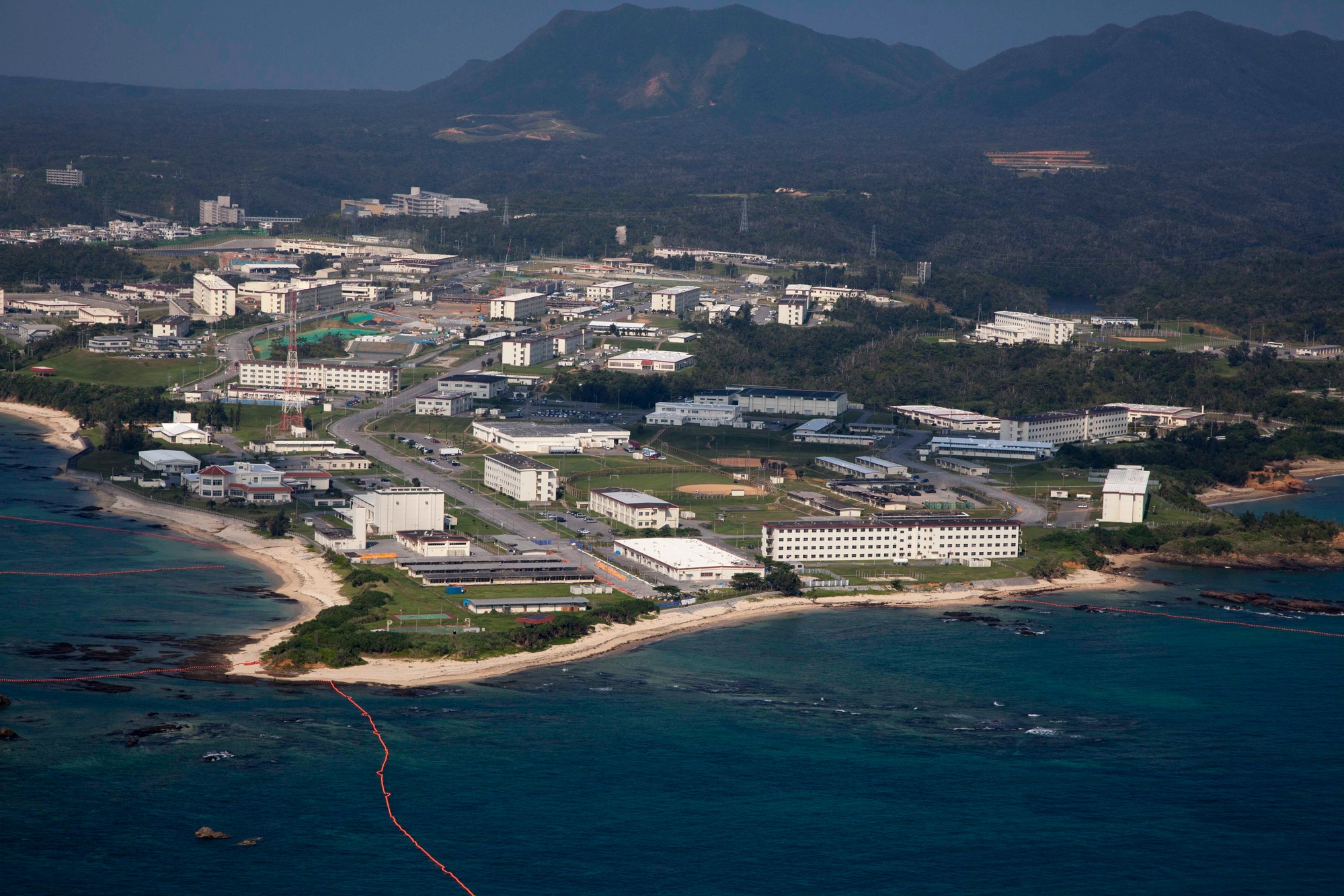
Camp Schwab sits up at Henoko, on Oura Bay in the city of Nago, about as far north as the Marine Corps goes on Okinawa. It is home to the 4th Marine Regiment, the only forward deployed infantry regiment in the Corps, along with reconnaissance and logistics units of the 3rd Marine Division, and it is the most politically watched piece of ground in Japan. The new airfield meant to replace MCAS Futenma is being built on reclaimed land right off Schwab's shoreline, a multibillion-dollar project sunk into a soft seabed that has drawn protesters to the gate and cameras to the bay for years. It is rugged, it is isolated, and the legal center and the courtrooms are an hour and more down the island to the south.
That distance does not put a Marine out of the military justice system's reach. Infantry Marines training hard at the far end of the island run into the UCMJ like Marines anywhere, and on Okinawa there is a second layer most never think about until it lands: an off base incident can put a Marine in front of the Japanese authorities at the same time the Corps is building a court martial. A case out of Camp Schwab is a fight for a career, a record, and sometimes freedom, and the only way to win it is to deny the prosecution the easy conviction it expects and force it to prove every element of what it has charged.
The Marine Behind the Schwab Name
Camp Schwab carries the name of a Marine who gave everything on this island. Private First Class Albert Ernest Schwab was a flamethrower operator with the 1st Battalion, 5th Marines, 1st Marine Division during the Battle of Okinawa. On May 7, 1945, with his company pinned in a valley and taking heavy casualties from a machine gun firing down from a ridge, Schwab climbed the face of that ridge alone, under fire the whole way, and destroyed the gun position with his flamethrower. When a second gun opened up on him, he pressed the attack with almost no fuel left and knocked that one out too, and he was mortally wounded by the last burst. He died that day, more than five weeks into a battle that would run for nearly three months, and the camp was named for him so the Marines who train on this ground would carry his name. He went up that ridge because the Marines below him could not move until he did, and that is the standard we bring to a fight with the military justice system.
Why Marines at Camp Schwab Fly Us In
This firm is on Okinawa year in and year out. Tim Bilecki built his practice trying cases across this island, working its commands from the crowded south to the remote northern camps for close to twenty years. From 2008 to 2010 Bilecki served as the Senior Defense Counsel for the Army's Trial Defense Service across the Pacific Rim, responsible for the defense of service members throughout Korea, Okinawa, and mainland Japan. That is the experience he brings to a Schwab case, and we know how one travels from the far north of the island down to the legal center in the south.
The military justice system is not in the business of finding the truth. It exists to preserve good order and discipline, and it does that through the public example, because one destroyed career keeps a thousand others in line whether the Marine was guilty or not. A serious case at Schwab is investigated by NCIS, and for sexual assault, domestic violence, and other covered offenses the decision to refer charges to a court martial no longer belongs to your command; it goes to an independent Special Trial Counsel in the Marine Corps Office of Special Trial Counsel. Under the U.S.-Japan Status of Forces Agreement the Japanese authorities hold the primary right to prosecute most off base offenses against Japanese nationals, and when prosecutors see that kind of counsel fly in, the easy conviction they were counting on is gone.
UCMJ Charges We Defend at Camp Schwab
The charges below are common at Camp Schwab, but our practice is not confined to them. We defend service members against any UCMJ offense.
Sexual Assault and Sex Offenses (UCMJ Article 120 / Article 134). The pressure on commands to show results on sexual misconduct has made the accusation itself do the work of proof, treated as settled before the investigation is finished, and when the evidence will not support a charge the command falls back on administrative separation. An allegation can be a weapon, used to retaliate against a former partner or to steer scrutiny away from the accuser, and a command bent on showing compliance is in no position to weigh those motives. These cases now run through an independent Special Trial Counsel, and they demand counsel who will investigate independently and contest the case early, before charges are preferred.
Okinawa is also the home of the NCIS online sting, the operation often likened to the old "To Catch a Predator" show, which has swept up Marines and Sailors across the island. An undercover agent runs an adults only profile, drops in a claim of being fourteen or fifteen only deep into a sexual chat, and makes an arrest at a controlled meeting at which there was never a child, leaving an attempt charge under Article 80 that requires specific intent and an act that goes beyond mere preparation. Entrapment and the gap between a fantasy exchange and real criminal intent are what win these cases. The firm took the first Okinawa sting ever tried to a full acquittal and has handled many more since with results that speak for themselves. We also examine compliance with Internet Crimes Against Children protocols for weaknesses in the investigation and the agents’ credibility. A protocol violation alone is not a legal defense; its significance depends on the charged offense, the evidence, and the applicable defense.
Fraud and Larceny (UCMJ Article 121). Overseas allowance rules are complicated, and a housing payment drawn against a dependent listed somewhere other than where they actually live, or a travel claim that does not reconcile, gets written up as deliberate fraud once an investigator decides it was. Intent to defraud is a required element, and the government has to prove you knowingly set out to cheat it, not merely that a number came out wrong. We handle BAH and OHA fraud, larceny, wrongful appropriation, and conspiracy to defraud cases, and we force the prosecution to prove the intent it likes to assume.
Domestic Violence and Assault (UCMJ Articles 128b and 128). These days domestic violence under Article 128b is one of the largest parts of what we defend, prosecuted with the weight of a sexual assault. Article 128b covers a spouse, an intimate partner, or a family member, and makes strangulation or suffocation a serious standalone charge even where nothing is visible. The federal Lautenberg Amendment then bars a Marine with a qualifying conviction from any firearm or ammunition, which can end a career. The Article 128 assault side is real work here too. Put hard-training infantry Marines together at the end of a long field problem and the occasional fight is no surprise, and on Okinawa a scuffle that involves a Japanese national becomes a serious matter fast, because the command does not want the diplomatic fallout, least of all from a base already under a microscope over Henoko. Who actually started it usually looks different once the night is reconstructed from the evidence rather than taken from whoever reached the authorities first. Self defense is a recognized defense, and we take on assault, aggravated assault, manslaughter, and murder cases.
Drug Offenses (UCMJ Article 112a). Japan enforces some of the strictest drug laws in the developed world, and that severity drives how the command treats any allegation here, where a substance brought onto the island or obtained off base can carry both a UCMJ charge and exposure to the Japanese system. A positive urinalysis is serious, but it does not end the fight. The chain of custody can be challenged, innocent ingestion is a recognized defense, and the government still has to prove that any use or possession was knowing and wrongful. These cases reward counsel who understands both the evidence and the host nation pressure shaping them.
Military Specific Offenses (UCMJ Articles 77 to 134). Unauthorized absence, dereliction, disrespect, false official statement, and fraternization get stacked onto a charge sheet to inflate the maximum punishment and the pressure to plead, and overseas commands file charges that would never surface stateside. Every specification still has to be proven beyond a reasonable doubt on its own, and the weak ones on an inflated charge sheet are the first to fall. We contest each charge rather than letting it inflate the government's leverage.
Even a Mistake at the Far End of Okinawa Deserves a Defense
Not every Marine who calls us is innocent, and we do not pretend otherwise. Some made a bad decision and know it. That does not mean accepting the worst the system can hand out, prosecuted by an institution eager to make their case a warning to everyone else. Whether you need a firm like ours turns on how serious the case is, not on your rank. If it is genuinely minor and does not call for a civilian trial lawyer, your free detailed defense counsel through the Defense Services Organization can handle it, and we will tell you so straight, because we do not take every case and we will not take a Marine's money for one that does not need us.
But when the case is serious, everything is on the line at once: your career, your retirement, your good name, and your freedom, and a Japanese prosecution that can run on top of the court martial. A court martial conviction is a federal criminal conviction. Under the sentencing rules now in force, a military judge sentences within set confinement parameters, with mandatory minimum punishments for the most serious offenses, so it can mean confinement a judge has little room to avoid, a punitive discharge that follows you for the rest of your life, and on a sex offense a place on a registry, whatever your rank. That is why you fight back, because the system expects you to fold.
If you are facing an investigation or court martial at Camp Schwab, reach out for a free defense strategy session. We will come to the far end of the island, tell you exactly what you are facing, and lay out how we would defend it. The investigation is already moving. The only question is whether you will have your own counsel moving on it.
Cases Connected to Camp Schwab
These cases include trials, hearings, investigations, and administrative matters. A connection to this location does not necessarily mean that the trial occurred here.
- Case connected to this location: E-6 Caught in Teen Sex Sting, Involved with Schoolgirl, Serves Less Than Year
FAQ
NCIS opened a sexual assault investigation on me at Camp Schwab. Should I talk to them?
Decline the interview and get counsel before you say a word. An NCIS interview is not your chance to clear things up; it is evidence collection, and under Article 31b of the UCMJ you have the right to stay silent and to a lawyer. Many of these allegations can be stopped during the investigation, before they ever reach trial, because a defense that engages early can get the command, or the independent Special Trial Counsel who decides covered offenses, to decline to prefer charges at all. Stationed out at the far end of the island, the temptation is to handle it yourself and get it over with, but that is exactly how a survivable case becomes a court martial. The move is to stay quiet, ask for a lawyer, and put a defense to work before that file is ever built.
My command is offering me NJP instead of a court martial. Should I just take it?
Not without advice, because accepting nonjudicial punishment carries consequences a lot of Marines underestimate. You generally have the right to refuse NJP and demand trial by court martial, and whether that is the smart move turns on how strong the evidence actually is, what the NJP would do to your record and your career, and what a court martial would really risk. Sometimes turning it down is the leverage that gets a weak case dropped; sometimes accepting is clearly the right call. The mistake is treating NJP as harmless and signing off without understanding what it forecloses. Talk to counsel before you accept, so you are choosing with the full picture instead of just making it go away.
A lot of what we do here is hard field training. How do training incidents, a negligent discharge, or a hazing allegation get handled?
They can go several ways, and the path matters. A training mishap, a negligent discharge, or a hazing allegation can be handled at nonjudicial punishment, through administrative action, or as a court martial, and a serious one can draw NCIS and, for a covered offense, the independent Special Trial Counsel. An accident is not automatically a crime, and these cases often turn on what the standard actually required, what was foreseeable, and whether anyone truly acted wrongfully rather than simply being closest when something went wrong. Getting counsel involved before you give a statement is what keeps a bad day in the field from being built into a criminal case.