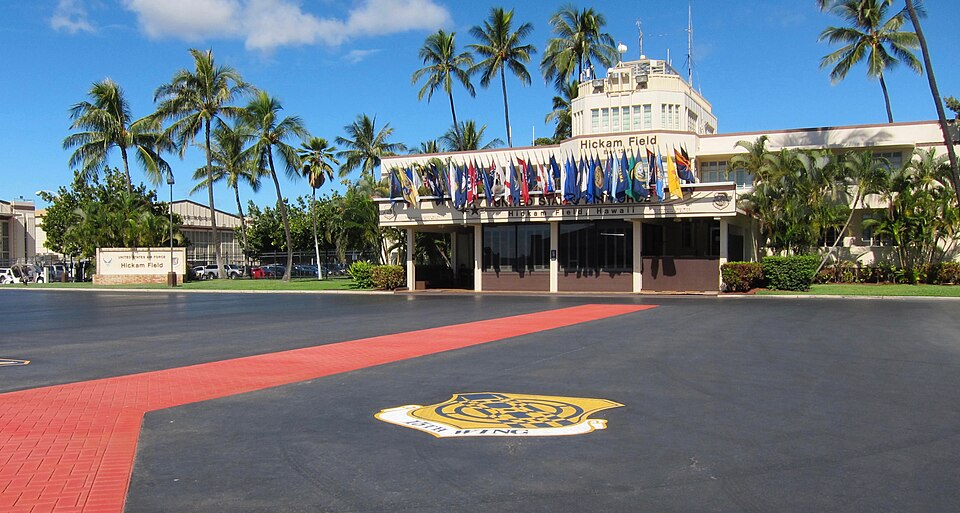
Hickam Field: The Home of Pacific Air Forces and the Air Component of Hawaii's Joint Base
On the edge of Pearl Harbor, joined to the Navy base as Joint Base Pearl Harbor-Hickam, the Hickam side is the heart of American air power in the Pacific. It is the headquarters of Pacific Air Forces, the command that runs Air Force operations across half the globe, the home of the 15th Wing and its airlift and command aircraft, and the home of the Hawaii Air National Guard's 154th Wing, whose 199th Fighter Squadron flies the F-22 Raptor as the "Hawaiian Raptors" alongside the active duty 19th Fighter Squadron. Its runways still carry the bullet scars of December 7, 1941. For an Airman stationed here, the prominence of the place cuts both ways, because a major command headquarters cannot be seen tolerating misconduct and it charges accordingly.
For this firm, Hickam sits on home ground. An Airman facing an investigation or court martial here is fighting for a career, a retirement, and sometimes freedom. The only way to win that fight is to deny the prosecution the easy conviction it expects and make it prove every element of what it has charged.
The Pilots Who Got Airborne and Fought Back
While Hickam Field burned on the morning of December 7, 1941, two young Army Air Forces pilots refused to be caught on the ground. Second Lieutenant George Welch and his wingman Kenneth Taylor drove through the attack to a small auxiliary strip at Haleiwa where their P-40 fighters were parked, took off straight into a sky full of Japanese aircraft, and waded in. Between them they shot down at least six enemy planes, Welch credited with four, landing under fire to rearm and going right back up. They were among the only American pilots to get airborne and fight that day, and Welch is generally credited with one of the first aerial victories of the Pacific war. Both were awarded the Distinguished Service Cross. They flew into a fight no one could have blamed them for sitting out, because the alternative was to do nothing while their airfield was destroyed, and that refusal to stay on the ground is the standard we bring to a fight at Hickam.
Why Airmen at Hickam Fly Us In
This firm's roots are in Honolulu, and so is a trial record built over nearly two decades on this island. Tim Bilecki founded Bilecki Law Group in Honolulu and ran it from the islands, winning full acquittals in contested courts martial across Oahu year after year. The firm is based in Tampa now, and Airmen fly Tim in from around the world for how he tries cases. Hawaii is home, and a case here is one the firm is glad to take. A government lawyer at Hickam who finds that kind of counsel on the other side knows the easy conviction is off the table.
The reason it matters is that the military justice system was not built to find the truth. It exists to preserve good order and discipline, and at a command headquarters it does that by making a public example of someone, because a ruined career reassures the leadership that the standard still has teeth. A serious case at Hickam is investigated by the Air Force Office of Special Investigations, and for sexual assault, domestic violence, and other covered offenses the decision to refer charges to a court martial no longer belongs to your command; it goes to an independent Special Trial Counsel in the Air Force's Office of the Special Trial Counsel. Your Area Defense Counsel can be capable and committed, but carries a heavy caseload inside the same system, which is why Airmen who are serious about the fight bring in their own counsel.
UCMJ Charges We Defend at Hickam
These reflect the cases we see most at Hickam. If your allegation is different, we still defend it, because we handle every UCMJ charge.
Sexual Assault and Sex Offenses (UCMJ Article 120 / Article 134). The Air Force runs its SAPR program at Hickam under intense institutional pressure. An allegation is often treated as established before the investigation is finished, and where the evidence will not support a charge, the command falls back on administrative discharge. Airmen have also learned that a complaint can redirect an investigation or settle a dormitory or relationship dispute, and a command focused on showing it takes every report seriously is in no position to weigh motive. These cases route to an independent Special Trial Counsel now, and for a rated officer or career enlisted aviator they carry the added threat of a Flying Evaluation Board, so they demand counsel who will investigate independently and contest the case early, before charges are preferred.
A serious and growing part of our Hawaii work is defending service members swept up in the online predator stings run on this island, the Operation Keiki Shield operations. These are joint stings. Military investigators from NCIS, Army CID, and the Air Force Office of Special Investigations work alongside the State's Internet Crimes Against Children task force. An agent poses online as a fourteen or fifteen year old, steers the conversation toward sex and a meeting, and arrests whoever shows up. There is usually no actual child, which means that under the UCMJ the charge is most often an attempt under Article 80 and it requires specific intent and an act that goes beyond mere preparation. We defend the court martial that comes out of these stings, and we have won them, with numerous full acquittals over the years. In one at Schofield, Tim argued entrapment and exposed agents who had used photographs of an adult to pose as a minor. The defenses are a mistake of fact as to age, where the person reasonably believed they were dealing with an adult; entrapment, where the government planted the idea in someone who was not predisposed to it. After the arrest, agents push hard for a written statement or an apology letter, because that is the fastest way to lock in their case. Do not give one, and if you already have, a statement taken under that kind of pressure can still be challenged. We also examine compliance with Internet Crimes Against Children protocols for weaknesses in the investigation and the agents’ credibility. A protocol violation alone is not a legal defense; its significance depends on the charged offense, the evidence, and the applicable defense.
Fraud and Larceny (UCMJ Article 121 / Article 107). Honolulu carries one of the highest housing allowance rates in the country, which makes BAH a target for auditors here. The typical case starts with an Airman drawing BAH set by a dependent's address, where an auditor later decides the dependent does not live where the paperwork says, or that a marriage or dependency claim does not hold up. Because the form is what authorizes the rate, the government charges it as larceny under Article 121 and as a false official statement under Article 107, the same paperwork serving as both the theft and the lie. The government still has to prove intent, and a finance office error, bad guidance, or a family whose living situation genuinely changed is not a scheme. We defend BAH fraud, travel and voucher fraud, larceny, wrongful appropriation, and conspiracy to defraud, and we win them on the paper trail and the intent the government would rather assume.
Domestic Violence and Assault (UCMJ Articles 128b and 128). Domestic violence under Article 128b has become one of the largest parts of our caseload, and a base with this many families stationed far from home sees a great deal of it. Since the Office of the Special Trial Counsel took these cases over it is charged as aggressively as any offense in the UCMJ. It covers a spouse, an intimate partner, or a family member, and makes strangulation or suffocation a separate, serious charge even when there is little or no visible injury. A qualifying conviction also triggers the federal Lautenberg firearms bar, which can end an Air Force career and is disqualifying for many career fields. We also defend assault under Article 128, including the off base fights the military can still prosecute under the UCMJ even when civilian police never filed a charge. Self defense is a recognized defense, and what actually happened often looks different from the first report once the evidence comes in.
Drug Offenses (UCMJ Article 112a). Hawaii has a longstanding problem with methamphetamine, and the drug cases the command worries about here are less about a single marijuana positive than about ice and other substances bought on the island. A positive urinalysis or a possession allegation is serious but not the end of the fight. The chain of custody can be challenged, innocent ingestion is a recognized defense, and the government still has to prove that any use or possession was knowing and wrongful. Get experienced counsel involved as early as you can, because the government works hardest to lock in its case at the very start.
Military Specific Offenses (UCMJ Articles 134, 92, and more). A lot of these charges start off duty, in Waikiki, in Chinatown, and on Hotel Street in Honolulu, where a bar fight, a DUI, or a drunk and disorderly under Article 134 follows an Airman back to the command. Others grow out of duty itself, from a failure to obey an order or regulation under Article 92 to the reliability and access concerns that come with a base full of sensitive missions. Stack an unauthorized absence under Article 86 and conduct unbecoming on top, and a single incident becomes a charge sheet built to inflate the punishment and the pressure to plead. Every specification still has to be proven beyond a reasonable doubt on its own, and the weak ones on an inflated charge sheet are the first to fall.
Even in Paradise, a Mistake Shouldn't End a Career
Not every Airman who calls us from Hawaii is innocent, and we do not pretend otherwise. Some made a bad decision and know it. That does not mean they have to accept the worst the system can hand out, prosecuted by an institution eager to turn one case into a warning for everyone else on the base. Rank does not decide whether you need a firm like ours; the seriousness of the case does. If a matter is genuinely minor, your Area Defense Counsel can handle it, and we will tell you so honestly, because we do not take every case and we will not take an Airman's money for one that does not need us.
But when the case is serious, everything is on the line at once: your career, your retirement, your good name, and your freedom. A court martial conviction is a federal criminal conviction. Under the sentencing rules now in force, it can mean confinement a judge has little discretion to avoid, a punitive discharge that follows you for life, and on a sex offense a place on a registry, no matter your rank. That is why you fight, and the system is counting on you not to.
If you are facing an investigation or court martial at Hickam, reach out for a free defense strategy session. We know this island, we know how these cases move here, and we will tell you exactly what you are facing and how we would defend it. The government is already building its case. The only question is whether anyone is building yours.
Cases Connected to Hickam Air Force Base
These cases include trials, hearings, investigations, and administrative matters. A connection to this location does not necessarily mean that the trial occurred here.
- Case connected to this location: Charges Not Preferred for Airman Accused of Sexual Assault by Ex-Girlfriend
- Case connected to this location: Airman Accused of 10K Theft Guilty of Stealing a Shirt, Stays with Air Force
- Case connected to this location: Air Force O-4 Facing 14 Years for Steroid Import Gets Reprimand
- Case connected to this location: Senior Airman’s Meth Charges Partly Dropped After Confession Suppressed
- Case connected to this location: Airman Faces Charges for MDMA and Cocaine, Bilecki Secures Pretrial Agreement
- Case connected to this location: Bilecki Reduces DFAS Debt by $187K for Air Force E-8 Facing BAH Charges
- Case connected to this location: No Charges Preferred for Airman in Sex Assault Case After Legal Battle
- Case connected to this location: No Jail Time for E-5 in Minor Sex Assault Due to Entrapment and Mistake of Fact
- Case connected to this location: Army SGT Caught in Child Sex Sting, Bilecki Negotiates Plea for Lesser Offense
FAQ
OSI wants to interview me at Hickam. Do I have to talk to them?
No, and not without counsel. The interview is not your chance to clear things up; it is evidence collection, and under Article 31b of the UCMJ you have the right to remain silent and to ask for a lawyer. For covered offenses like sexual assault, the decision to refer charges to a court martial no longer belongs to your command but to an independent Special Trial Counsel in the Air Force's Office of the Special Trial Counsel. OSI works for the command and the prosecution, not for you, so decline the interview, ask for counsel, and call a lawyer before you say anything.
Why hire Bilecki Law Group instead of a local attorney already on island?
We win court martial cases. Airmen fly us in from all over the world because military defense is all we do and our trial record proves it. We are not new to this island either: Bilecki Law Group was founded in Honolulu and defended courts martial across Oahu for more than a decade, so our national record comes with real knowledge of the Hawaii commands and how these cases move here.
Will an investigation affect my flying status or my access to the mission?
It can, on a track separate from the court martial. For a rated officer or career enlisted aviator, an allegation or investigation can trigger a Flying Evaluation Board, and you can be grounded while it runs; for Airmen in sensitive duties, the command can pull your access on the strength of an open investigation. Those consequences can land before any finding of guilt and can outlast the criminal case even if it never produces a conviction, so they have to be managed alongside the defense from the start rather than treated as an afterthought.
I was arrested in an Operation Keiki Shield sting. Is there a defense when I showed up to the meeting?
Yes. These cases turn on intent, and intent is fought over in the messages that came before the meeting, not in the fact that someone showed up. There is no real child in a sting, so the charge is usually an attempt under Article 80, and the government has to prove what you actually intended. The defenses we use are a mistake of fact as to age, where you reasonably believed you were dealing with an adult; entrapment, where investigators planted the idea in someone who was not predisposed to it. Do not give a statement or write an apology letter, and if you already have, one taken under that kind of pressure can still be challenged. We also examine compliance with Internet Crimes Against Children protocols for weaknesses in the investigation and the agents’ credibility. A protocol violation alone is not a legal defense; its significance depends on the charged offense, the evidence, and the applicable defense.