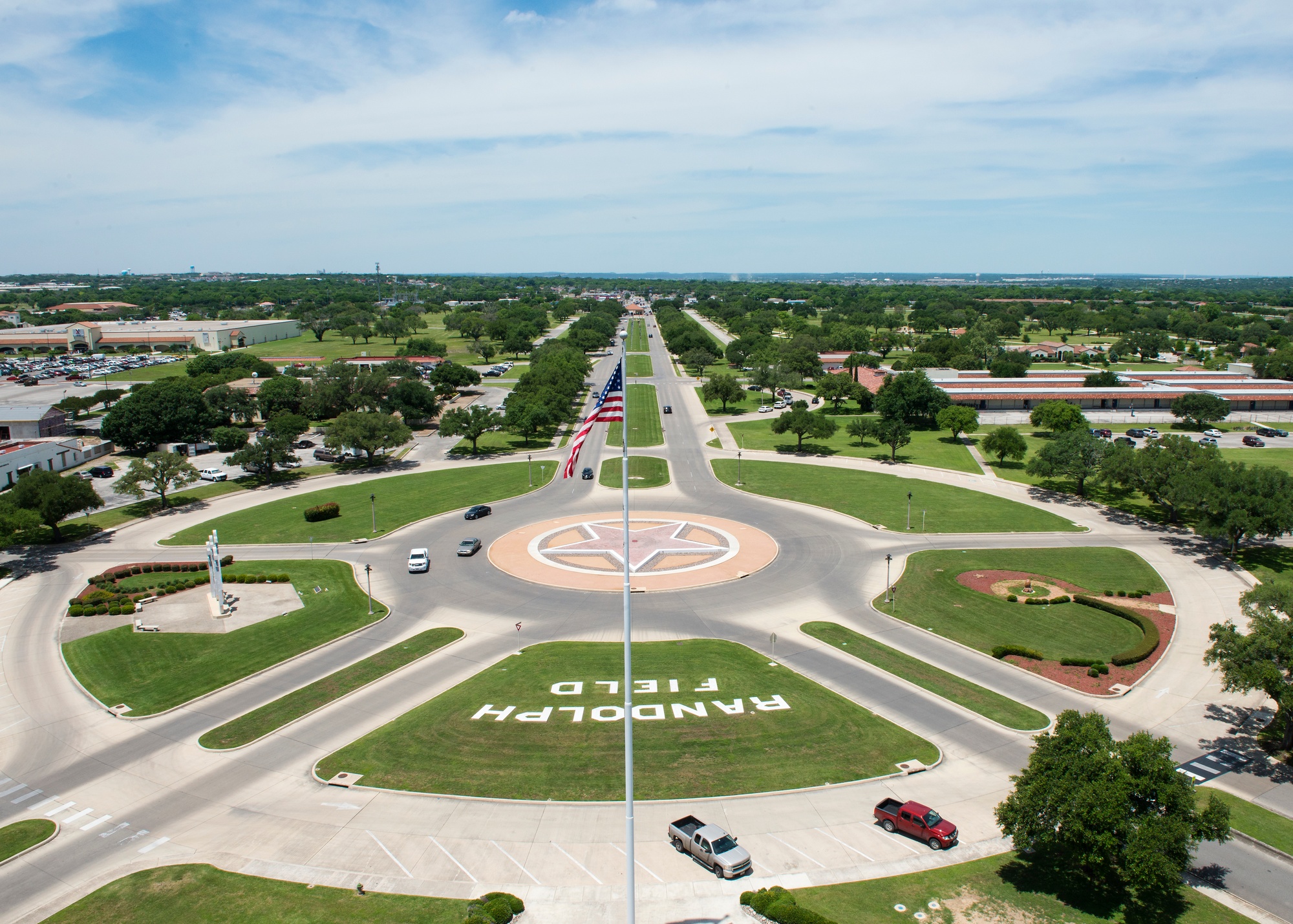
Joint Base San Antonio: Lackland, Randolph, and Fort Sam Houston
San Antonio is Military City USA, and Joint Base San Antonio is the reason. JBSA-Lackland runs the Air Force's only enlisted Basic Military Training, the front door every Airman walks through. JBSA-Randolph, the Showplace of the Air Force, runs pilot training and houses the Air Education and Training Command. And JBSA-Fort Sam Houston is the heart of Army medicine, home to Brooke Army Medical Center and the Medical Education and Training Campus where the enlisted medics of all the services are trained. Tens of thousands of trainees, students, instructors, and medical professionals move through these three posts, from recruits at Lackland on the southwest side to student pilots and families out near Randolph in Universal City and Schertz, with the River Walk, the Alamo, some of the best Tex-Mex in the country, and the long South Texas summer waiting off duty. A command responsible for the institution's training pipeline and its medical corps has every reason to make an example of someone who embarrasses it.
Military City USA has plenty of lawyers, and a recruit or an instructor facing charges will hear that local is the safe choice. It is not. A contested court martial is decided by the trial record of the lawyer who tries it, not by how close his office is to Lackland or Fort Sam. Military defense is all Bilecki Law Group does, and Airmen and Soldiers bring us in from Tampa for what we have done at trial.
The Pararescueman Who Would Not Leave
Joint Base San Antonio is an Air Force base at heart, and the Air Force standard was set by a pararescueman over a jungle in Vietnam. On April 11, 1966, near Cam My, Airman First Class William H. Pitsenbarger rode a hoist roughly a hundred feet down into a firefight to reach an Army infantry company that was being cut to pieces. He treated the wounded on the ground and organized their evacuation, and when the helicopter could have lifted him to safety, he waved it off and stayed. He kept working on the wounded, then picked up a rifle to help hold the perimeter, and he was killed doing it. The pararescue creed is that others may live, and he lived it to the end. That refusal to leave the wounded behind is the standard we bring to a case at San Antonio.
Why Airmen and Soldiers at San Antonio Bring Us In
We win court martial cases. Military defense is all we do, and service members fly us in from all over the country because of our trial record. The military justice system is not built to find the truth; it exists to preserve good order and discipline, and a command that runs the Air Force's entire enlisted training pipeline will make an example of someone to protect the institution's image. A serious case is investigated by the Air Force Office of Special Investigations, or by Army CID for a matter at Fort Sam Houston, and for sexual assault and other covered offenses the decision to refer charges to a court martial no longer belongs to your commander but goes to an independent Special Trial Counsel. The free counsel detailed to you, an Area Defense Counsel or an Army Trial Defense Service attorney, may be capable but carries a heavy caseload inside the same system, which is why those serious about winning bring in their own counsel.
UCMJ Charges We Defend at Joint Base San Antonio
These are the allegations we see most at Joint Base San Antonio. The full range of UCMJ charges is within what we defend, listed here or not.
Sexual Assault and Sex Offenses (UCMJ Article 120 / Article 134). These allegations route to an independent Special Trial Counsel now, and the command treats a report as established before the investigation is finished, all the more so in a training environment where word of an allegation travels fast and the command wants to look decisive. These cases demand counsel who will run an independent investigation and contest the case rather than let the allegation stand in for proof, because a conviction can mean confinement and a federal record, with registration required for a covered sex offense under the applicable federal and state law.
Domestic Violence and Assault (UCMJ Articles 128b and 128). Domestic violence under Article 128b is charged as aggressively as any offense in the UCMJ since the Office of Special Trial Counsel took these cases over. It covers a spouse, an intimate partner, or a family member, and it treats strangulation or suffocation as its own charge that the government can bring even with no visible injury. A qualifying conviction also triggers the federal Lautenberg firearms bar, which can end a military career because a service member has to be able to carry a weapon. We also defend assault under Article 128, the usual charge when a night out on the River Walk ends in a fight, where self defense is a recognized defense.
Trainee Maltreatment and Instructor Misconduct (UCMJ Articles 93 and 92). With basic military training and much of the Air Force's technical and medical training on one installation, the instructor and trainee line is enforced relentlessly here. The government charges maltreatment of a trainee under Article 93 and a violation of the no-contact and professional-relationship rules under Article 92, and a military training instructor can be charged on a trainee's complaint alone. The relationships are real, but the government must still show the maltreatment, the authority behind it, and a rule that was actually violated.
Drugs and Off Duty Conduct (UCMJ Articles 112a and 134). Drug cases often turn on the chain of custody and the government's burden to prove any use was knowing and wrongful. A trainee or a permanent party member is subject to the UCMJ off duty, so a night out in San Antonio that ends badly comes back to the command, and a positive urinalysis is one of the most common ways a young Airman's career comes apart. A positive test is evidence the government may use to argue knowing, wrongful use, not an automatic finding of guilt, so the collection, the chain of custody, and whether any use was knowing all remain the government's to prove, which is why these cases are more defensible than a lab result makes them look.
A Career and a Reputation Worth Defending
We do not pretend that every service member who calls us from San Antonio is innocent. What matters is how serious the case is, not your rank. If a matter is genuinely minor, the detailed defense counsel can handle it, and we will tell you so honestly. But when the case is serious, everything is on the line at once: your career, your retirement, your good name, and your freedom. A court martial conviction is a federal criminal conviction, and where the sentencing parameters apply, a judge sentences within a set confinement range, two and a half to ten years for sexual assault and ten to twenty for rape, and must state specific facts in writing to support a departure, along with any required or adjudged punitive discharge and, on a covered sex offense, sex offender registration. That is why you fight. The court’s jurisdiction and the convicted offense determine which sentencing rules apply; some offenses use separate sentencing criteria rather than these ranges.
If you are facing an investigation or court martial at Joint Base San Antonio, reach out for a free defense strategy session. We will tell you exactly what you are facing and how we would defend it. The government is already building its case. The only question is whether anyone is building yours.
Cases Connected to Joint Base San Antonio
These cases include trials, hearings, investigations, and administrative matters. A connection to this location does not necessarily mean that the trial occurred here.
- Case connected to this location: Bilecki Closes Larceny / BAH-OHA Fraud Court Martial Track on Army SGT at Camp Humphreys with GOMOR Only; No Preferral, No Court Martial
- Case connected to this location: Bilecki Closes Article 121 Larceny GCM on Army 1LT at Fort Sam Houston with Charges Withdrawn and Dismissed After Article 32
- Case connected to this location: Bilecki Holds Article 120 Abusive Sexual Contact Disposition at GOMOR for Newly Commissioned Army CPT; No Show Cause / BOI; No Court Martial
FAQ
OSI or CID wants to interview me at JBSA. Do I have to talk to them?
No. Whether it is the Air Force Office of Special Investigations or, at Fort Sam Houston, Army CID, you are not required to sit for the interview or answer their questions. Under Article 31b of the UCMJ you have the right to remain silent and to a lawyer, and you can invoke both at any point, including before the interview begins. They are collecting evidence, not giving you a chance to explain, and it takes very little to be titled as a subject, a label that follows you for years. Decline, ask for counsel, and call a defense lawyer before you give any statement.
I'm a Military Training Instructor accused of maltreating a trainee. What am I facing?
An Article 93 maltreatment charge, and at Lackland the command treats these cases as a threat to the entire training mission, so it investigates hard and charges aggressively. But Article 93 has real elements the government has to prove: that the trainee was subject to your orders, and that what you did was objectively cruel, abusive, or unwarranted, not the lawful, demanding training basic training is designed to be. The line between hard training and maltreatment is where these cases are won or contested, and if the allegation includes a sexual component it can add an Article 120 or 120c charge that raises the stakes enormously. Do not try to explain it to OSI; get your own counsel first.
What is an Article 32 hearing, and can it stop my case before trial?
An Article 32 is the preliminary hearing that must happen before a general court martial, and a strong defense there can keep a case from ever reaching trial. It is the first sworn look at the government's evidence, a chance to cross-examine its witnesses and expose what the case is really built on, and the hearing officer's report can push the command to withdraw the charges rather than refer them. We have done exactly that at Fort Sam Houston, where an Article 121 larceny general court martial was dismissed after the Article 32 hearing. The hearing is an opportunity, not a formality, and it should be litigated by counsel who will actually work it.
I'm a provider at Brooke Army Medical Center under an Article 120 investigation. Can it be kept out of court?
Sometimes, yes. The goal in a contested case is to defeat it at the investigation and the charging decision, before charges are ever preferred, which for a medical professional can be the difference between a career and a federal sex-offense conviction. We have done it here, holding an Article 120 allegation to a reprimand alone, with no court martial and no Board of Inquiry, so the provider kept practicing. A credentialing or clearance review can ride on the same allegation, which is one more reason to fight the underlying charge hard and early. Do not sit down with CID or OSI without your own lawyer.