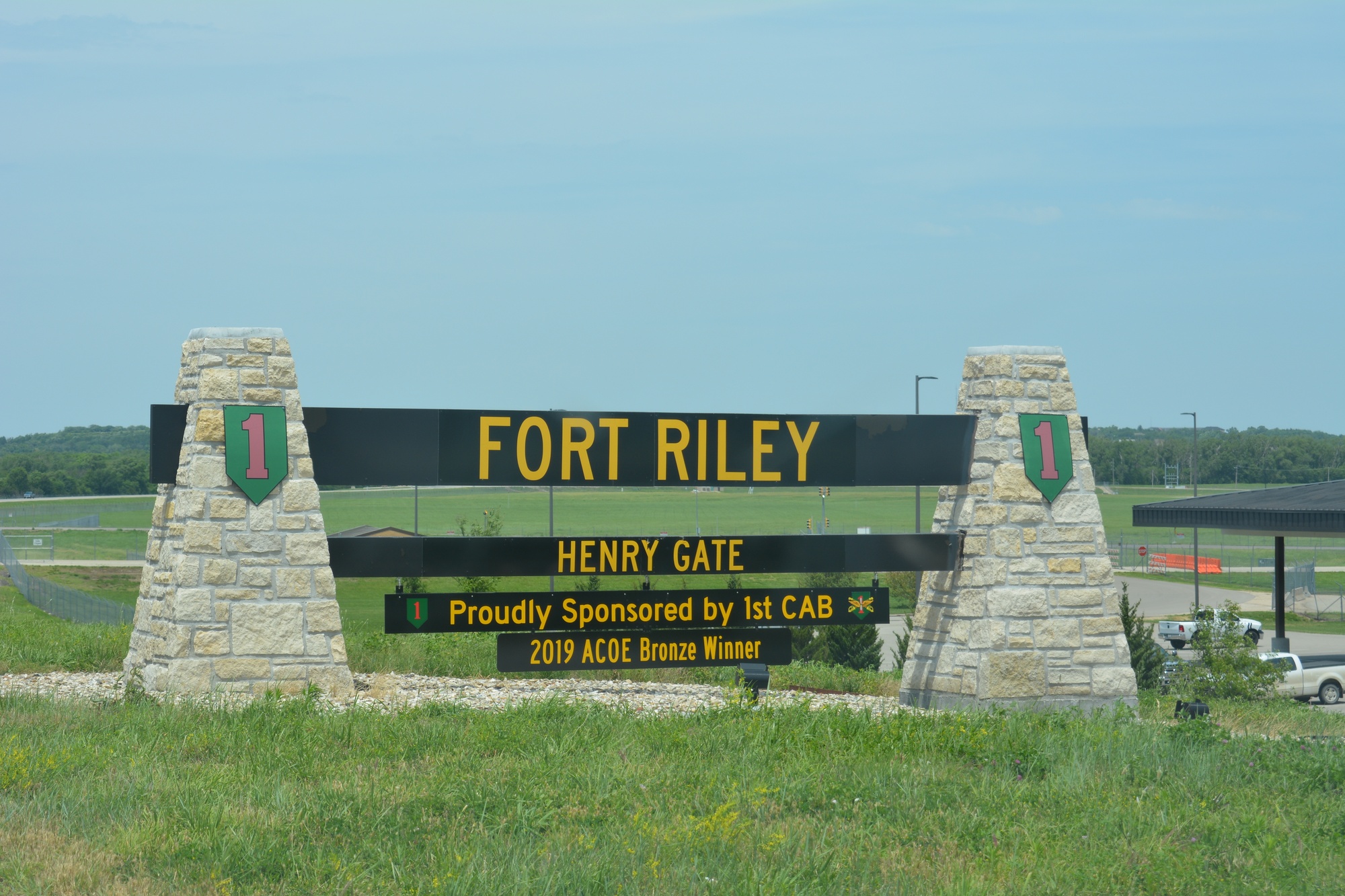
Fort Riley: Home of the 1st Infantry Division
On the Kansas prairie between Junction City and Manhattan, Fort Riley is the home of the 1st Infantry Division, the Big Red One, the Army's oldest continuously serving division. Some fifteen thousand Soldiers are stationed here in the tallgrass Flint Hills, with Manhattan, the Little Apple, and its Aggieville bar district by Kansas State the social hub, the prairie wind and big skies all around, and Kansas City about two hours east. It is a storied division on an open stretch of country, and a command that carries the history the Big Red One carries has every reason to make an example of a Soldier who steps wrong.
Military defense is all Bilecki Law Group does, and Soldiers fly us in from our office in Tampa because a contested court martial is decided by trial experience, and we bring it to Riley the same way we bring it anywhere.
The Lieutenant Who Led the Way off Omaha Beach
The Big Red One's standard was set on the deadliest beach of the war by First Lieutenant Jimmie W. Monteith. On June 6, 1944, on Omaha Beach, with his men pinned in the open and being cut to pieces, Monteith got them moving. He went back into the fire to organize the assault, then led two tanks on foot through a minefield to bring their guns to bear, and took the high ground beyond the beach. He held it, surrounded, until he was killed. He led the way off the beach when staying put meant dying on it. That willingness to stand up and lead when it costs the most is the standard we bring to a case at Riley.
Why Soldiers at Riley Bring Us In
We win court martial cases. Military defense is all we do, and Soldiers fly us in from all over the country because of our trial record. The military justice system is not built to find the truth; it exists to preserve good order and discipline, and a command that prizes its reputation the way this division does will make an example of a Soldier to keep the standard sharp. A serious case is investigated by Army CID, and for sexual assault and other covered offenses the decision to refer charges to a court martial no longer belongs to your command but goes to an independent Special Trial Counsel. Your Trial Defense Service counsel may be capable but carries a heavy caseload inside the same system, which is why Soldiers serious about winning bring in their own counsel.
UCMJ Charges We Defend at Fort Riley
We handle every type of court martial at Fort Riley. The charges below are the ones we see most, not the only ones we take.
Sexual Assault and Sex Offenses (UCMJ Article 120 / Article 134). These allegations route to an independent Special Trial Counsel now, and the command treats a report as established before the investigation is finished, all the more so in a tight unit where word of an allegation travels fast and the command wants to look decisive. These cases demand counsel who will run an independent investigation and contest the case rather than let the allegation stand in for proof, because a conviction can mean confinement and a federal record, with registration required for a covered sex offense under the applicable federal and state law.
Domestic Violence and Assault (UCMJ Articles 128b and 128). Domestic violence under Article 128b is charged as aggressively as any offense in the UCMJ since the Office of Special Trial Counsel took these cases over. It covers a spouse, an intimate partner, or a family member, and it treats strangulation or suffocation as its own charge that the government can bring even with no visible injury. A qualifying conviction also triggers the federal Lautenberg firearms bar, which can end an Army career because a Soldier has to be able to carry a weapon. We also defend assault under Article 128, the usual charge when a night out in Aggieville ends in a fight, where self defense is a recognized defense.
Larceny and Government Property (UCMJ Articles 121 and 108). An infantry division is issued a great deal of weapons, optics, night vision, and field gear, and accountability is taken seriously. The government treats missing gear, an item that cannot be reconciled, or property that walked off as larceny under Article 121 or wrongful disposition of military property under Article 108, but a shortage on a hand receipt is not the same as theft, and the government still has to prove the state of mind required by the charged offense: intent for larceny or fraud, or negligence where Article 108 permits it, not just that something cannot be found.
Drugs and Off Duty Conduct (UCMJ Articles 112a and 134). Drug cases often turn on the chain of custody and the government's burden to prove any use was knowing and wrongful. A Soldier is subject to the UCMJ off duty, so a night out in Manhattan or down in Kansas City that ends badly comes back to the command. A positive urinalysis is one of the most common ways a young Soldier's career comes apart, but a positive test is evidence the government may use to argue knowing, wrongful use, not an automatic finding of guilt, so the collection, the chain of custody, and whether any use was knowing all remain the government's to prove.
A Career and a Reputation Worth Defending
We do not pretend that every Soldier who calls us from Riley is innocent. What matters is how serious the case is, not your rank. If a matter is genuinely minor, your Trial Defense Service counsel can handle it, and we will tell you so honestly. But when the case is serious, everything is on the line at once: your career, your retirement, your good name, and your freedom. A court martial conviction is a federal criminal conviction, and the applicable sentencing parameters tie a confinement range to the offense, two and a half to ten years for sexual assault and ten to twenty for rape, that a judge can depart from only by stating specific facts in writing. It can also mean a punitive discharge and, for a covered sex offense, sex offender registration. That is why you fight. The court’s jurisdiction and the convicted offense determine which sentencing rules apply; some offenses use separate sentencing criteria rather than these ranges.
If you are facing an investigation or court martial at Fort Riley, reach out for a free defense strategy session. We will tell you exactly what you are facing and how we would defend it. The government is already building its case. The only question is whether anyone is building yours.
Cases Connected to Fort Riley
These cases include trials, hearings, investigations, and administrative matters. A connection to this location does not necessarily mean that the trial occurred here.
- Case connected to this location: Bilecki Closes Article 115 Communicating a Threat Investigation on Army First Lieutenant at Fort Riley After Sunday Night MP Detention; No Charges, No NJP, No GOMOR, No Officer Elimination, Officer Retained on Active Duty
- Case connected to this location: Bilecki Reduces Article 80 Attempted Article 120b GCM on Army SGT at Fort Riley to Single Article 134 Indecent Language SPCM Plea with No SORNA
- Case connected to this location: Bilecki's Strategic Engagement with CID Saves Soldier from Child Porn Charges
FAQ
Army CID wants to interview me at Riley. Do I have to talk to them?
No. You are not required to sit for a CID interview or answer their questions. Under Article 31b of the UCMJ you have the right to remain silent and to a lawyer, and you can invoke both at any point, including before the interview begins. CID is collecting evidence, not giving you a chance to explain, and it takes very little to be titled as a subject, a label that follows you for years. Decline, ask for counsel, and call a defense lawyer before you give any statement.
I'm facing an Article 120 or 120b allegation. Can it be kept off the sex offender registry?
Often, yes, and that is the whole objective, because registration requirements and duration depend on the covered conviction and the applicable federal and state law. The fight is to defeat the charge or reduce it to an offense that does not require registration. We have done exactly that at Riley, where an attempted Article 120b charge was reduced to a plea to indecent language with no sex offender registration. The earlier counsel is involved, the more room there is to steer a case off the registry, so do not wait and do not talk to CID first.
An investigation was opened over something I said or wrote. Can it really end my career?
It can, because the command can open a threat or communications investigation on very little and let it hang over you, and for an officer even an unfounded one can stall a career. But these are often built on thin evidence, and the answer is to get ahead of it. We have had them closed outright, including a threat investigation at Riley that ended with no charges and the officer retained. Do not try to talk your way out of it with CID; get counsel and force the investigation to prove what it actually has.