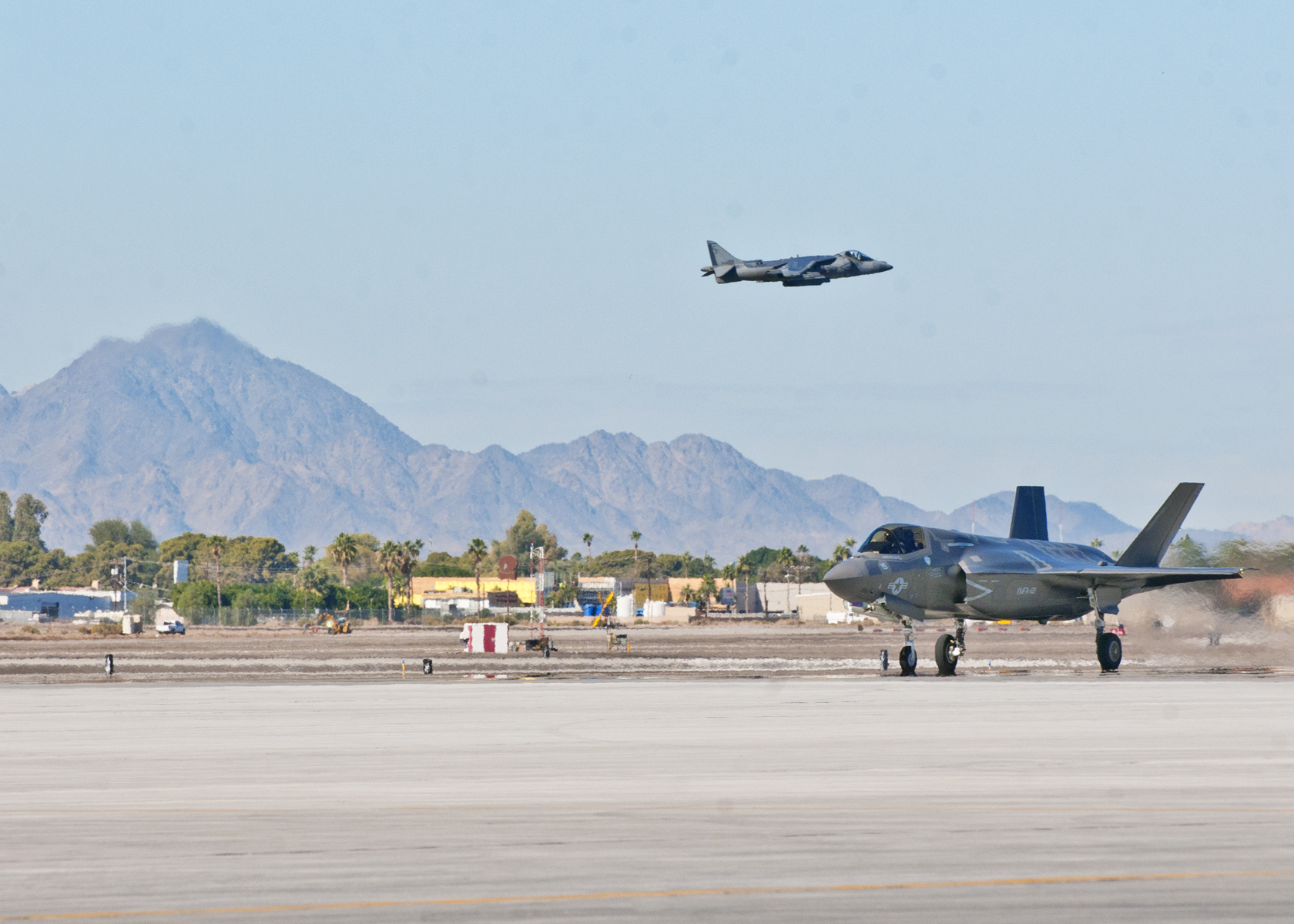
MCAS Yuma: Where Marine Aviation Sharpens Its Edge
There is a reason Marines talk about a Yuma summer the way they talk about a deployment. This stretch of Sonoran desert, near the Mexican border, runs past a hundred and seven in the shade under something like three hundred and fifty days of sun a year, and every winter the snowbirds roll in by the thousands and clog the town until spring. None of that slows the flying. Yuma is the busiest air station in the Marine Corps, sitting on millions of acres of range that carry the bulk of the Corps' air to ground training, and it is the home of Marine Aviation Weapons and Tactics Squadron One, the schoolhouse that turns out the Corps' Weapons and Tactics Instructors. The best aviators and ground Marines in the service cycle through here to be pushed to the limit.
That same intensity is why UCMJ trouble at Yuma is not rare. Put high performing, aggressive people in a hot, isolated, demanding place and decisions get made that a command can turn into a court martial. When that happens, a Marine at Yuma is in a fight for a career, a retirement, and sometimes freedom, and the only way to win it is to deny the prosecution the easy conviction it expects and make it prove every element it has charged.
The Black Sheep Still Fly Out of Yuma
The most famous squadron in Marine aviation calls Yuma home. VMFA-214, the Black Sheep, flies its F-35Bs out of this air station today, and the squadron earned its name the hard way. In the South Pacific in 1943, Major Gregory "Pappy" Boyington was handed a collection of castoffs and replacement pilots and forged them into one of the highest scoring outfits in the theater, running up fourteen kills of his own in a single thirty two day stretch. In January 1944 he was shot down over Rabaul, pulled from the water by a Japanese submarine, and spent the last twenty months of the war written off as dead in a prison camp. He came home to the Medal of Honor. The Black Sheep were the squadron nobody believed in until they started winning, and that is the fight we bring to Yuma: we take the case the government has already counted as a loss and we make it prove otherwise.
Why Yuma Marines End Up Facing the UCMJ
The conditions at Yuma that make it valuable also make it a place where careers run into the military justice system. The tempo is relentless, the desert is isolating, and the off duty options in a remote border town are limited, which is a documented recipe for the kind of incident that ends up in front of a command. And commands at a high visibility aviation installation are sensitive to anything that looks like a discipline problem, which pushes them toward formal action and administrative consequences even when the evidence is thin.
A serious case at Yuma is investigated by the Naval Criminal Investigative Service, which handles felony level matters for the Marine Corps. For sexual assault, domestic violence, and other covered offenses, the decision to refer charges to a court martial no longer belongs to your command. It goes to an independent Special Trial Counsel in the Department of the Navy Office of Special Trial Counsel. Tim Bilecki spent years inside the military justice system as a JAG defense counsel and then a Senior Defense Counsel before going civilian, and in more than twenty years since he has tried contested courts martial across the country and overseas, with his work recognized in national legal publications. When prosecutors at Yuma see that kind of counsel enter the case, the easy win they planned for is gone.
UCMJ Charges We Defend at MCAS Yuma
We defend every kind of military charge. The ones below are simply the most common at MCAS Yuma.
Sexual Assault and Sex Offenses (UCMJ Article 120 / Article 134). The Marine Corps Sexual Assault Prevention and Response program operates at Yuma under the same pressures that drive these prosecutions everywhere: commands under political pressure to demonstrate accountability, allegations treated as credible before the investigation is finished, and administrative action pursued even when the evidence will not support a charge. Service members have learned that an allegation can derail an investigation into the accuser's own conduct, retaliate against a former partner, or provide leverage in a dispute, and a command focused on showing compliance is not positioned to examine those motivations critically. These cases demand counsel willing to investigate independently and fight for every element the prosecution must prove.
Fraud and Larceny (UCMJ Article 121). Most of the Article 121 cases we see at Yuma begin as an administrative error rather than a scheme: a miscalculated BAH entitlement, an unreported change in status, a paperwork mistake an investigator decides to treat as criminal intent. Intent to defraud is a required element, and a great many of these cases collapse once the defense forces the prosecution to actually prove it. We handle BAH and OHA fraud, larceny, wrongful appropriation, extortion, and conspiracy to defraud the military.
Domestic Violence and Assault (UCMJ Articles 128b and 128). Domestic violence is now among the offenses we defend most, weighed by the Office of Special Trial Counsel like any covered offense. Article 128b covers a spouse, an intimate partner, or a family member, and makes strangulation or suffocation a distinct, serious charge regardless of visible injury. The consequence many Marines never see coming is the federal Lautenberg firearms bar, which a qualifying conviction triggers and which can end a career. The Article 128 assault charges are real too. Marines have been getting into off duty altercations for as long as there have been Marines, and most are handled quietly. The fights that produce Article 128 charges are the ones where someone got badly hurt, a weapon came into it, or the command wanted to send a message. The full sequence of who started it and who escalated usually looks very different once it is reconstructed rather than told by whoever reached investigators first. Self defense is a recognized defense, and we take assault, aggravated assault, manslaughter, and murder cases.
Drug Offenses (UCMJ Article 112a). Arizona legalized recreational marijuana in 2020, and that legal status means nothing under the UCMJ. A Marine at Yuma who uses marijuana legally off base as a civilian would can still test positive and face an Article 112a charge, and the easy availability just across the line in a legal state has produced positive tests among people who did not understand their exposure. These cases are still defensible, because the chain of custody can be challenged, innocent exposure is a recognized defense, and the government must still prove the use was knowing and wrongful, but they require counsel who understands both the science of testing and the elements the prosecution has to prove.
Military Specific Offenses (UCMJ Articles 77 to 134). No one finishes a Marine Corps career without brushing against the punitive articles, because the UCMJ is comprehensive and enforcement is selective. Charge stacking, filing multiple offenses to inflate the apparent severity, is common and built to pressure a plea. Every one of those charges has to be proven on its own, and made to carry that burden across the board, the prosecution often cannot hold them all.
How to Beat a Court Martial out of Yuma
When we say fight, we mean it. It comes down to how serious the case is, not how much rank you have. If it is a genuinely minor matter that does not need a civilian trial lawyer, your free detailed defense counsel at the Defense Services Organization can handle it, and we will tell you so, because we do not take every case and we are not in the business of charging a Marine for one a free counsel can do. But when it is serious, and the more time you have in the more there is to lose, the stakes run across all of it: your career, your retirement, your good name, and your freedom. A court martial conviction is a federal criminal conviction, and under the sentencing scheme now in force a judge works within established confinement parameters, with mandatory minimum punishments for the most serious offenses, so it can put you in confinement, saddle you with a punitive discharge for life, and on a sex offense land you on a sex offender registry, with far less room to avoid time behind bars than there used to be. That is why service members fly Bilecki in from all over rather than trust the outcome to whoever happens to be assigned. Even if you made a mistake, you fight for the best possible outcome.
The work is independent investigation, hard cross examination, and forcing the government to carry the burden it took on when it preferred charges, giving up nothing it has not actually proven. If you are facing an investigation or court martial at Yuma, reach out and we will tell you exactly what you are up against. We are based in Tampa, but the whole world is our area of operations, and the desert is no obstacle to a real defense.
Cases Connected to MCAS Yuma
These cases include trials, hearings, investigations, and administrative matters. A connection to this location does not necessarily mean that the trial occurred here.
- Case connected to this location: SSgt Charged with Sex Assault, Alcohol to Minors, Gets Best Possible Outcome
FAQ
I'm an aviator or a Marine going through WTI at MAWTS-1. What does a pending charge do to my training and my career?
It can stop both cold. An investigation or a preferred charge can get you pulled from flight status or removed from a course like Weapons and Tactics Instructor training, and it can trigger a flag that freezes promotions, schools, and assignments while it is in place, none of which waits for a finding of guilt. For an aviator or a Marine selected for the most demanding training the Corps offers, that interruption alone can be career altering. The early phase is where that damage is contained or not, which is why getting counsel engaged before the command locks in its narrative matters so much here.
Marines at Yuma cross into Mexico at Los Algodones all the time. What happens if I get into trouble across the border?
Crossing the line does not put you outside the reach of the UCMJ. A quick run to Los Algodones for cheap dental work or a night out is a Yuma tradition, but if something goes wrong down there, an incident, a substance, an arrest, you can face military consequences for off duty conduct in a foreign country, and you can face Mexican authorities on top of it, in a legal system that works nothing like ours. The cross border piece also makes the investigation messy, with evidence and witnesses on the other side of an international boundary. If you are in that situation, say nothing to investigators until you have counsel, because what looks like a simple bad night abroad can become a serious case fast.
NCIS wants to interview me at Yuma. Do I have to talk to them?
No, and not before you have a lawyer. NCIS works for the command and the prosecution, not for you, and under Article 31b of the UCMJ you can stay silent and ask for counsel before answering anything. The interview is evidence collection no matter how casual it is made to sound, and the first one usually shapes the whole case. For covered offenses like sexual assault, an independent Special Trial Counsel in the Department of the Navy, not your command, decides whether to refer charges to a court martial. Decline, ask for counsel, and call a lawyer before you say anything.