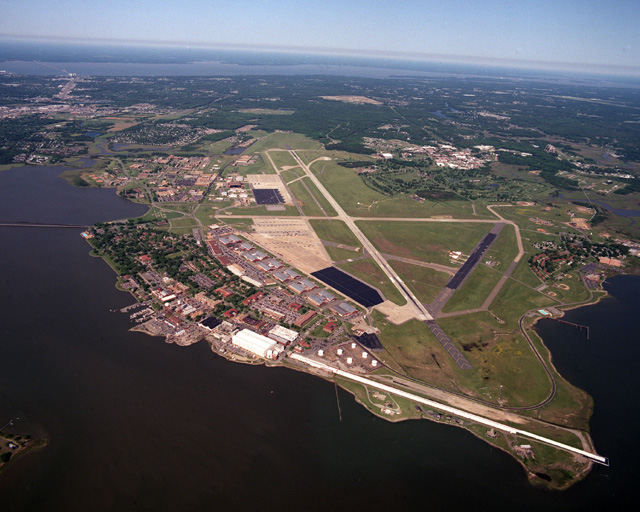
Joint Base Langley-Eustis: Where Military Justice Runs at High Volume
Virginia holds the second largest concentration of military personnel in the country, and that volume runs straight into the courtroom: more service members means more investigations, more charges, and more courts martial. Joint Base Langley-Eustis is a strange animal even by joint base standards, two posts seventeen miles apart on I-64 that share a name and little else. Langley, up in Hampton, flies the F-22 Raptor and trains the pilots who will fly it, and Fort Eustis, down in Newport News, is the former home of Army Training and Doctrine Command and still houses the schoolhouses that move the Army's people and equipment. An Airman and a Soldier on the same base can be an hour apart and living in different worlds, and all of it sits in the hurricane prone, brass heavy sprawl of Hampton Roads.
The military justice system treats convictions as a numbers game. It needs them to keep order and deter the next violation, and any service member will do, with innocence or guilt secondary to the institutional need for accountability. There is no shortage of defense attorneys in Tidewater. What separates effective counsel from the rest is the willingness to fight aggressively, take the cases others avoid, and deny the prosecution the easy conviction it is counting on.
They Court Martialed the Man Who Was Right
The most famous court martial in the history of American airpower started with an airplane that took off from Langley. In 1921, Brigadier General Billy Mitchell led bombers out of Langley Field and sent the captured battleship Ostfriesland to the bottom in about twenty minutes, proving that aircraft could sink the warships the Navy had called unsinkable. When the establishment brushed his warnings aside and aviators kept dying in preventable crashes, Mitchell said so in public, and in 1925 the Army court martialed him for insubordination before a panel of generals that included Douglas MacArthur. They convicted him, and he resigned. History vindicated him completely, and the airpower he fought for grew into the United States Air Force. The system once court martialed the man who turned out to be right. We make sure it has to prove its case against you.
Why Virginia's Military Justice Environment Is So Active
The density of military personnel in Virginia produces a court martial environment that runs at high volume and with institutional momentum, well resourced, experienced, and efficient at moving cases from investigation to conviction. Commands at Langley-Eustis know their decisions are visible to higher headquarters and that appearing to tolerate misconduct carries institutional risk, and that does not produce careful decision making. It produces more aggressive prosecution and more reliance on administrative action even when criminal charges cannot be sustained. From junior enlisted to senior officers, service members here face UCMJ trouble for conduct that would be handled informally at a lower profile installation.
Because Langley-Eustis is a joint base, a serious case is investigated by the Air Force Office of Special Investigations or by Army CID depending on your service. For sexual assault, domestic violence, and other covered offenses, the charging decision no longer belongs to your command. It goes to an independent Special Trial Counsel in your service's Office of Special Trial Counsel. Tim Bilecki learned this system from the inside, first as a JAG defense counsel and then as a Senior Defense Counsel, before going civilian. He is admitted before every military court and the Court of Appeals for the Armed Forces, and his trial work has been recognized nationally and covered by CNN, Fox News, and USA Today. When prosecutors at Langley-Eustis see retained civilian counsel enter a case, the easy path to conviction they expected disappears.
UCMJ Charges We Defend at Joint Base Langley-Eustis
The charges below are where most Joint Base Langley-Eustis cases start, not where our defense ends. Whatever you are facing under the UCMJ, we take it.
Sexual Assault and Sex Offenses (UCMJ Article 120 / Article 134). The military's sexual assault programs, SHARP for the Army at Fort Eustis and SAPR for the Air Force at Langley, operate with the same pressures that drive prosecution everywhere: commands under political pressure to show accountability, allegations treated as credible before the investigation is done, and administrative action pursued even when the evidence will not support a charge. Service members have also learned to weaponize an allegation to derail their own investigation, retaliate against a former partner, or gain leverage in a dispute, and commands under pressure to show compliance are not positioned to examine those motivations critically. You need counsel prepared to investigate independently and fight for every element the prosecution must prove.
Fraud and Larceny (UCMJ Article 121). BAH fraud charges are common here, and most begin with administrative error rather than criminal intent: a miscalculated entitlement, an unreported status change, a paperwork mistake that an investigator decides to call a scheme. Intent to defraud is a required element, and many Article 121 cases cannot survive once the defense forces the prosecution to prove it. We handle BAH and OHA fraud, larceny, wrongful appropriation, extortion, and conspiracy to defraud the military.
Domestic Violence and Assault (UCMJ Articles 128b and 128). On a joint base or anywhere else, domestic violence under Article 128b is now a major part of what we defend, prosecuted by each service's Special Trial Counsel with the weight of a covered offense. It reaches a spouse, an intimate partner, or a family member, and makes strangulation or suffocation a serious standalone charge even with no visible injury. A qualifying conviction triggers the federal Lautenberg firearms bar, which can end careers because a service member has to be able to carry a weapon. We also defend assault under Article 128. Service members have been getting into off duty altercations since the Continental Army, and most are handled quietly. The ones that become Article 128 charges usually involve a serious injury, a weapon of some kind, or a command that decided to make a point. The full sequence of who started it and who escalated usually looks very different once it is reconstructed rather than told by whoever reached investigators first. Self defense is a recognized defense, and we defend assault, aggravated assault, manslaughter, and murder charges.
Drug Offenses (UCMJ Article 112a). Virginia permits adult marijuana possession within statutory limits and allows medical use, and the national trend toward legalization creates a dangerous assumption that what is increasingly legal in civilian life must carry reduced military consequences. It does not. A positive urinalysis is serious but not the end of the fight, because the chain of custody is open to challenge, innocent ingestion is a recognized defense, and the law still requires proof that the use was knowing and wrongful. These cases require counsel who understands both the technical side of drug testing and the elements the prosecution must prove.
Military Specific Offenses (UCMJ Articles 77 to 134). No one completes a career without brushing against the punitive articles, because the UCMJ is comprehensive and enforcement is selective. Charge stacking, filing multiple offenses to inflate the apparent severity, is common and designed to pressure a plea. Each charge requires proof, and forced to carry the burden on every one, the prosecution frequently cannot sustain them all.
Get Ahead of the Case at Langley-Eustis
If you are facing an investigation or court martial at Joint Base Langley-Eustis, reach out for a free defense strategy session. We will go through what happened, tell you directly what is at stake, and show you how we would attack the case. Even if you made a mistake, you are still entitled to the best possible result, and the prosecution will never hand it to you. What is on the line is your career, your retirement, your good name, and your freedom, because a conviction is a federal criminal conviction. Under the sentencing rules now in force, it can carry confinement a judge has little discretion to avoid, a punitive discharge, and on a sex offense a place on a registry, whatever your rank.
Cases Connected to Joint Base Langley-Eustis
These cases include trials, hearings, investigations, and administrative matters. A connection to this location does not necessarily mean that the trial occurred here.
- Case connected to this location: The Army Took Two Shots. Bilecki Got the First GOMOR Destroyed and Stopped Permanent Filing of the Second
FAQ
Langley is Air Force and Eustis is Army. Which service handles my case?
It matters, and it depends on your service and your command. The investigating agency, the prosecuting office, and the sexual assault program all differ between the two, the Air Force Office of Special Investigations and SAPR on the Langley side, Army CID and SHARP on the Eustis side, with each service's own Office of Special Trial Counsel handling covered offenses. On a joint installation, questions about which command holds your case and under whose rules can get complicated, and those details shape your options. We work both sides of a joint base so the seams between the services never become a weakness in your defense.
I'm a student in one of the schools at Fort Eustis. What does a pending investigation do to my course and my follow-on assignment?
It can stall both. Fort Eustis is a training and doctrine hub, home to the Army's transportation and aviation logistics schoolhouses, and a Soldier under investigation can be held back, recycled, or removed from a course while the matter is open, with a flag that freezes your graduation, your follow-on assignment, and any favorable action. None of that waits for a finding of guilt, and time lost in a training pipeline is rarely recovered cleanly. The follow-on orders you were counting on can evaporate while the case drags. That is why the early phase matters so much, and why getting counsel engaged before you give a statement, while the command is still deciding what to do with you, can be what keeps the pipeline open.
I'm an instructor or aircrew at Langley-Eustis with a security clearance. What happens to my access during an investigation?
Your access can be suspended quickly, on a standard well below the criminal one. Langley is an ISR and Air Combat Command hub, and a great deal of the work runs on a clearance, so a command or security manager who learns of a serious allegation can suspend your access to classified information right away, which sidelines you from the job long before anything is proven. Revoking the clearance itself is a separate decision, made not by your command but by the Defense Counterintelligence and Security Agency under the National Security Adjudicative Guidelines; if it moves to revoke, you receive a Statement of Reasons setting out the concerns and a window to respond in writing before anything is final. Because that process feeds off what the investigation finds, the way to protect your clearance is to fight the underlying allegation early, not to treat the security review as a problem for later.