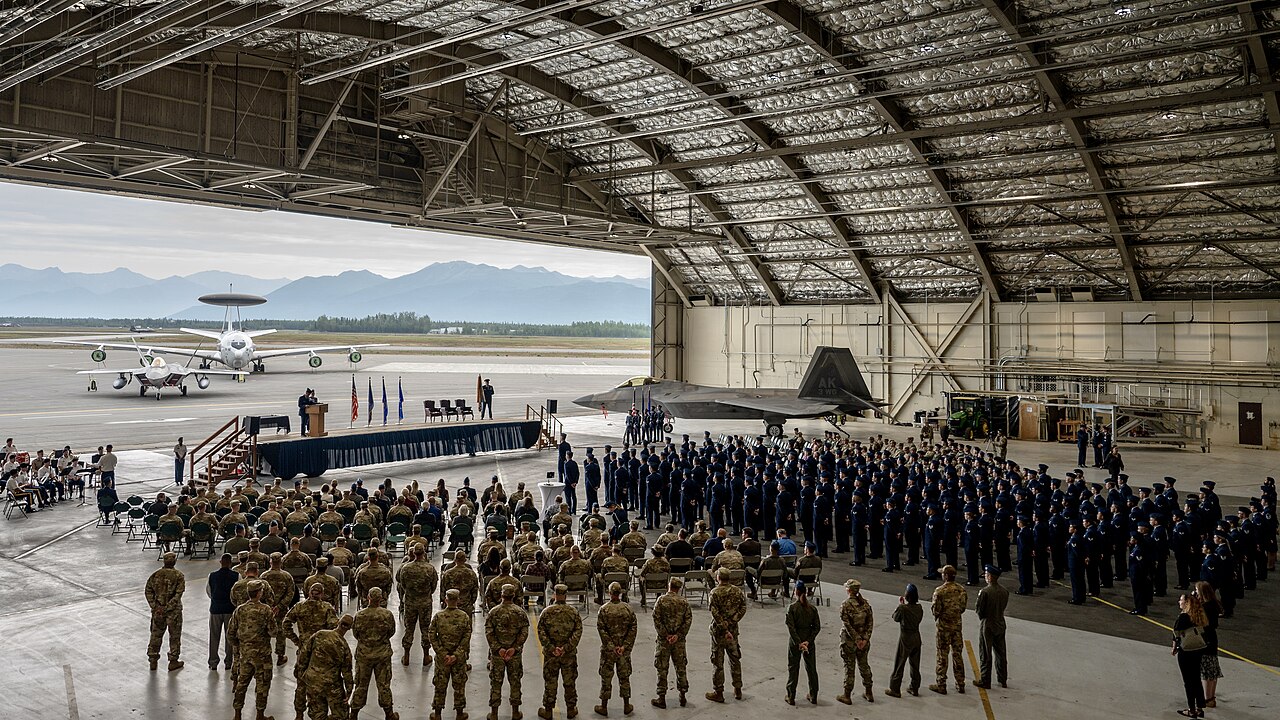
Joint Base Elmendorf-Richardson: The Hub of America's Arctic Defense
Joint Base Elmendorf-Richardson anchors Anchorage and the whole of America's defense in the Arctic. It is a true joint base, home to the Air Force's 3rd Wing and its F-22 Raptors that scramble to intercept Russian aircraft probing Alaskan airspace, and to the Army's 11th Airborne Division, the paratroopers who own the high latitudes. Thousands of Soldiers and Airmen draw an assignment here far from family, far from the lower 48, and far from the legal resources of more populated military markets.
Alaska duty comes with its own pressures. The isolation, the long winter nights, the limited outlets, and the demands of operating in an unforgiving environment all contribute to conduct that can run afoul of the UCMJ, and when it does, JBER's commands tend to respond aggressively. The pool of experienced military court martial counsel in Anchorage is small, which is exactly the situation the prosecution counts on.
The Angels' Most Famous Raid
JBER is the home of the 11th Airborne Division, the Arctic Angels, and the Angels earned that name on one unforgettable morning. On February 23, 1945, the 11th Airborne and Filipino guerrillas struck the Los Baños internment camp twenty miles behind Japanese lines and pulled out more than two thousand starving prisoners, by parachute, by amphibious tractor, and by sheer audacity, with almost no losses. General Colin Powell later called it the textbook airborne operation for all ages and all armies. The division reactivated here at JBER in 2022, and its Soldiers carry that legacy north today. We plan a case the way the Angels planned that raid, and we go in to win.
Why a Posting at JBER Raises UCMJ Exposure
Isolation is its own kind of pressure. Service members at JBER are thousands of miles from home in an environment where boredom, cold, and limited social outlets produce poor decisions faster than people expect, and the same conditions that make Alaska duty difficult make UCMJ trouble more likely. When that trouble surfaces, a remote command has fewer distractions and more bandwidth to focus on disciplinary matters, and it uses the UCMJ to keep order. Civilian legal options are limited, and many Soldiers and Airmen feel stuck with assigned JAG counsel who, capable as they are, work under structural constraints that civilian counsel do not.
Because JBER is a joint base, a serious case is investigated by Army CID or the Air Force Office of Special Investigations depending on your service. For sexual assault, domestic violence, and other covered offenses, the charging decision no longer belongs to your command. It goes to an independent Special Trial Counsel in your service's Office of Special Trial Counsel. Before he ever defended a service member as a civilian, Tim Bilecki served as an Army JAG defense counsel and then as a Senior Defense Counsel, and over two decades he has tried the cases other lawyers would not take. His closing arguments were published in the 2018 book Kick-Ass Closings. When prosecutors at JBER see that you have flown in that kind of counsel, the easy win they expected is gone.
Legal Marijuana in Alaska, Still Illegal Under the UCMJ
Alaska legalized recreational marijuana in 2014, and that legal status means nothing under the UCMJ. Federal law governs every Soldier and Airman, and marijuana remains a controlled substance regardless of Alaska law. A service member at JBER who uses marijuana legally off base can still test positive and face an Article 112a charge. The dispensaries around Anchorage and the normalization of use have produced positive tests among people who genuinely did not understand their exposure. These cases are defensible, because the chain of custody can be challenged and innocent exposure is recognized, but they require counsel who understands both the evidence and the elements the prosecution must prove, including its burden to show any use was knowing and wrongful.
UCMJ Charges We Defend at Joint Base Elmendorf-Richardson
We are not limited to the charges below. They are the most common at Joint Base Elmendorf-Richardson, and we defend the full range of UCMJ allegations.
Sexual Assault and Sex Offenses (UCMJ Article 120 / Article 134). The military's sexual assault programs, SHARP for the Army and SAPR for the Air Force, operate at JBER with the same pressures that drive prosecution everywhere, and the compressed social environment of a remote base makes them more volatile. Relationships form in tight units with limited outlets, and when they end badly the fallout plays out in a community with no anonymity. False allegations and allegations that misrepresent consensual encounters occur in these environments, and a service member under their own scrutiny knows a complaint can redirect attention. You need counsel who understands how those dynamics shape a case.
Fraud and Larceny (UCMJ Article 121). BAH fraud charges are common at JBER, and most begin with administrative error rather than criminal intent. Intent to defraud must be proven, not assumed, and many of these cases cannot survive once the defense forces the government to establish it. From BAH and OHA fraud to larceny, wrongful appropriation, and conspiracy to defraud, we defend the whole category.
Domestic Violence and Assault (UCMJ Articles 128b and 128). On a joint Army and Air Force base, domestic violence under Article 128b runs through each service's independent Special Trial Counsel, prosecuted as hard as a sexual assault, and it is now a major part of our caseload. It covers a spouse, an intimate partner, or a family member, and makes strangulation or suffocation a serious standalone charge even with no injury to show. A qualifying conviction triggers the federal Lautenberg firearms bar, which can end careers because a service member has to be able to carry a weapon. We also defend assault under Article 128. Put service members in a remote, stressful environment and the occasional fight is not a surprise. Most are handled informally. The ones that turn into Article 128 charges tend to involve a real injury, a weapon, or a command looking to set an example. Often the person charged was defending themselves or a friend. We defend everything from assault and aggravated assault to manslaughter and murder, including self defense.
Drug Offenses (UCMJ Article 112a). As above, Alaska's legalization creates specific exposure here, and beyond that the standard defenses apply: the chain of custody can be challenged, innocent exposure is recognized, the government must prove any use was knowing and wrongful, and the line between knowing possession and circumstantial contact is a factual question. A positive result opens a fight. It does not end one.
Military Specific Offenses (UCMJ Articles 77 to 134). Charge stacking is a prosecution tool designed to make a plea on one charge look rational when you are staring at five or six. Each requires proof, and when the defense addresses every one on its merits, the prosecution frequently cannot carry the burden it accepted. One mistake should not become six convictions through a deal built to look like mercy.
Get a Straight Read on Your JBER Case
If you are facing an investigation or court martial at Joint Base Elmendorf-Richardson, reach out for a free defense strategy session. We will listen, tell you honestly what the charges mean, and explain the defense we would build. We fly to Alaska. The map does not decide the quality of your defense, and neither does your rank, because a conviction is a federal criminal conviction. Under today's sentencing rules, it can carry confinement a judge cannot simply set aside, a punitive discharge, and on a covered sex offense sex offender registration, on top of a career, a retirement, and a good name. Your decision to fight does.
FAQ
I'm a paratrooper with the 11th Airborne facing an Article 128 charge from an off duty fight. What does that do to my jump status and my career?
Potentially a great deal, and fast. An investigation or a pending charge can get you pulled from jump status and flagged, which freezes promotions, schools, and assignments while it is in place, and for an airborne Soldier losing jump status is both a professional and a financial hit through jump pay. None of that waits for a finding of guilt. The early phase is where that damage is contained or not, which is why getting counsel engaged before the command locks in its narrative matters so much for a paratrooper's career.
JBER has both Army and Air Force. Does it matter which service investigates and charges me?
It matters. The investigating agency, the prosecuting office, and even the sexual assault program differ by service: Army CID and SHARP on the Army side, the Air Force Office of Special Investigations and SAPR on the Air Force side, with each service's own Office of Special Trial Counsel handling covered offenses. On a joint base, which command holds your case and under whose rules can get complicated, and those details shape your options. We work both sides of a joint installation, so the seams between the services do not become a weakness in your defense.
If I beat the court martial, can the Army still separate me or deny my reenlistment?
Yes, and it catches Soldiers off guard. Even after a court martial is dropped or you are acquitted, the command can still pursue administrative separation, a bar to reenlistment, or a flag on the same underlying allegation, under a far lower standard of proof. That is why a real defense does not stop at the criminal case. We fight the administrative track and the characterization of any discharge with the same intensity, because an adverse separation can cost you the benefits and the career you earned just as surely as a conviction.