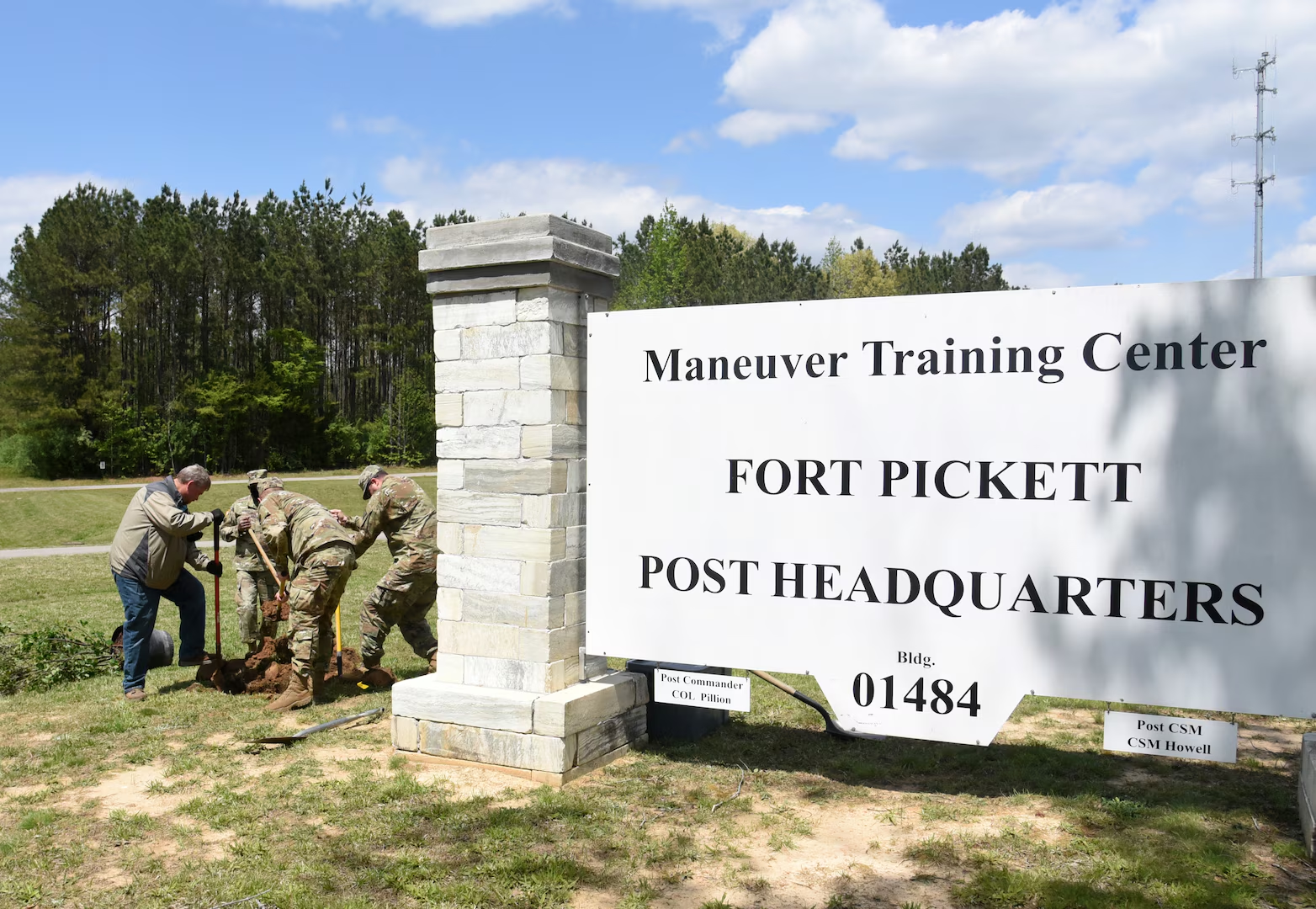
Fort Pickett: A Guard Training Ground in the Virginia Woods
Fort Pickett sits outside Blackstone, in the rural Southside country between Richmond and the North Carolina line, and it is not a typical active duty post. It is a Virginia Army National Guard installation, a forty two thousand acre maneuver training center built so units can come and train the way they will actually fight: live fire ranges, forward operating bases, urban assault sites, and mock villages spread across the pines. The Virginia Guard runs it, and active, Reserve, Guard, ROTC, and special operations units all cycle through to do the hard, realistic training a home station cannot support, then head home.
That transient, train-and-leave nature shapes everything about a UCMJ case here. The incident happened in the field, on a compressed training timeline, often involving a Guard installation, a visiting unit, and a home station hundreds of miles away, and untangling who has authority and where the case belongs is the first fight. A court martial connected to Fort Pickett is still a fight for a career, a retirement, and sometimes freedom, and the only way to win it is to deny the prosecution the easy conviction it expects and force it to prove every element of what it has charged.
The Soldier Fort Pickett Is Named For
Fort Pickett carries its old name again, attached now to a young infantry officer who earned it the hard way. First Lieutenant Vernon W. Pickett led a rifle platoon with the 137th Infantry in France in 1944, not long after the Normandy landings. Pinned down by enemy machine gun fire near Azelot, he crawled forward alone and knocked out two enemy positions with grenades, breaking the deadlock for his men. He was later captured, escaped, and made his way back to his own unit to keep fighting, and he was killed in action before the war was over. He received the Distinguished Service Cross for his valor. Pickett crawled straight into the guns because the job in front of him would not get done any other way, and that is the posture we bring to a fight with the military justice system.
Why Soldiers Fly Us In to Fight a Case Out of Fort Pickett
The military justice system does not exist to pursue truth and justice. It exists to maintain order and discipline, and it does that by making an example of someone, because a conviction keeps the rest of the force in line whether the accused was guilty or not. Military prosecutors run a high conviction rate, and the rules are built to favor them. If you play the game by their rules you will lose, and the system is counting on you not knowing the difference until it is too late.
A serious case connected to Fort Pickett is investigated by Army CID, and for sexual assault, domestic violence, and other covered offenses, the decision to refer charges to a court martial does not belong to your command. It goes to an independent Special Trial Counsel in the Army's Office of Special Trial Counsel. Tim Bilecki spent years inside that system as an Army JAG defense counsel and then a Senior Defense Counsel before going civilian, and he has defended active, Reserve, and National Guard Soldiers across the country and around the world. When prosecutors see that kind of counsel enter a case, the easy win they were counting on disappears.
UCMJ Charges We Defend at Fort Pickett
The charges below are where most Fort Pickett cases start, not where our defense ends. Whatever you are facing under the UCMJ, we take it.
Sexual Assault and Sex Offenses (UCMJ Article 120 / Article 134). The Army runs its Sexual Harassment/Assault Response and Prevention program under enormous political pressure, and the result has been a climate where a rumor is enough to end a career, guilt is presumed from the start, and the command will pursue administrative separation even when it cannot prefer charges. Soldiers have also learned to weaponize an allegation, to retaliate against a former partner or to derail an investigation into their own conduct, and a command focused on showing compliance is not positioned to weigh those motivations. For a Guard or Reserve Soldier, an allegation tied to a training period can follow you home and threaten a civilian life too. If you are being investigated, your guilt is presumed, and you will have to fight hard for the truth to come out.
Fraud and Larceny (UCMJ Article 121). Many Article 121 charges trace back to a misunderstanding or an administrative error rather than a crime, and the pay and entitlement rules are even easier to get wrong for Guard and Reserve Soldiers moving between statuses and duty periods. Intent to defraud is a required element, and the government has to prove you knowingly set out to cheat it, not merely that you were overpaid. A great many of these cases do not survive once the defense forces that burden. We handle BAH and OHA fraud, larceny, wrongful appropriation, extortion, and conspiracy to defraud the military.
Domestic Violence and Assault (UCMJ Articles 128b and 128). Domestic violence under Article 128b is now a major part of our caseload, charged by an independent Special Trial Counsel and treated as seriously as any covered offense. It applies to a spouse, an intimate partner, or a family member, and makes strangulation or suffocation a distinct, serious charge even with no visible injury. A qualifying conviction carries the federal Lautenberg firearms bar, potentially career ending for a Soldier required to carry a weapon. Plain Article 128 assault remains part of the caseload. Bring units together for hard field training, add long days and the release that follows, and the occasional off duty fight is no surprise. Most should never reach a courtroom. The charges escalate when more than one person joins in or a weapon turns up, and the command comes down hard when a civilian gets hurt or when it wants to send a message to a visiting unit. Once the night is actually reconstructed, who started it and who escalated often looks nothing like the account the first person gave investigators. Self defense is a recognized defense, and we handle assault, aggravated assault, manslaughter, and murder cases.
Drug Offenses (UCMJ Article 112a). A positive urinalysis is serious, but it does not end the fight. The chain of custody on a sample has documented gaps, innocent exposure is a recognized defense for some substances, and whether possession was knowing rather than incidental is a fact the government has to prove, not assume. These cases reward counsel who understands both the testing science and the elements the prosecution must establish, and there is usually more behind a hot sample than an investigator's first assumption.
Military Specific Offenses (UCMJ Articles 77 to 134). Fraternization, unauthorized absence, disobeying a lawful order, dereliction of duty, and the rest of the punitive articles have no civilian equivalent, and they get enforced unevenly from one command to the next. Charge stacking is meant to inflate the maximum punishment and pressure a plea, and a single training-period mistake can be broken into several charges. Every charge has to be proven on its own, and when the defense makes the government carry that burden across the board, the full stack rarely holds up.
One Mistake in Southside Virginia Isn't the Whole Story
Some Soldiers find a page like this already knowing they crossed a line. Whether you need a firm like ours turns on how serious the case is, not on your rank. If it is genuinely minor and does not call for a civilian trial lawyer, your free Trial Defense Service counsel can handle it, and we will tell you so, because we do not chase every case, and we will not charge you for one your free counsel can handle. But when the case is serious, and the longer you have served the more you stand to lose, it is all on the line for active and Guard Soldiers alike: your career, your retirement, your good name, and your freedom, and for a Guard or Reserve Soldier a civilian career back home on top of it. A court martial conviction is a federal criminal conviction, and where the sentencing parameters apply a judge sentences within set confinement ranges, with mandatory minimum punishments for the most serious offenses, so it can mean confinement under the applicable sentencing rules, a punitive discharge that follows you for life, and on a covered sex offense sex offender registration, no matter how junior you are. It is worth fighting for, because investigators lose cases through their own mistakes and prosecutors run thin cases on the bet that nobody will push back. The court’s jurisdiction and the convicted offense determine which sentencing rules apply; some offenses use separate sentencing criteria rather than these ranges.
If you are facing an investigation or court martial connected to Fort Pickett, reach out for a free defense strategy session. We will tell you exactly what you are facing and how we would defend it. Do not let the prosecution think it has an easy win. Get ready for a fight, and get us into it on your behalf.
FAQ
Fort Pickett is a Virginia National Guard installation, not a regular active duty post. Does that change who has authority over my case?
It can complicate it, which is exactly why it is worth sorting out early. The installation is run by the Virginia Army National Guard, but the authority over you in a UCMJ case turns on your own status and chain of command, not on who owns the gate. An active duty Soldier training here answers to the federal active duty chain, a Guard or Reserve Soldier's authority depends on whether they are on Title 10 federal orders or Title 32 or state duty, and the installation, the visiting unit, and the home station can all have a role. Those layers are easy to get wrong and easy for the prosecution to use, so getting counsel to map the jurisdiction early can change where your case is heard and what is even on the table.
I'm active duty and I only came to Pickett for a training rotation. Does being on a Guard post change anything for me?
Not as much as people fear, but the practical seams are real. Your federal active duty chain of command generally keeps authority over you, and the case usually follows you back to your home station even though the alleged conduct happened on a Guard installation in the Virginia woods. What changes is the logistics: the investigation starts here, the witnesses scatter back to home stations across the country when the rotation ends, and the record can be built by whoever was still around to talk to. A defense that moves fast, locks down witnesses before they disperse, and keeps the case from being shaped in your absence is what protects you, and that is the work we do.
Something went wrong on a live fire range or in a training accident. Can that really turn into a UCMJ charge?
It can, and these are some of the hardest cases, because a tragedy in training looks for someone to blame. A serious range incident or training mishap can lead to charges like dereliction of duty, negligent homicide, or involuntary manslaughter, often aimed at whoever was in charge or running the range, and the investigation tends to start from the assumption that someone broke a rule. But an accident is not automatically a crime. These cases turn on what the standard of care actually was, what the regulations and the range procedures required, what was reasonably foreseeable, and whether any failure rose to the level of criminal negligence. We bring in the right expertise to reconstruct what happened and hold the government to that line, rather than letting a terrible outcome stand in for proof of a crime.