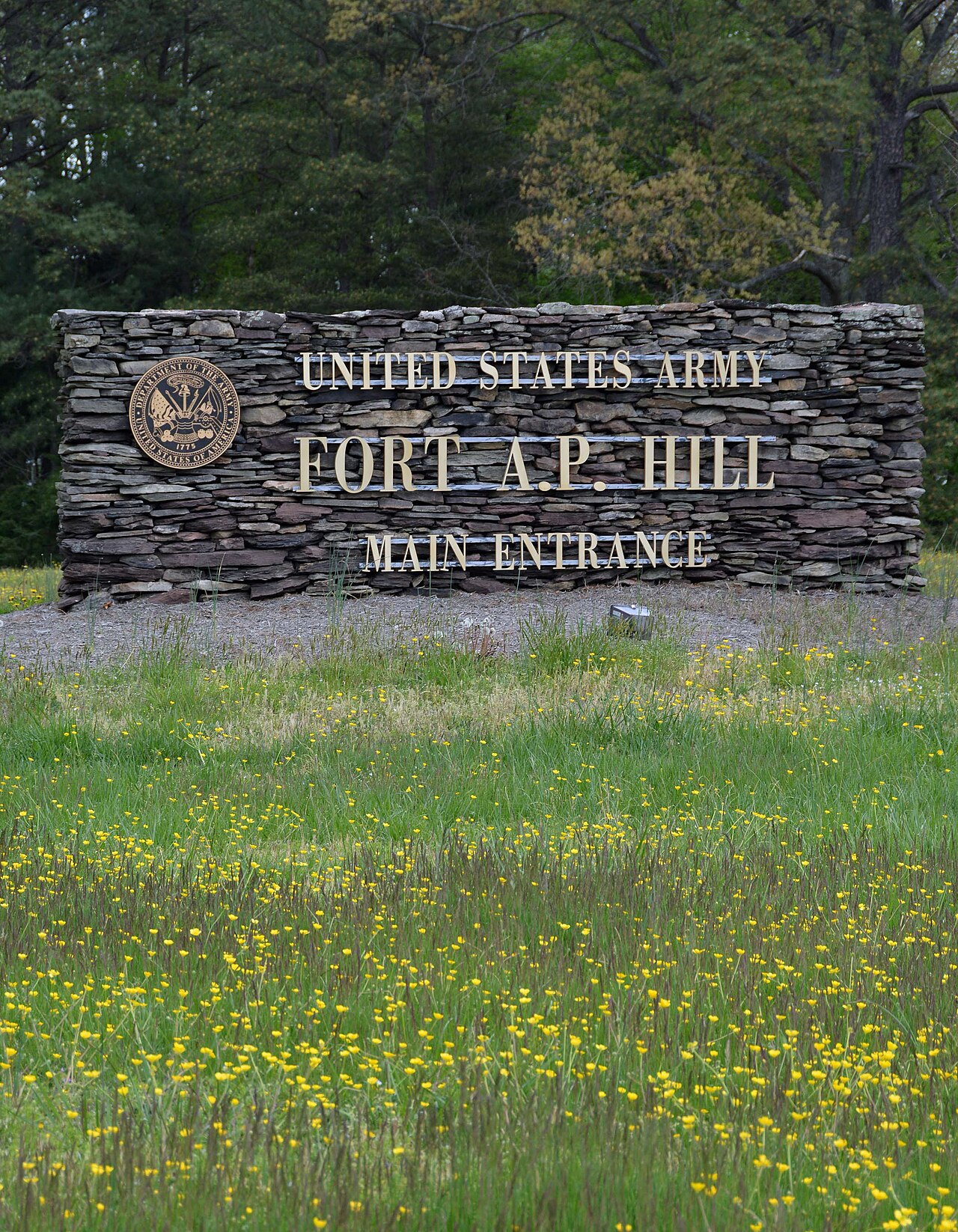
Fort A.P. Hill: A Training Ground, Not a Hometown
Most Soldiers do not get stationed at Fort A.P. Hill. They get sent here. Spread across some seventy six thousand acres of Caroline County between Fredericksburg and Richmond, A.P. Hill is a maneuver and training reservation, a place of ranges, drop zones, and mock towns where active, Reserve, Guard, and ROTC units roll in for a field problem, live in the Virginia woods with the ticks and the chiggers and the summer heat, train hard, and roll back out. There is no big permanent party population and no real strip outside the gate, just the pines, the ranges, and whatever your unit hauled in with it.
That transient nature shapes everything about a UCMJ case here. The thing that went wrong happened in the field, on someone else's training schedule, and by the time anyone sorts it out half the witnesses have redeployed to home stations across the country. A court martial connected to A.P. Hill is still a fight for a career, a retirement, and sometimes freedom, and the only way to win it is to deny the prosecution the easy conviction it expects and force it to prove every element of what it has charged.
The Three Soldiers This Post Is Named For
For more than eighty years this post carried the name of a Confederate general. It keeps the same initials now, but they stand for three very different men. Fort Anderson-Pinn-Hill, shortened to A.P. Hill, honors three Union Soldiers who each earned the Medal of Honor in the Civil War. Private Bruce Anderson served in the 142nd New York Infantry, and First Sergeant Robert A. Pinn served in the U.S. Colored Troops. Both were Black Soldiers who fought for a country that had not yet decided to treat them as equals, Pinn at Chaffin's Farm in Virginia and Anderson in the assault on Fort Fisher in North Carolina. Lieutenant Colonel Edward Hill earned his at Cold Harbor. Three men, three brutal fights, one nation's highest award for valor, and a name chosen so the post could keep its initials while standing for the right thing. They took the hardest fights of their war and would not be turned back, and that is the standard we bring to a fight with the military justice system.
Why Soldiers Fly Us In to Fight a Case Out of A.P. Hill
The military justice system does not exist to pursue truth and justice. It exists to maintain order and discipline, and to do that it has to make a public example of someone, because a conviction keeps the rest of the force in line whether the accused was guilty or not. Military prosecutors run a high conviction rate, and the rules are built to favor them. If you play the game by their rules you will lose, and the system counts on you not knowing that until it is too late.
A serious case connected to A.P. Hill is investigated by Army CID, and for sexual assault, domestic violence, and other covered offenses, the decision to refer charges to a court martial does not belong to your command. It goes to an independent Special Trial Counsel in the Army's Office of Special Trial Counsel. Tim Bilecki spent years inside that system as an Army JAG defense counsel and then a Senior Defense Counsel before going civilian, and Soldiers fly him in from around the world because he is a brawler who knows how to win at trial. When prosecutors see that kind of counsel enter a case, the easy win they were counting on disappears.
UCMJ Charges We Defend at Fort A.P. Hill
Whatever you have been accused of under the UCMJ, we defend it. The list below just reflects the charges we see most at Fort A.P. Hill.
Sexual Assault and Sex Offenses (UCMJ Article 120 / Article 134). The Army runs its Sexual Harassment/Assault Response and Prevention program under enormous political pressure, and the result has been a climate where a rumor is enough to end a career, guilt is presumed from the start, and the command will pursue administrative separation even when it cannot prefer charges. Soldiers and spouses have learned to weaponize an allegation, to retaliate against a cheating partner or to derail an investigation into their own conduct, and a command focused on showing compliance is not positioned to weigh those motivations. If you are being investigated, understand that your guilt is presumed, and you will have to fight hard for the truth to come out.
Fraud and Larceny (UCMJ Article 121). Many Article 121 charges trace back to a misunderstanding or an administrative error, and yet investigators will act as if they caught you running guns to Mexico. Intent to defraud is a required element, and the government has to prove you knowingly set out to cheat it, not merely that an overpayment happened. A great many of these cases do not survive once the defense forces that burden. BAH and OHA fraud, larceny, wrongful appropriation, extortion, conspiracy to defraud, we defend the whole category.
Domestic Violence and Assault (UCMJ Articles 128b and 128). Domestic violence has become one of the biggest parts of what we defend, and since OSTC assumed these cases the Army prosecutes them as hard as any offense in the UCMJ. Article 128b covers violence against a spouse, intimate partner, or family member and makes strangulation or suffocation its own charge regardless of visible injury. A qualifying conviction triggers the Lautenberg firearms ban, and a Soldier who cannot carry a weapon faces serious career consequences. We also take the plain Article 128 assault cases. The three Soldiers this post honors had one thing in common: they took the fight to the enemy and did not flinch. The Army still needs Soldiers like that, and a routine off duty scrap should not end a career. The trouble starts when more than one person piles on or a weapon comes into play, even an improvised one, and the charges escalate fast, especially when a civilian is involved. The real sequence usually looks very different once the evidence comes in. Self defense is a recognized defense, and we represent Soldiers on assault, aggravated assault, manslaughter, and murder charges.
Drug Offenses (UCMJ Article 112a). A positive urinalysis is serious, but it is not a conviction. The chain of custody is seldom as airtight as the report suggests, innocent exposure is a recognized defense for some substances, the knowing-and-wrongful element is the government's burden, and the difference between knowing possession and incidental contact is a question of fact, not an assumption. These cases demand counsel fluent in both the testing science and the elements the prosecution has to establish.
Military Specific Offenses (UCMJ Articles 77 to 134). Fraternization, unauthorized absence, disobeying a lawful order, conduct unbecoming, and the rest of the punitive articles are the Army's catch all for discipline, and prosecutors use them to pile on charges for maximum impact. Some of these are serious and some are plainly silly, the kind that would never have surfaced under a different command. Each charge has to be proven on its own merits, and once the government is forced to do that across every count, the stack tends to fall apart.
A Mistake in the Field Doesn't Have to End Your Career
If you are reading this, you may be carrying shame and fear because you believe you violated the UCMJ. Do not let that talk you into accepting defeat. What matters is how serious the case is, not your rank. If it is genuinely minor, the kind of thing that does not call for a civilian trial lawyer, your free Trial Defense Service counsel can handle it, and we will tell you so, because we do not take every case and we will not take a Soldier's money for one that does not need us. But when the case is serious, and the longer you have served the more you stand to lose, all of it is on the line: your career, your retirement, your good name, and your freedom. A court martial conviction is a federal criminal conviction. Where the sentencing parameters apply, a judge sentences within set confinement ranges, with a departure requiring specific facts in writing and mandatory minimum punishments for the most serious offenses, so it can mean real confinement, a punitive discharge that follows you for the rest of your life, and on a sex offense registering as a sex offender, no matter how junior you are. That is worth fighting for, because investigators blow cases through their own errors and prosecutors push thin cases knowing most people will not fight back. When someone finally calls them on it, they fold, because they hate losing at trial. The court’s jurisdiction and the convicted offense determine which sentencing rules apply; some offenses use separate sentencing criteria rather than these ranges.
If you are facing an investigation or court martial connected to Fort A.P. Hill, reach out for a free defense strategy session. We will explore every axis of attack and tell you exactly what you are facing. Do not let the prosecution think it has an easy win, because if it smells blood it will roll over you to pad its stats. Get ready for a fight, and get us into it on your behalf.
FAQ
My unit only came to A.P. Hill for a training exercise. If I'm charged, whose command handles it?
Generally your home station, your own chain of command, keeps UCMJ authority over you, even though the alleged conduct happened in the Virginia field. It is not always that clean, because the command running the exercise and the installation can be involved too, and the case usually follows you home, scattering witnesses and evidence across two places at once. Those jurisdictional seams are easy to get wrong and easy for the prosecution to exploit, which is exactly why you want experienced counsel sorting them out early rather than after the case has built momentum.
I'm a Reserve or National Guard Soldier here for annual training. Does the UCMJ even reach me?
It can reach you, and your duty status is the first thing that has to be pinned down. While you are on federal active duty orders for annual training or other Title 10 duty, you are under the UCMJ the same as any active component Soldier, and conduct during that period can be charged. On state or Title 32 status the analysis is different and your state's military code and chain may control instead. Reserve and Guard Soldiers move between these statuses, and the status you were in when the alleged conduct occurred can decide who has jurisdiction and what is even available as punishment. Getting that right early can change the whole case, which is why you do not want to sort it out alone.
Something happened out on the ranges during the FTX, and by the time it gets investigated everyone has scattered back across the country. Does that hurt the case, or can it help me?
It can absolutely cut in your favor if the defense moves fast. A field incident with witnesses now spread across a dozen home stations is hard for the government to build cleanly: memories fade, accounts drift, the scene is long gone, and the record is often whatever a couple of people told investigators first. A prepared defense gets to those witnesses early, locks down what they actually saw, and exposes the gaps in a rushed field investigation, while the prosecution is still trying to track everyone down. The same scatter that looks like a problem can become reasonable doubt. The key is engaging counsel before the government locks in its version of events.