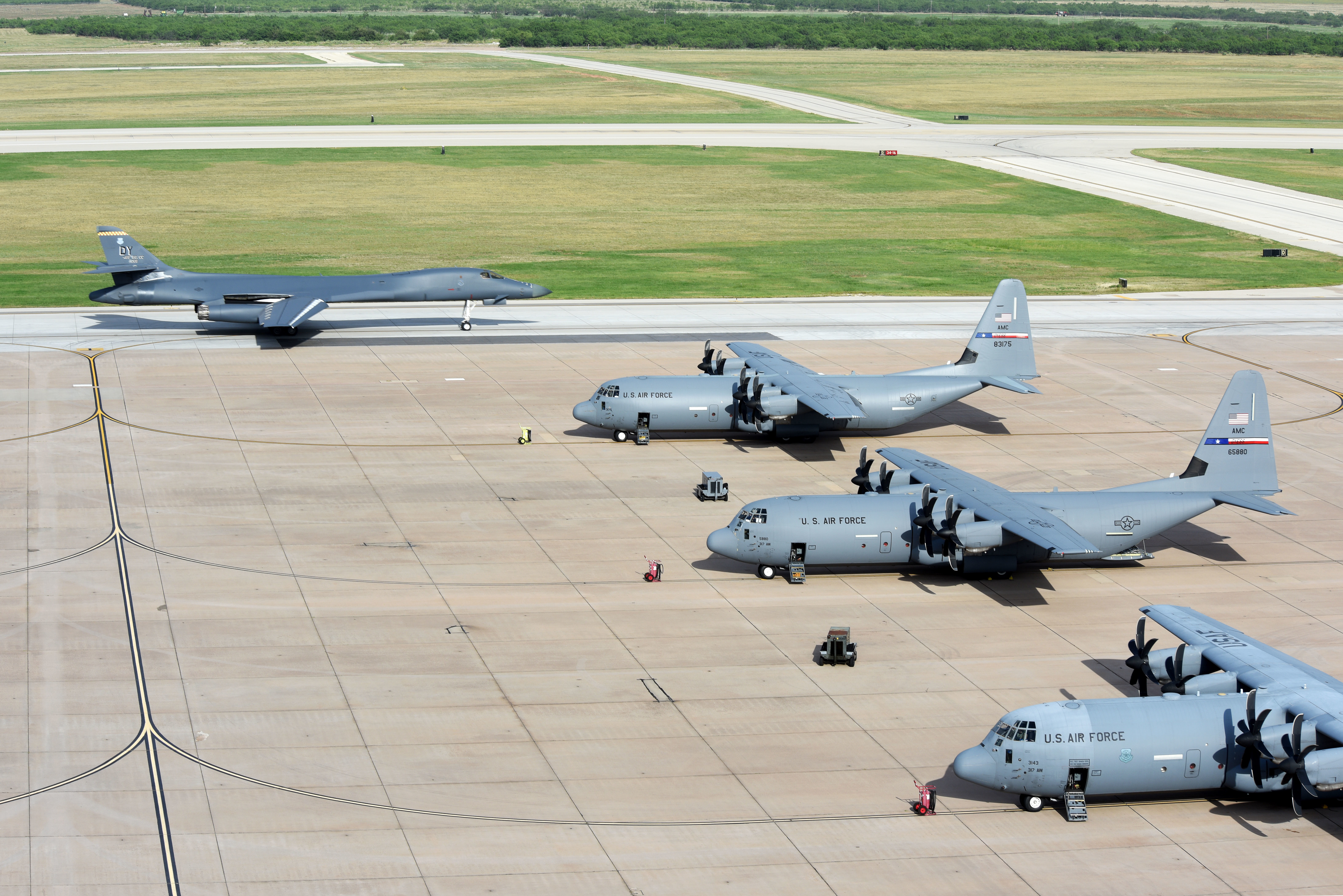
Dyess Air Force Base: Bombers and Airlift in the Big Country
In the Big Country of West Texas, Dyess Air Force Base pairs two missions on one flightline: the 7th Bomb Wing and its B-1B Lancers and the 317th Airlift Wing and its C-130J Super Hercules, so the base runs both heavy conventional bombers and tactical airlift out of Abilene. It is a well-integrated military town in Taylor County, flat mesquite plains and big skies, churchy and tight knit, with Abilene Christian, Hardin-Simmons, and McMurry in town and Fort Worth about a hundred and fifty miles east. A base with two demanding flying missions enforces its standards hard on the crews who fly and maintain them.
Military defense is all Bilecki Law Group does, and Airmen fly us in from around the world because a contested court martial is decided by trial experience, not by which lawyer is nearest the gate. When the wings and the clearance can be lost before any verdict, getting your own counsel early is what protects the career.
The Bomber Pilot Who Led the Mission to the Target
The standard for a bomber crew was set by Major John L. Jerstad, who had already finished his tour but volunteered to lead the low-level Ploesti raid of August 1, 1943. Flying in the lead aircraft, he pressed on to the target after his bomber was hit and set afire, choosing to complete the run rather than break off or make a forced landing, and was killed carrying the mission through. He led from the front and would not turn back. That is the standard we bring to a case at Dyess.
Why Airmen at Dyess Bring Us In
We win court martial cases. Military defense is all we do, and Airmen fly us in from all over the country because of our trial record. The military justice system is not built to find the truth; it exists to preserve good order and discipline, and a base running two flying missions will make an example of an Airman to keep its standards beyond question. For a rated bomber or airlift crew member there is a second front, because an allegation can pull you off flying status by a Flying Evaluation Board on a standard far below a conviction, so the criminal case and the aviation career are two fights at once. A serious case is investigated by the Office of Special Investigations, and for sexual assault and other covered offenses the decision to refer charges to a court martial no longer belongs to your command but goes to an independent Special Trial Counsel. The Area Defense Counsel may be capable but carries a heavy caseload inside the same system, which is why Airmen serious about winning bring in their own counsel.
UCMJ Charges We Defend at Dyess Air Force Base
These are among the most common allegations at Dyess. The list is not exhaustive, and we defend the full range of UCMJ charges.
Sexual Assault and Sex Offenses (UCMJ Article 120 / Article 134). These allegations route to an independent Special Trial Counsel now, and the command treats a report as established before the investigation is finished. A conviction can mean confinement and a federal record, with registration required for a covered sex offense under the applicable federal and state law, and for a rated officer the same allegation can ground you while the case is still open. These cases demand counsel who will run an independent investigation and contest the case rather than let the allegation stand in for proof.
Domestic Violence and Assault (UCMJ Articles 128b and 128). Domestic violence under Article 128b is charged as aggressively as any offense in the UCMJ since the Office of Special Trial Counsel took these cases over. It covers a spouse, an intimate partner, or a family member, and it treats strangulation or suffocation as its own charge that the government can bring even with no visible injury. A qualifying conviction also triggers the federal Lautenberg firearms bar, which can end an Air Force career because an Airman has to be able to carry a weapon. We also defend assault under Article 128, the usual charge when a night out in Abilene ends in a fight, where self defense is a recognized defense.
Drugs (UCMJ Article 112a). A positive urinalysis is one of the most common ways a young Airman's career comes apart, and for aircrew it grounds you on top of the criminal case. But a positive test is evidence the government may use to argue knowing, wrongful use, not an automatic finding of guilt: the collection, the chain of custody, the lab work, and whether any use was knowing and wrongful all remain the government's to prove.
Drunken Operation and Dereliction (UCMJ Articles 113 and 92). A night out in Abilene that ends in a DUI is charged as drunken or reckless operation under Article 113, and a lapse against a flight discipline rule or a standing order is charged as dereliction or a failure to obey under Article 92, either of which can put a rated Airman in front of a board as well as a court. Both still require the government to prove the elements, an applicable duty or lawful order, a violation, and the state of mind required by the charged theory or reckless operation, impairment, or a prohibited alcohol concentration, as charged, not just an accusation.
A Career and a Reputation Worth Defending
We do not pretend that every Airman who calls us from Dyess is innocent. What matters is how serious the case is, not your rank. If a matter is genuinely minor, the Area Defense Counsel can handle it, and we will tell you so honestly. But when the case is serious, everything is on the line at once: your wings, your clearance, your career, and your freedom. A court martial conviction is a federal criminal conviction, and the applicable sentencing parameters tie a confinement range to the offense, two and a half to ten years for sexual assault and ten to twenty for rape, that a judge can depart from only by stating specific facts in writing, on top of any required or adjudged punitive discharge and, for a covered sex offense, sex offender registration. That is why you fight. The court’s jurisdiction and the convicted offense determine which sentencing rules apply; some offenses use separate sentencing criteria rather than these ranges.
If you are facing an investigation or court martial at Dyess Air Force Base, reach out for a free, confidential strategy session. We will tell you exactly what you are facing and how we would defend it. The government is already building its case. The only question is whether anyone is building yours.
FAQ
OSI wants to interview me at Dyess. Do I have to talk to them?
No. Under Article 31b of the UCMJ you have the right to remain silent and to a lawyer, and you can invoke both before the interview begins. OSI is gathering evidence, not offering a chance to explain, and a statement can drive both the criminal case and an action against your flying status or your clearance. Decline, ask for the Area Defense Counsel or your own lawyer, and say nothing until you have one.
I'm a rated pilot. If I beat the charge, can I still lose my flying status?
Yes, because a Flying Evaluation Board is a separate proceeding on a lower standard than a conviction. You can win the court martial and still lose your wings if the board side is not fought, which is why the underlying allegation has to be defended on both tracks from the start. We handle the criminal case and the aviation board together.
I'm under an Article 120 investigation. Will I have to register as a sex offender if I'm convicted?
A court martial conviction for a covered Article 120 offense triggers registration duties under the applicable federal and state law, with requirements and duration determined by the covered conviction and jurisdiction. The entire defense is aimed at defeating the charge or reducing it to an offense that carries no registration, and the investigation and the charging decision are where these cases are most often turned. Get your own counsel involved before you ever sit down with OSI.