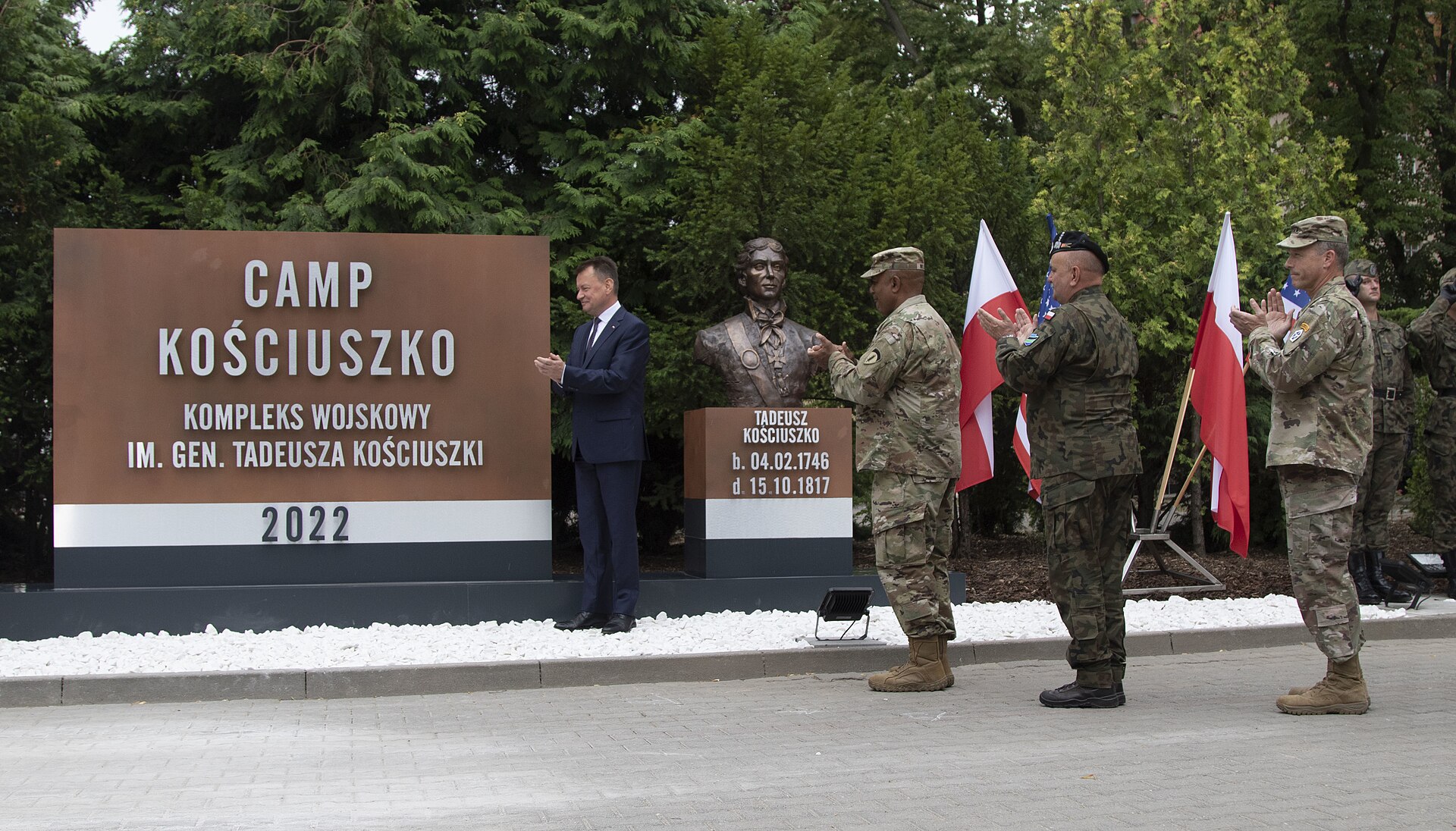
Camp Kościuszko and USAG Poland: The Army's First Garrison in Poland
In Poznań, in western Poland, Camp Kościuszko is the forward headquarters of U.S. Army V Corps and the home of U.S. Army Garrison Poland, the first permanent Army garrison ever stood up in the Republic of Poland. The garrison supports thousands of Soldiers across a dozen sites on NATO's eastern flank, a mix of the permanent party who run the garrison and the rotational combat units that cycle through Poland under Operation Atlantic Resolve. It is a new posting in a country that has become the center of gravity for the Army in Europe, and a command standing up something this visible has every reason to be seen enforcing discipline hard.
Here is what makes Poland different from the rest of Europe: the Army now holds courts martial in Poland. V Corps built the first U.S. military courtroom in the country at Camp Kościuszko, and cases are being tried there. A Soldier charged in Poland can face a court martial in Poland, which makes who you put in that courtroom a decision worth getting right the first time. Military defense is all Bilecki Law Group does, Europe has become a growing part of its practice since the move to Tampa, and it flies in for the fight. A case here does not have to be handled by whoever happens to be nearest.
The Polish Hero Who Fought for American Independence
The base is named for Tadeusz Kościuszko, and the name is a fitting one for an American garrison in Poland. Kościuszko was a Polish military engineer who crossed the Atlantic to fight in the American Revolution, and he proved to be one of the most gifted engineers of the war. He designed the fortifications at Saratoga that helped trap a British army and turn the tide of the Revolution, and he built the defenses at West Point that guarded the Hudson. When the war was won he went home and led an uprising for Poland's own independence. He spent his life fighting for the freedom of others and of his own people, an ocean apart, and asked nothing in return. That refusal to back down from a hard fight on principle is the standard we bring to a case at Camp Kościuszko.
Why Soldiers in Poland Bring Us In
We win court martial cases. Military defense is all we do, and Soldiers bring us in from all over the world because of our trial record. For a contested case, the question is not who is closest to the gate but who you want in the courtroom when your career and your freedom are on the line. The military justice system is not built to find the truth; it exists to preserve good order and discipline, and a high visibility command on the eastern flank will make an example of a Soldier to show the alliance it holds the line. A serious case is investigated by Army CID, and for sexual assault and other covered offenses the decision to refer charges to a court martial no longer belongs to your command but goes to an independent Special Trial Counsel. Your Trial Defense Service counsel may be capable but carries a heavy caseload inside the same system, which is why Soldiers serious about winning bring in their own counsel.
UCMJ Charges We Defend in Poland
Sexual Assault and Sex Offenses (UCMJ Article 120 / Article 134). The first courts martial tried in Poland were sexual assault cases, and these allegations now route to an independent Special Trial Counsel. The command treats a report as established before the investigation is finished, all the more so on a high profile posting where the Army wants to look decisive. These cases demand counsel who will run an independent investigation and contest the case rather than let the allegation stand in for proof, because a conviction means confinement, a federal record, and a place on a sex offender registry.
Domestic Violence and Assault (UCMJ Articles 128b and 128). Domestic violence under Article 128b is charged as aggressively as any offense in the UCMJ since the Office of Special Trial Counsel took these cases over. It covers a spouse, an intimate partner, or a family member, and it treats strangulation or suffocation as its own charge that the government can bring even with no visible injury. A qualifying conviction also triggers the federal Lautenberg firearms bar, which can end an Army career because a Soldier has to be able to carry a weapon. We also defend assault under Article 128, where self defense is a recognized defense.
Larceny and Government Property (UCMJ Articles 121 and 108). A rotational force moving units, vehicles, and equipment in and out of a theater is awash in property changing hands, and that makes accountability cases common. The government treats missing gear, an item that cannot be reconciled, or property that walked off as larceny under Article 121 or wrongful disposition of military property under Article 108, but the churn of a rotation is not the same as theft, and the government still has to prove the state of mind required by the charged offense: intent for larceny or fraud, or negligence where Article 108 permits it, not just that something is missing.
Drugs and Off Duty Conduct (UCMJ Articles 112a and 134). Drug cases often turn on the chain of custody and the government's burden to prove any use was knowing and wrongful. A Soldier is subject to the UCMJ off duty, so a night out in Poznań that goes wrong comes back to the command, and an incident off the installation can also draw the attention of the Polish authorities under the agreement that governs U.S. forces here. A bad night can put you in front of your command and a foreign legal system at once, so get counsel involved before you talk to anyone.
A Career and a Reputation Worth Defending
We do not pretend that every Soldier who calls us from Poland is innocent. What matters is how serious the case is, not your rank. If a matter is genuinely minor, your Trial Defense Service counsel can handle it, and we will tell you so honestly. But when the case is serious, everything is on the line at once: your career, your retirement, your good name, and your freedom. A court martial conviction is a federal criminal conviction, and where the sentencing parameters apply the judge sentences within confinement ranges fixed by the offense, two and a half to ten years for sexual assault and ten to twenty for rape, with specific facts in writing required to support a departure, on top of any required or adjudged punitive discharge and, on a covered sex offense, sex offender registration. That is why you fight. The court’s jurisdiction and the convicted offense determine which sentencing rules apply; some offenses use separate sentencing criteria rather than these ranges.
If you are facing an investigation or court martial in Poland, reach out for a free defense strategy session. We will tell you exactly what you are facing and how we would defend it. The government is already building its case. The only question is whether anyone is building yours.
FAQ
I'm on a rotation to Poland. If I'm charged, would my court martial be held in Poland or back in Germany or the States?
It can now be held in Poland. The Army built the first U.S. military courtroom in the country at Camp Kościuszko and is trying cases there, so a charge that arises in Poland can be convened and tried in Poland rather than sent back to Germany or stateside. That is a recent change, and it means the case moves on the Army's timeline right where you are, so you want your own counsel engaged early rather than after charges are referred.
CID wants to interview me in Poland. Do I have to talk to them?
No. You are not required to sit for a CID interview or answer their questions. Under Article 31b of the UCMJ you have the right to remain silent and to a lawyer, and you can invoke both at any point, including before the interview begins. CID is collecting evidence, not giving you a chance to explain. Decline, ask for counsel, and call a defense lawyer before you give any statement.
Something happened off base in Poznań. Could the Polish authorities get involved too?
They can. Poland is a NATO host nation, and an off base incident can draw the local authorities under the agreement that governs U.S. forces here, on a separate track from the UCMJ case your command is pursuing. Investigations in the two systems may overlap, and what you say to one can affect the other, so do not give a statement to anyone until you have talked to a defense lawyer. The SOFA allocates primary jurisdiction and limits a second trial for the same offense; overlapping investigations do not mean that both countries may freely try the same charge.