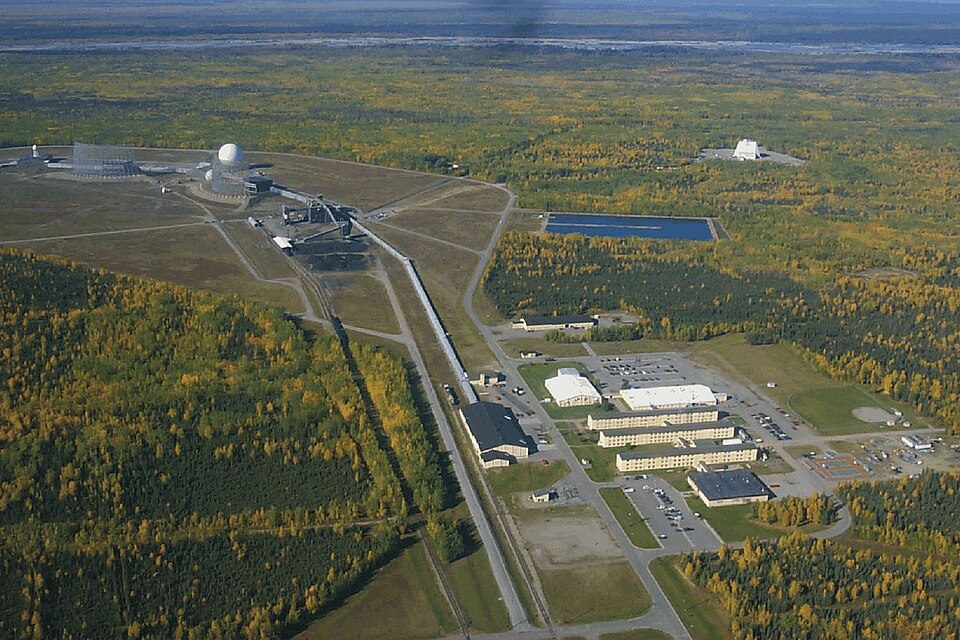
Clear Space Force Station: A Critical Mission in the Middle of Nowhere
Clear is about as far from the rest of the Space Force as a Guardian can get. The nearest town, Anderson, has a couple hundred people and almost nothing in it, the nearest anything is Healy and the gate to Denali, and the nearest real city is Fairbanks, the better part of two hours up the Parks Highway. Many of the roughly one hundred and fifty people who run this place commute in and pull multi-day shifts on station, because you do not casually drive home from Clear. The mission is as serious as it gets, missile warning and space tracking for the whole continent, now anchored by the giant new Long Range Discrimination Radar, but day to day life is defined by deep interior cold, long darkness, and an isolation that makes the warm space hubs in Colorado and Florida feel like another planet.
That environment matters when UCMJ trouble surfaces. Formal proceedings typically run through Joint Base Elmendorf-Richardson in Anchorage, the legal hub for military justice across Alaska, but the pressures that lead to charges, the close quarters of a tiny crew where everyone knows everyone, are shaped entirely by what it means to be stationed at Clear. We defend Guardians and other service members at Clear, at JBER, and anywhere else in Alaska, and if we need to run our own investigation on the ground in the interior, we do that too.
Alaska Has Always Been Worth Defending
Clear watches the skies over Alaska now, but the cost of holding this ground was paid long ago. In May 1943, one of the only land battles of World War II fought on American soil took place out on the Aleutian island of Attu, in brutal cold against a dug in enemy. On May 26, Private Joe P. Martinez, an automatic rifleman, rose to his feet under heavy machine gun, rifle, and mortar fire and led the advance up a snow covered ridge that had pinned his unit down, clearing enemy positions with his BAR and grenades until the high ground was taken. He was mortally wounded doing it, and he received the Medal of Honor posthumously. Alaska was worth defending then, and the watch the Guardians stand at Clear is worth standing now. Refuse to stay pinned down, and we will take the high ground of your case with you.
What Makes the UCMJ Environment at Clear Different
Isolation is its own kind of command pressure. Small units in remote locations are tightly supervised and socially constrained, with fewer outlets for the stress of remote duty, and the same conditions that make boredom a documented risk factor for misconduct also make the social consequences of any UCMJ matter immediate and inescapable. At a large installation you have some anonymity, a larger peer group, and a clearer path to legal resources. At Clear, everyone knows, the unit is small, the chain of command is close, and civilian legal support in the surrounding area is essentially nonexistent. The prosecution is counting on exactly that, because the isolation that makes Clear duty hard also makes a plea deal look like the easiest path. It is not the easiest path. It is a conviction that follows you for life.
A serious case is investigated by the Air Force Office of Special Investigations. For sexual assault, domestic violence, and other covered offenses, the decision to refer charges to a court martial goes to an independent Special Trial Counsel in the Department of the Air Force Office of Special Trial Counsel, not your command. Tim Bilecki worked inside this system for years, as an Army JAG defense counsel and then a Senior Defense Counsel, before going civilian. Over more than twenty years his cases have made national news, and his closings were good enough to be published in Kick-Ass Closings. We fly to Alaska, and the prosecution counting on your isolation is the first advantage we take from them.
A Note on Alaska and Marijuana
Alaska has legalized marijuana for recreational use, and that legal status means nothing under the UCMJ. Federal law governs service members, and marijuana remains a controlled substance regardless of Alaska state law. A Guardian at Clear who uses marijuana legally as a civilian in their off hours can still test positive and face charges under Article 112a. The proximity of legal dispensaries and the assumption that what is legal off base must carry some protection have contributed to positive tests among service members who genuinely did not understand their exposure. That does not change the current legal risk, but it changes how these cases must be argued, and it creates real defense angles that inexperienced counsel often misses.
UCMJ Charges We Defend at Clear Space Force Station
We defend the full range of UCMJ charges. The ones below are the most common at Clear Space Force Station, not the boundary of what we will fight.
Sexual Assault and Sex Offenses (UCMJ Article 120 / Article 134). The SAPR environment that has reshaped these prosecutions does not stop at the perimeter of a remote installation, and if anything the dynamics of small unit life make it more volatile. Relationships develop in compressed environments, and when they end badly the consequences play out in a unit where there is nowhere to go and no one who does not already know. False allegations and allegations that misrepresent consensual interactions occur in these environments, and a service member under their own UCMJ scrutiny knows a complaint can redirect attention. We fight these cases, and the social dynamics and isolation of small unit life are often central to understanding what actually happened.
Fraud and Larceny (UCMJ Article 121). BAH fraud is among the more common financial charges at remote installations, where the housing allowance structure creates genuine complexity. A mistake in a housing claim or a missed status update is an administrative error that investigators can decide, after the fact, to call criminal intent. Intent must be proven, not assumed, and many of these cases do not survive rigorous challenge.
Domestic Violence and Assault (UCMJ Articles 128b and 128). Even at a station as remote as Clear, domestic violence under Article 128b is a significant part of our caseload, charged by the Office of Special Trial Counsel in the Department of the Air Force. Article 128b covers a spouse, an intimate partner, or a family member, and makes strangulation or suffocation a distinct, serious charge even with no injury to show. A qualifying conviction triggers the federal Lautenberg firearms bar, potentially career ending for a Guardian who must be able to carry a weapon. We also take the plain Article 128 assault cases. Isolation and limited outlets have produced altercations in every era, and at a remote installation, where the command has more bandwidth for disciplinary matters, the threshold for formal action can be lower. A fight that escalated because someone grabbed a nearby object, or a situation where acting in defense of a colleague produced the charge, has defenses, and they require someone willing to reconstruct the full sequence. We take assault, aggravated assault, manslaughter, and murder cases.
Drug Offenses (UCMJ Article 112a). As above, Alaska's marijuana situation creates unique exposure here, and beyond that the standard defenses apply: the chain of custody is open to challenge, innocent exposure is recognized, the government must prove any use was knowing and wrongful, and the line between knowing possession and circumstantial contact is not always where the prosecution claims. A positive result opens a fight. It does not end one.
Military Specific Offenses (UCMJ Articles 77 to 134). Charge stacking is a prosecution tool, not a reflection of the evidence. Five or six charges are meant to make a plea on one look rational, but each requires proof, and when the defense addresses every one on its merits, the prosecution frequently cannot carry the burden it accepted.
Get a Straight Answer About What You Are Facing
If you are under investigation or facing a court martial connected to your service at Clear Space Force Station, reach out for a free defense strategy session. You will get a direct, honest assessment of the charges, what the prosecution likely has, where the case is vulnerable, and what a real defense would require. We fly to Alaska, and we have run investigations on remote installations where the nearest legal resource was hundreds of miles away. Geography does not determine the quality of your defense, and neither does rank, because whether you are a brand new Guardian or a senior NCO a conviction is a federal criminal conviction that can cost you your good name and your freedom, with confinement governed by the applicable sentencing rules, a punitive discharge, and on a sex offense registration, on top of your career and your retirement. The decision to fight does.
FAQ
I work the missile-warning radar mission at Clear and hold a clearance. What does an investigation do to my access?
Your access can be suspended quickly, on a standard well below the criminal one. Clear's missile-warning and Long Range Discrimination Radar mission runs on cleared work, so a commander or security manager who learns of a serious allegation can suspend your access to classified information and pull you off the mission before anything is proven. Revoking the clearance itself is a separate decision, made not by your command but by the Defense Counterintelligence and Security Agency under the National Security Adjudicative Guidelines, with a Statement of Reasons and a written response window if it moves to revoke. Because that process feeds off what the investigation finds, the underlying allegation has to be fought early, not handled as a separate problem later.
My proceedings will run through JBER in Anchorage, but I was charged at Clear. How does that work?
It is common in Alaska. Clear does not have the full legal apparatus of a large base, so the investigation may start at Clear while the actual court martial or board process is administered through Joint Base Elmendorf-Richardson. That split affects logistics, scheduling, and where witnesses and evidence end up, and it means the people who can speak to what happened at Clear may be hundreds of miles from where your case is heard. We are used to working that geography, locking down the Clear side of the case while litigating through JBER, rather than letting the distance work against you.
I'm a Guardian, and the Space Force is brand new and tiny. Does court martial work differently for us?
Not in the way people assume. The Space Force has no separate military justice system, so a Guardian falls under the same UCMJ as everyone else, a serious case is investigated by the Air Force Office of Special Investigations, and covered offenses go to a Special Trial Counsel in the Department of the Air Force. What is different at Clear is the human terrain. You may be one of only a handful of Guardians for a thousand miles, in a crew small enough that everyone knows your business, and that isolation shapes how an allegation spreads and how a command reacts. The law is the same. The environment is not, and a defense that understands both is what you want.