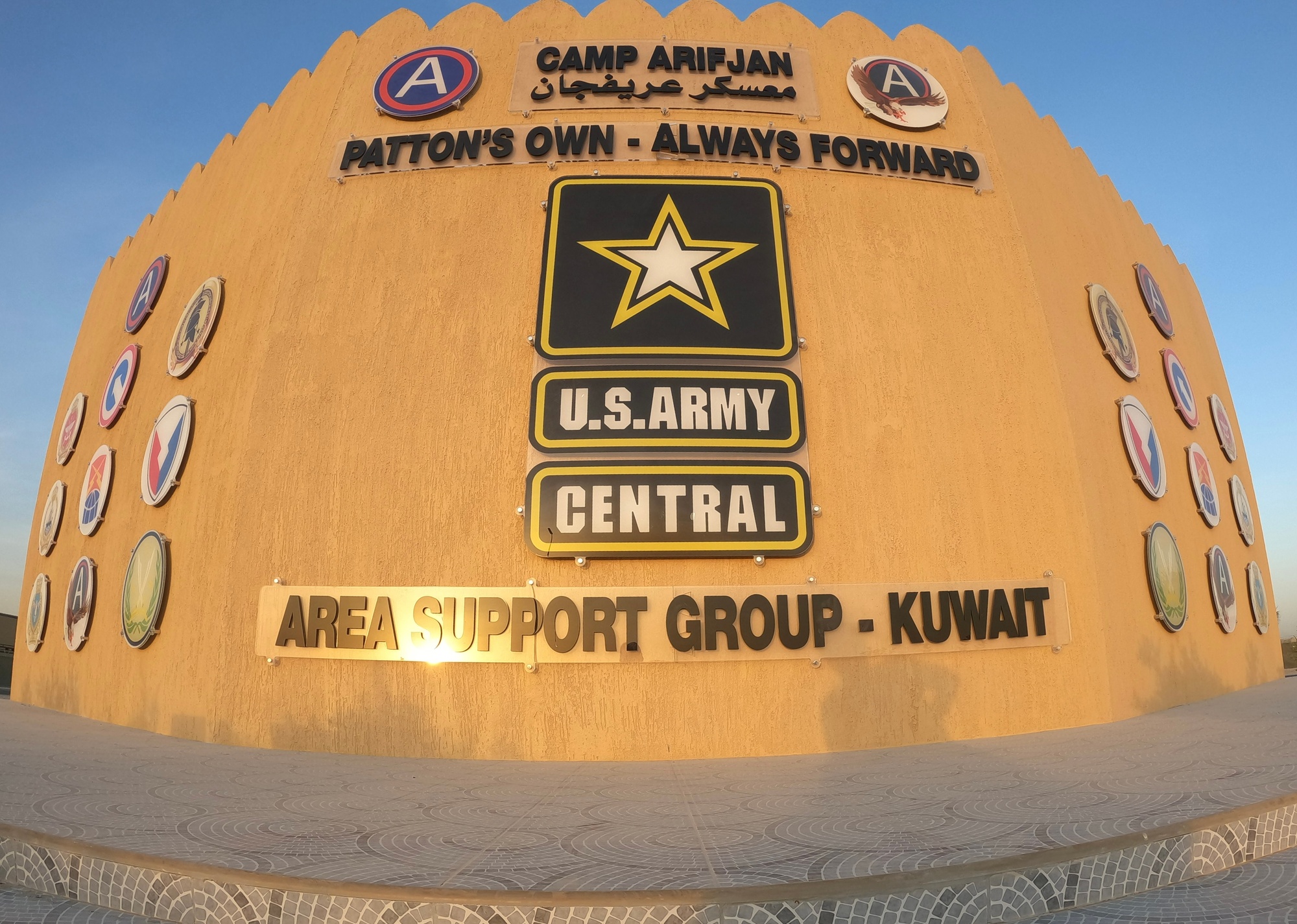
Camp Arifjan: The Staging Ground for a Generation of War
Kuwait has sat at the center of U.S. military operations in the Middle East for more than three decades. From the Gulf War to two invasions of Iraq to the sustained presence that followed, this country has served as a staging ground, a logistics hub, and a permanent fixture of America's posture in the region. Camp Arifjan sits at the heart of that presence, and it will keep housing thousands of U.S. service members for the foreseeable future.
That volume of personnel means the UCMJ gets enforced, command structures are active and watchful, and when a service member runs into trouble, whether the allegation is serious or the product of a misunderstanding that spiraled, the military justice system moves quickly and without much tolerance for nuance. What Kuwait does not have is a deep bench of experienced civilian military defense attorneys. You have two options here: assigned JAG counsel, or someone who flies in. Bilecki Law Group flies in.
One Man Held the Line at Baghdad Airport
The road to Baghdad in 2003 ran through Kuwait, and Camp Arifjan staged much of it. On April 4 of that year, near Baghdad International Airport, Sergeant First Class Paul Ray Smith and his engineers were building a holding area for prisoners when a company sized enemy force hit them and threatened to overrun more than a hundred Soldiers. Smith organized a hasty defense, then climbed onto a damaged armored personnel carrier and manned its exposed .50 caliber machine gun, fully in the open, firing on the enemy and covering the evacuation of the wounded until he was killed. He held the line, and the hundred men behind him lived. He became the first Soldier awarded the Medal of Honor in the War on Terror. That refusal to give ground is the example, and it is the kind of fight you need at Arifjan. Hold the line the way Smith held it, and make them fight for every charge on the sheet.
Why Soldiers at Camp Arifjan Fly Us In
A serious case at Arifjan is investigated by Army CID. For sexual assault, domestic violence, and other covered offenses, the decision to refer charges to a court martial no longer belongs to your command. It goes to an independent Special Trial Counsel in the Army's Office of Special Trial Counsel. For everything else, the command and its Office of the Staff Judge Advocate still drive the case, in a deployment environment where leadership is especially sensitive to anything that could create a diplomatic problem.
The military justice system maintains a high conviction rate, and that is not because only guilty people get charged. It reflects a system built from the ground up to produce convictions, because convictions reinforce order and let a command make an example. JAG defense counsel work inside that system, with constrained resources and within a chain of command answering to the same institutional pressures driving the prosecution. Tim Bilecki spent years inside that system as an Army JAG defense counsel and Senior Defense Counsel before going civilian. His closing arguments were published in Kick-Ass Closings, and his cases have been featured on CNN, Fox News, and USA Today. When the prosecution at Arifjan sees retained civilian counsel walk in, the expectation of an easy conviction is the first thing we take from them.
Do Not Make Permanent Decisions Based on Temporary Discomfort
There is a psychological dimension to overseas prosecution that rarely gets discussed openly. Investigators and prosecutors know a Soldier at Camp Arifjan is far from family and under the daily stress of a deployment, and they know that isolation makes any deal look attractive. A deal that looks like a way home is still a conviction, and convictions have consequences that extend well past the flight back to the States. Do not let the system rush you. Get counsel that can actually fight.
UCMJ Charges We Defend at Camp Arifjan
These are the most common cases at Camp Arifjan. They are examples, not limits, and we defend service members against the full range of UCMJ offenses.
Sexual Assault and Sex Offenses (UCMJ Article 120 / Article 134). The Army's SHARP program was developed to address a genuine and serious problem. Its implementation has produced a system where allegations are treated as established fact before investigations are complete, where careers end on rumor and unverified accounts, and where a Soldier in trouble for their own conduct has learned that filing a complaint of their own can shift the investigative focus. Commands under political pressure to demonstrate SHARP compliance are not positioned to examine these cases neutrally. If you are facing sex offense charges at Arifjan, you need counsel that knows how to dismantle the prosecution's case and surface the inconsistencies and motivations in the accuser's account.
Fraud and Larceny (UCMJ Article 121). A large share of these cases begin not with criminal intent but with administrative error: a reimbursement claim filed wrong, a housing calculation that did not account for a status change, a miscoded payment. Investigators looking for wrongdoing find the discrepancy and treat it as a scheme. The difference between an honest mistake and a crime is intent, which the government must prove, not something you must disprove.
Domestic Violence and Assault (UCMJ Articles 128b and 128). Downrange and at home, domestic violence under Article 128b is now one of the largest parts of what we defend, prosecuted by an independent Special Trial Counsel with the weight of a sexual assault. It reaches a spouse, an intimate partner, or a family member, and makes strangulation or suffocation a standalone serious charge even where nothing is visible. A qualifying conviction triggers the federal Lautenberg firearms bar, and a Soldier who cannot carry a weapon faces serious career consequences. Article 128 assault is part of the docket too. Service members are trained to be physically capable and aggressive in ways most civilians are not, and that culture does not turn off in garrison. When someone is seriously injured or an improvised object gets used, informal handling disappears and Article 128 appears. Often the Soldier charged was defending themselves or someone else. The facts that establish self defense exist; they need to be surfaced and argued by someone who knows how. Our violent-offense work covers assault and aggravated assault under Article 128, manslaughter under Article 119, and murder under Article 118.
Drug Offenses (UCMJ Article 112a). Kuwait prohibits both drugs and alcohol, which makes the command acutely sensitive to any drug allegation, because anything involving controlled substances carries diplomatic and reputational weight. That pressure can produce an overreaction to the evidence. A positive urinalysis is not automatic proof of voluntary use; the chain of custody can be compromised, innocent exposure is documented, and the government still has to prove the use was knowing and wrongful. A positive test is the beginning of a fight you can win.
Military Specific Offenses (UCMJ Articles 77 to 134). Charge stacking, filing multiple offenses to inflate the maximum punishment and make a plea feel like the only rational choice, is one of the more insidious tactics in this system. You have been charged with six offenses and offered a plea to one, and it looks like a deal. It is a conviction. The proper response is a defense that addresses every charge on its merits and forces the prosecution to prove each one. They rarely can.
A Free Strategy Session, and Straight Talk
If you are under investigation or facing a court martial at Camp Arifjan, reach out for a free defense strategy session. We will tell you directly what you are facing, what the prosecution likely has, where the case is vulnerable, and how we would defend it. No vague reassurances and no pressure. Even if you made a mistake, you have the right to the best possible outcome, and the military justice system will not find it for you on its own. On the line is your career, your retirement, your good name, and your freedom: a conviction is a federal criminal conviction. Where the sentencing parameters apply, it can carry confinement a judge has little room to avoid, a punitive discharge, and on a covered sex offense sex offender registration, no matter your rank. We fly to Kuwait. We fight for you. The court’s jurisdiction and the convicted offense determine which sentencing rules apply; some offenses use separate sentencing criteria rather than these ranges.
FAQ
I'm a Reservist mobilized to Arifjan. Does the UCMJ apply to me the same way it applies to active duty?
Yes. Once you are on federal active duty orders, you are fully subject to the UCMJ, the same as any active component Soldier, and a deployment to Arifjan puts you squarely under it. What changes for Reserve and Guard members is on the back end: an adverse action can affect your civilian employer relationship, your reserve career, and your benefits in ways that are easy to overlook in the moment. Those downstream consequences are exactly why a mobilized Soldier should not treat an investigation as something to ride out alone.
Kuwait bans alcohol and drugs entirely, and we're under General Order No. 1. How does that affect my case?
General Order No. 1 prohibits things in the deployed environment that are perfectly legal back home, including alcohol, and that expands the ways you can end up facing UCMJ action at Arifjan. Conduct that would be a non issue stateside becomes a chargeable offense here, and commands enforce it to keep good order in a sensitive host nation. It also means the government has to prove you actually violated a lawful order, with the specific knowledge and conduct that requires. Those orders and their enforcement are contestable, and a real defense holds the prosecution to that burden rather than assuming the violation.
Army CID wants to interview me at Arifjan. Do I have to talk to them?
No, and downrange it matters even more. A CID interview is evidence collection, not your chance to explain, and Article 31b of the UCMJ lets you stay silent and ask for a lawyer before any question. In a deployed environment witnesses rotate out fast and the record made now is the one that follows the case home, so the first interview carries extra weight. For covered offenses like sexual assault, an independent Special Trial Counsel, not your deployed command, decides whether to refer charges to a court martial. Decline, ask for counsel, and call a lawyer before you say anything.