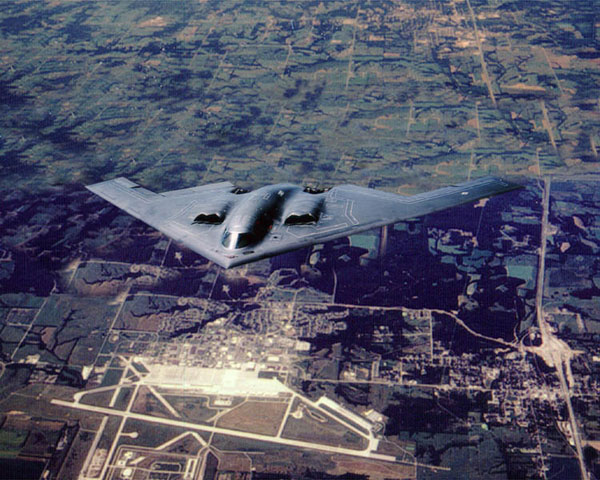
Whiteman Air Force Base: The Home of the B-2
In the rolling farmland of west-central Missouri, Whiteman Air Force Base is the only operational home of the B-2 Spirit, the stealth bomber, flown by the 509th Bomb Wing with the Missouri Air National Guard's 131st Bomb Wing alongside it. It is a small, elite community, where a crew of two takes one of the most expensive and secret aircraft in the world into the nuclear mission, and where everyone is read into programs and access that an allegation can freeze overnight. Families live around Knob Noster and Warrensburg in Johnson County, with the University of Central Missouri in town and Kansas City about seventy miles to the northwest. A wing that carries the stealth nuclear mission enforces its standards with no room to spare.
Military defense is all Bilecki Law Group does, and Airmen fly us in from around the world because a contested court martial is decided by trial experience, not by which lawyer is nearest the gate. In a community this small and this scrutinized, where the mission and the clearance can be gone before any verdict, getting your own counsel early is what protects them.
The Airman Who Gave Up His Own Parachute
The standard for a bomber crew was set by Second Lieutenant David R. Kingsley, a B-17 bombardier over Ploesti on June 23, 1944. When his crippled bomber fell out of formation and a wounded gunner's parachute harness was lost, Kingsley stripped off his own harness and strapped it onto the wounded man, helped the crew bail out, and stayed with the falling aircraft; his body was found in the wreckage. He gave away his only way out to save someone else. That is the standard we bring to a case at Whiteman.
Why Airmen at Whiteman Bring Us In
We win court martial cases. Military defense is all we do, and Airmen fly us in from all over the country because of our trial record. The military justice system is not built to find the truth; it exists to preserve good order and discipline, and a stealth nuclear wing will make an example of an Airman to keep its standards beyond question. On top of the criminal case, the Personnel Reliability Program runs in parallel, and a positive test, a security flag, or even an unproven allegation can pull a crew member off the mission at once, on a standard far below what a conviction requires. A serious case is investigated by the Office of Special Investigations, and for sexual assault and other covered offenses the decision to refer charges to a court martial no longer belongs to your command but goes to an independent Special Trial Counsel. The Area Defense Counsel may be capable but carries a heavy caseload inside the same system, which is why Airmen serious about winning bring in their own counsel.
UCMJ Charges We Defend at Whiteman Air Force Base
The cases below are the most common at Whiteman. If yours is not here, call anyway, because we defend the full spectrum of military charges.
Sexual Assault and Sex Offenses (UCMJ Article 120 / Article 134). These allegations route to an independent Special Trial Counsel now, and the command treats a report as established before the investigation is finished. A conviction can mean confinement and a federal record, with registration required for a covered sex offense under the applicable federal and state law, and a single allegation can pull a crew member off the nuclear mission long before the case is resolved. These cases demand counsel who will run an independent investigation and contest the case rather than let the allegation stand in for proof.
Domestic Violence and Assault (UCMJ Articles 128b and 128). Domestic violence under Article 128b is charged as aggressively as any offense in the UCMJ since the Office of Special Trial Counsel took these cases over. It covers a spouse, an intimate partner, or a family member, and it treats strangulation or suffocation as its own charge that the government can bring even with no visible injury. A qualifying conviction also triggers the federal Lautenberg firearms bar, which can end an Air Force career because an Airman has to be able to carry a weapon. We also defend assault under Article 128, where self defense is a recognized defense.
Drugs (UCMJ Article 112a). The sharpest trap here is marijuana. It is legal under Missouri law, but it is still a federal controlled substance and a court martial offense under Article 112a, and a single dispensary purchase that shows up on a urinalysis can end a B-2 career, because at a nuclear base it can trigger suspension from PRP duties or a reliability review that pulls you off the mission before the case is ever decided. The defense is real, though, because a positive test is evidence the government may use to argue knowing, wrongful use, not an automatic finding of guilt, so the collection, the chain of custody, and the lab work all have to hold up.
Drunken Operation and Dereliction (UCMJ Articles 113 and 92). A night out that ends in a DUI is charged as drunken or reckless operation under Article 113, and on a nuclear mission a lapse on duty or against a standing order is charged as dereliction or a failure to obey under Article 92. Both still require the government to prove the elements, an applicable duty or lawful order, a violation, and the state of mind required by the charged theory or reckless operation, impairment, or a prohibited alcohol concentration, as charged, not just an accusation.
A Career and a Reputation Worth Defending
We do not pretend that every Airman who calls us from Whiteman is innocent. What matters is how serious the case is, not your rank. If a matter is genuinely minor, the Area Defense Counsel can handle it, and we will tell you so honestly. But when the case is serious, everything is on the line at once: the mission, your clearance, your career, and your freedom. A court martial conviction is a federal criminal conviction, and the applicable sentencing parameters tie a confinement range to the offense, two and a half to ten years for sexual assault and ten to twenty for rape, that a judge can depart from only by stating specific facts in writing, on top of any required or adjudged punitive discharge and, for a covered sex offense, sex offender registration. That is why you fight. The court’s jurisdiction and the convicted offense determine which sentencing rules apply; some offenses use separate sentencing criteria rather than these ranges.
If you are facing an investigation or court martial at Whiteman Air Force Base, reach out for a free, confidential strategy session. We will tell you exactly what you are facing and how we would defend it. The government is already building its case. The only question is whether anyone is building yours.
FAQ
Marijuana is legal in Missouri. Why can I still be court martialed for it at Whiteman?
Because Missouri law does not control here. Marijuana is legal for adults under state law, but it remains a federal controlled substance and a court martial offense under Article 112a, and the base is federal land where it is illegal no matter what the state allows. For a crew member on the nuclear mission, a positive urinalysis is one of the fastest ways a career ends. The defense is real, though, because a positive test is only a permissive inference, and the collection, the chain of custody, and the lab work all have to hold up.
OSI wants to interview me. Do I have to talk to them?
No. Under Article 31b of the UCMJ you can stay silent and ask for a lawyer, and you should do both before the interview begins. OSI is gathering evidence, not offering a chance to explain, and a statement can drive both the criminal case and a reliability action that pulls you off the mission. Decline, ask for the Area Defense Counsel or your own lawyer, and say nothing first.
I was pulled off the nuclear mission over an allegation. Can I get back on status?
A reliability decertification is an administrative action, not a conviction, and it is not proof that you did anything. It should not be treated as evidence of guilt at a court martial, and the road back to status runs through defeating the underlying allegation. That is the case we fight, because winning or shrinking it is what reopens the mission and the career.