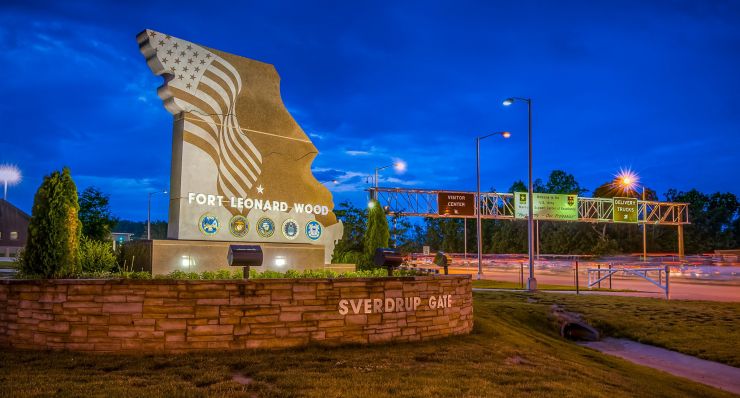
Fort Leonard Wood: Home of the Engineer, MP, and Chemical Regiments
Deep in the south-central Missouri Ozarks, Fort Leonard Wood is the Maneuver Support Center of Excellence, the home of the Army's Engineer, Military Police, and Chemical schools, and a Basic Combat Training post. Soldiers come here to be made in basic training and to learn the engineer, MP, and CBRN trades, and the Military Police school sitting on the same post means law enforcement and the courts are never far from anyone's mind. Sixty-one thousand acres of woods earned it the nickname Fort Lost-in-the-Woods; the small, fiercely patriotic gate towns of St. Robert and Waynesville sit just outside, with the Lake of the Ozarks the summer escape. A command training this much of the Army's support force will protect the mission and move hard against a Soldier who steps wrong.
Military defense is all Bilecki Law Group does, and Soldiers fly us in from our office in Tampa because a contested court martial is decided by trial experience, and we bring it wherever the case is.
The Engineer Who Smothered the Grenade
The standard was set by Technician Fifth Grade Robert D. Maxwell near Besançon, France, in September 1944, while serving in an infantry battalion’s communications platoon. When a German grenade landed among Maxwell and the men he was defending a command post with, armed only with a pistol, he threw himself onto it and pulled it under his body, smothering the blast with his own frame to shield the others. He was badly wounded but, almost impossibly, survived. He had a fraction of a second to choose and chose to take the blast for his men. That instinct to put himself between his Soldiers and the worst of it is the standard we bring to a case at Leonard Wood.
Why Soldiers at Leonard Wood Bring Us In
We win court martial cases. Military defense is all we do, and Soldiers fly us in from all over the country because of our trial record. The military justice system is not built to find the truth; it exists to preserve good order and discipline, and a command running a training mission and three branch schools will make an example of a Soldier to keep the standard sharp. A serious case is investigated by Army CID, and for sexual assault and other covered offenses the decision to refer charges to a court martial no longer belongs to your command but goes to an independent Special Trial Counsel. Your Trial Defense Service counsel may be capable but carries a heavy caseload inside the same system, which is why Soldiers serious about winning bring in their own counsel.
UCMJ Charges We Defend at Fort Leonard Wood
Do not read the list below as a menu. These are the most common charges at Fort Leonard Wood, and we defend any UCMJ offense a service member can face.
Sexual Assault and Sex Offenses (UCMJ Article 120 / Article 134). These allegations route to an independent Special Trial Counsel now, and the command treats a report as established before the investigation is finished, all the more so in a training environment where word of an allegation travels fast and the command wants to look decisive. These cases demand counsel who will run an independent investigation and contest the case rather than let the allegation stand in for proof, because a conviction can mean confinement and a federal record, with registration required for a covered sex offense under the applicable federal and state law.
Domestic Violence and Assault (UCMJ Articles 128b and 128). Domestic violence under Article 128b is charged as aggressively as any offense in the UCMJ since the Office of Special Trial Counsel took these cases over. It covers a spouse, an intimate partner, or a family member, and it treats strangulation or suffocation as its own charge that the government can bring even with no visible injury. A qualifying conviction also triggers the federal Lautenberg firearms bar, which can end an Army career because a Soldier has to be able to carry a weapon. We also defend assault under Article 128, the usual charge when a night out off post ends in a fight, where self defense is a recognized defense.
Maltreatment and Improper Cadre Relationships (UCMJ Articles 93 and 92). On a post that trains basic Soldiers and three branch schools at once, the cadre and trainee relationship is policed hard. The government brings maltreatment of a subordinate under Article 93 and a breach of the no-contact and professional-relationship rules under Article 92, and an initial-entry environment will charge on a trainee's word. The conduct may be alleged, but the government still has to prove it, prove the authority, and prove that a rule was broken, which a real defense tests rather than assumes.
Drugs and Off Duty Conduct (UCMJ Articles 112a and 134). Drug cases often turn on the chain of custody and the government's burden to prove any use was knowing and wrongful. Marijuana is one to keep in mind: it is legal in Missouri, but it is still a federal controlled substance and a court martial offense under Article 112a, and being legal off post does not make it lawful for a Soldier. A positive test is evidence the government may use to argue knowing, wrongful use, not an automatic finding of guilt, so the collection, the chain of custody, and whether any use was knowing all remain the government's to prove.
A Career and a Reputation Worth Defending
We do not pretend that every Soldier who calls us from Leonard Wood is innocent. What matters is how serious the case is, not your rank. If a matter is genuinely minor, your Trial Defense Service counsel can handle it, and we will tell you so honestly. But when the case is serious, everything is on the line at once: your career, your retirement, your good name, and your freedom. A court martial conviction is a federal criminal conviction, and the applicable sentencing parameters tie a confinement range to the offense, two and a half to ten years for sexual assault and ten to twenty for rape, that a judge can depart from only by stating specific facts in writing, on top of any required or adjudged punitive discharge and, for a covered sex offense, sex offender registration. That is why you fight. The court’s jurisdiction and the convicted offense determine which sentencing rules apply; some offenses use separate sentencing criteria rather than these ranges.
If you are facing an investigation or court martial at Fort Leonard Wood, reach out for a free defense strategy session. We will tell you exactly what you are facing and how we would defend it. The government is already building its case. The only question is whether anyone is building yours.
Cases Connected to Fort Leonard Wood
These cases include trials, hearings, investigations, and administrative matters. A connection to this location does not necessarily mean that the trial occurred here.
- Case connected to this location: Bilecki Walks Article 80 Attempted Murder Charge Off Charge Sheet for Army Captain at Fort Leonard Wood; SPCM Plea to Single Article 128b, Reprimand Only, General (UHC) Resignation
FAQ
Army CID wants to interview me at Leonard Wood. Do I have to talk to them?
No. You are not required to sit for a CID interview or answer their questions. Under Article 31b of the UCMJ you have the right to remain silent and to a lawyer, and you can invoke both at any point, including before the interview begins. CID is collecting evidence, not giving you a chance to explain, and it takes very little to be titled as a subject, a label that follows you for years. Decline, ask for counsel, and call a defense lawyer before you give any statement.
I've been charged with a serious violent offense like attempted murder. Is there any way out short of a long sentence?
Often, yes, because the most serious charges are frequently overcharged, and the gap between what the government alleges and what it can actually prove is where these cases are won. The path may be an outright defense, or it may be reducing a top charge down to something far less serious. We have done exactly that at Leonard Wood, where an attempted murder charge was dismissed and the case resolved with a special court martial plea to a single Article 128b offense. The work starts with making the government prove its theory rather than its headline, so get counsel before you give a statement.
I'm a drill sergeant accused of maltreating a trainee. What am I facing?
An Article 93 maltreatment charge, and on a basic training post the command treats an accusation against a cadre member as a threat to the mission and charges it hard. But the government still has to prove the elements: that the trainee was subject to your orders, and that your conduct was objectively cruel, abusive, or unwarranted, not the lawful, demanding training basic training is supposed to be. The honest fight is over where hard training ends and maltreatment begins, and the context is everything, so get your own counsel before you make a statement to CID.