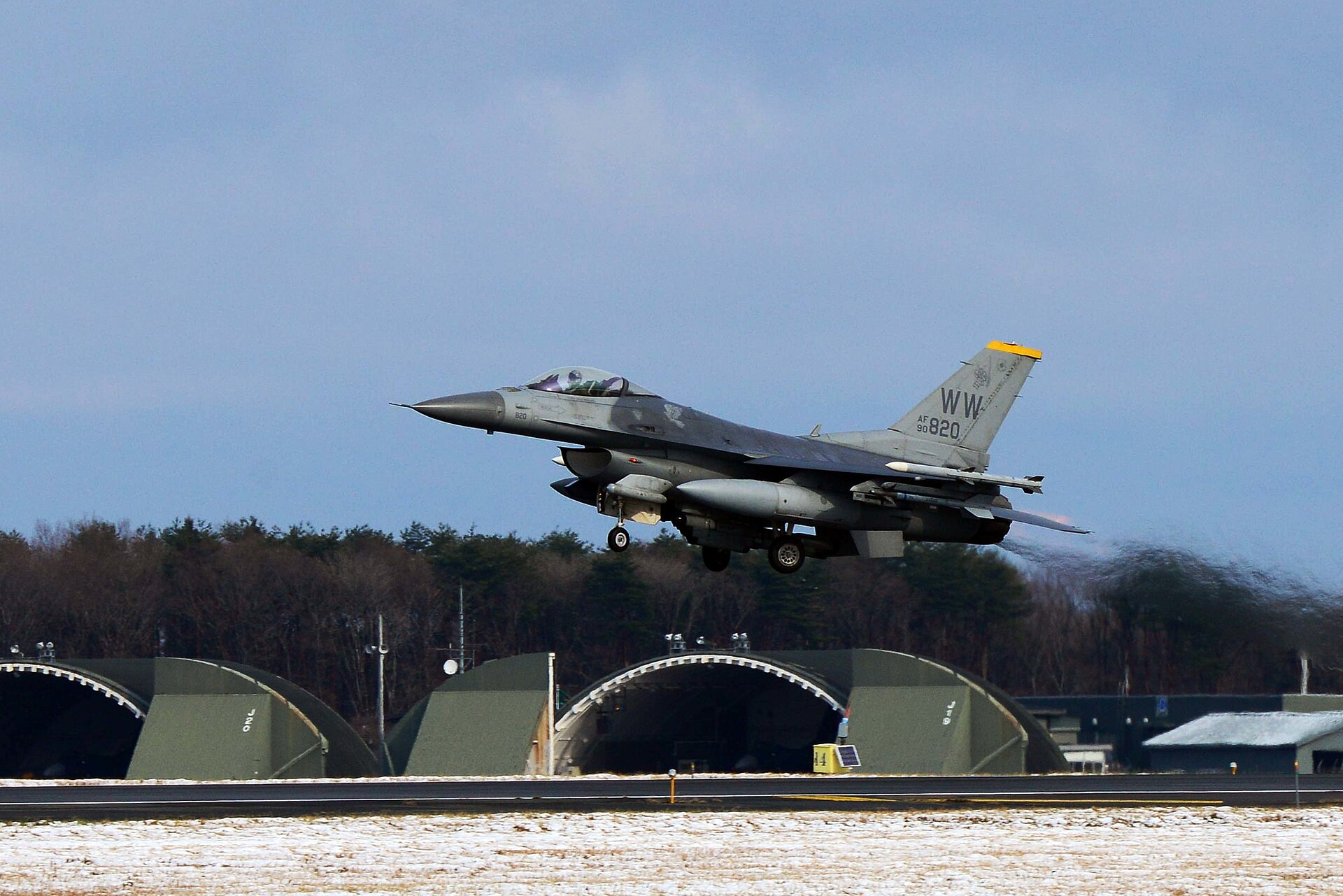
Misawa Air Base: The Joint Outpost in Aomori, Where the Wild Weasels Fly
Far up in Aomori Prefecture, at the northern end of Honshu and a long way from the bright lights of Tokyo, Misawa Air Base is one of the most unusual installations the United States runs in Japan. It is a joint base, shared by the U.S. Air Force, the U.S. Navy, and the Japan Air Self Defense Force, built around the 35th Fighter Wing and its F-16s flown in the demanding Wild Weasel role of hunting enemy air defenses, with a major Navy patrol and a large signals intelligence and cryptologic mission layered on top. It is cold, remote, and mission heavy, and the isolation that comes with it wears on people in ways a stateside base never does.
That same isolation is something the military justice system uses against you. A small, far north base where a command cannot afford an incident, and a cleared mission that can be pulled out from under you on an allegation alone, make for a place where a single bad night turns into a career ending case fast. And in Japan there is a second danger most never think about until it lands on them: under the Status of Forces Agreement, the Japanese authorities can pursue the same off base incident at the same time the American command does, and the Japanese criminal system works nothing like ours. A case at Misawa is a fight for a career, a clearance, a retirement, and sometimes freedom, and the only way to win it is to deny the prosecution the easy conviction it expects and make it prove every element of what it has charged. The SOFA allocates primary jurisdiction and limits a second trial for the same offense; overlapping investigations do not mean that both countries may freely try the same charge.
The Wild Weasel Who Gave Away His Fuel
The mission Misawa's fighter wing flies has a motto older than the base: first in, last out. It was earned by men like Major Leo Thorsness, a Wild Weasel pilot whose job was to fly into the teeth of enemy surface to air missiles so that the strike force behind him could get through. On April 19, 1967, over North Vietnam, Thorsness destroyed a missile site, shot down an enemy fighter, and then made pass after pass against more fighters to protect a downed crew on the ground, until he was nearly out of fuel. With another aircraft also critically low, he gave up his place at the tanker so the other pilot could take on fuel first, and nursed his own jet to a recovery base on fumes. Days later he was shot down and spent six years as a prisoner of war. He was awarded the Medal of Honor. He flew straight at the thing everyone else was running from, and that is exactly the standard we bring to a fight at Misawa.
Why Airmen and Sailors at Misawa Fly Us In
Northern Japan is a long way from anywhere, but it is not a long way from this firm's experience. Tim Bilecki spent his last active duty tour as the Army's Senior Defense Counsel for the Trial Defense Service across the Pacific Rim, with the defense of service members in Korea, Okinawa, and mainland Japan as his responsibility, and the firm has worked this country ever since, flying in for cases at bases far from any major city. When a prosecutor at Misawa sees that kind of Pacific record arrive on the case, the easy conviction stops looking easy.
Understand what the system is before you deal with it: it is not built to find the truth, it is built to keep order, and at an isolated base it keeps order by making an example, because a destroyed career keeps a small, far north force in line. A serious case at Misawa is investigated by the Air Force Office of Special Investigations, or by NCIS for the Navy side, and for sexual assault, domestic violence, and other covered offenses the decision to refer charges to a court martial no longer belongs to your commander; it goes to an independent Special Trial Counsel in your service's Office of Special Trial Counsel. Your free military defense counsel may be capable and committed, but works a heavy caseload inside that same system, which is why service members who are serious about the fight bring in their own counsel.
UCMJ Charges We Defend at Misawa Air Base
These are among the most common allegations at Misawa Air Base. The list is not exhaustive, and we defend the full range of UCMJ charges.
Sexual Assault and Sex Offenses (UCMJ Article 120 / Article 134). The services run their SAPR programs at Misawa under intense institutional pressure. An allegation is often treated as established before the investigation is finished, and where the evidence will not support a charge, the command falls back on administrative separation. On a small, remote base, a relationship that ends badly plays out in a community with no anonymity, and a command focused on showing it takes every report seriously is in no position to weigh motive. These cases route to an independent Special Trial Counsel now, and they demand counsel who will investigate independently and contest the case early, before charges are preferred.
Clearance and the Intelligence Mission. Much of what happens at Misawa runs on a security clearance, and on Security Hill a great deal of it runs on sensitive compartmented access. That is a second front the criminal case puts at risk, on a faster track and a lower standard. On a serious allegation alone, your command or security manager can suspend your access right away, and your Special Security Officer can pull your SCI access and open an incident report, all before anything is proven. Revoking the clearance itself is a separate decision, made not by your command but by the Defense Counterintelligence and Security Agency under the National Security Adjudicative Guidelines, with a Statement of Reasons and a written response window. Because that process feeds off what the investigation finds, the underlying allegation has to be fought early, not treated as a separate problem later.
Fraud and Larceny (UCMJ Article 121 / Article 107). Housing allowance fraud is common at overseas bases, and at Misawa it usually starts with a service member drawing OHA against a local lease, or BAH set by a dependent's stateside address, where an auditor later decides the rent, the residence, or the dependent's location does not match the paperwork. Because the housing form is what authorizes the rate, the government charges it as larceny under Article 121 and as a false official statement under Article 107, the same paperwork serving as both the theft and the lie. The government still has to prove intent, and a finance office error, bad guidance, or a family that genuinely moved is not a scheme. We defend BAH and OHA fraud, larceny, wrongful appropriation, and conspiracy to defraud.
Domestic Violence and Assault (UCMJ Articles 128b and 128). Domestic violence under Article 128b has become one of the largest parts of our caseload, and an isolated base under cold and stress sees its share. Since the Office of Special Trial Counsel took these cases over it is charged as aggressively as any offense in the UCMJ. It covers a spouse, an intimate partner, or a family member, and makes strangulation or suffocation a separate, serious charge even when there is little or no visible injury. A qualifying conviction also triggers the federal Lautenberg firearms bar, which can end a military career because the job requires being able to carry a weapon. We also defend assault under Article 128, where self defense is a recognized defense.
Drug and Military Specific Offenses (UCMJ Articles 112a, 92, 134, and more). Japan enforces some of the strictest drug laws in the developed world, and a substance bought off the local economy or shipped in can bring both a court martial and a far harsher Japanese prosecution; a positive urinalysis is the start of the fight, not the end, because the chain of custody can be challenged and the government still has to prove any use was knowing and wrongful. The rest of these charges tend to start on liberty in the bar district outside the Misawa gate, where Security Forces patrol and can apprehend, so resisting them comes in under Article 87a and disobeying a lawful order under Article 92, while an incident with a Japanese national draws the Japanese police and a curfew or off limits violation adds its own Article 92 charge. Stacked together with a drunk and disorderly under Article 134, one night becomes a charge sheet built to inflate the punishment, and we challenge each count on its own.
A Remote Base Is No Place to Fight Alone
Not every service member who calls us from Japan is innocent, and we do not pretend otherwise. Some made a bad decision and know it. That does not mean they have to accept the worst the system can hand out, prosecuted by a command eager to make one case a warning for a small base where everyone is watching. Rank does not decide whether you need a firm like ours; the seriousness of the case does. If a matter is genuinely minor, your free military counsel can handle it, and we will tell you so honestly.
But when the case is serious, everything is on the line at once: your career, your clearance, your retirement, your good name, and your freedom. A court martial conviction is a federal criminal conviction. Under the sentencing rules now in force it can mean confinement a judge has little discretion to avoid, a punitive discharge that follows you for life, and on a sex offense a place on a registry, no matter your rank. That is why you fight, and the system is counting on you not to.
If you are facing an investigation or court martial at Misawa Air Base, reach out for a free defense strategy session. We will fly to Japan, tell you exactly what you are facing, and lay out how we would defend it. The government is already building its case. The only question is whether anyone is building yours.
Cases Connected to Misawa Air Base
These cases include trials, hearings, investigations, and administrative matters. A connection to this location does not necessarily mean that the trial occurred here.
- Case connected to this location: Airman Facing Lew Acts on Minor Retains Bilecki, Avoids Jail Time
FAQ
OSI wants to interview me at Misawa. Do I have to talk to them?
No, and not without counsel. An OSI interview, like an NCIS interview on the Navy side, is evidence collection, not your chance to explain, and under Article 31b of the UCMJ you have the right to remain silent and to ask for a lawyer. For covered offenses like sexual assault, the decision to refer charges to a court martial no longer belongs to your commander but to an independent Special Trial Counsel in your service's Office of Special Trial Counsel. An off base incident involving a Japanese national can also draw the Japanese authorities under the Status of Forces Agreement, and a statement to one system can surface in the other. Decline the interview, ask for counsel, and call a lawyer before you say anything.
I hold a clearance and work the intelligence mission at Misawa. What does an investigation do to my access?
It can hit your access well before it touches the criminal case, and on a much lower standard. A command or security manager who learns of a serious allegation can suspend your access right away, and your Special Security Officer can pull your SCI and file an incident report, pulling you off the mission before anything is proven. Revoking the clearance itself is a separate decision, made by the Defense Counterintelligence and Security Agency under the National Security Adjudicative Guidelines, with a Statement of Reasons and a written response window if it moves to revoke. Because that process runs on what the investigation finds, the underlying allegation has to be fought early, which is exactly the work we do before charges are preferred.
I was detained by the Japanese police off base. What happens now?
It is both, and the Japanese side is the one most people are not prepared for. Under the Status of Forces Agreement the Japanese authorities hold the primary right to prosecute most off base offenses against Japanese nationals, and their system is very different from ours: police and prosecutors can hold and interrogate a suspect for up to roughly twenty three days before any charge is filed, often without a lawyer in the room, with heavy pressure to produce a confession. The United States generally keeps custody of a service member until the Japanese indict, but that is exactly the window where the damage is done. You can be facing the Japanese process and a court martial over the same night, and a statement to either one can sink both, so get experienced counsel and command and consular help involved immediately, before you talk to anyone.