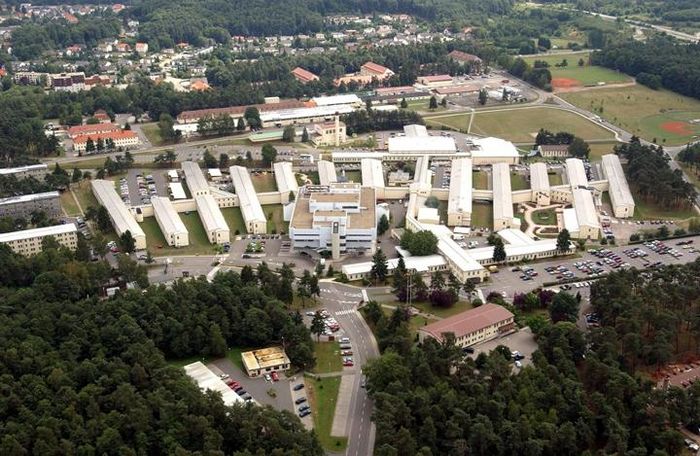
Landstuhl Regional Medical Center: Where the Wounded Come Home Through
Just up the hill from Ramstein, in the Kaiserslautern Military Community, Landstuhl Regional Medical Center is the largest American military hospital outside the United States and the place where the wounded evacuated from across the Middle East, Africa, and Europe are stabilized before they go home. Run by Medical Readiness Command, Europe under the Defense Health Agency, it is staffed by a tri service workforce of Army, Air Force, and Navy physicians, nurses, medics, and technicians, plus the civilians who keep the hospital running. The people here carry exposures a line unit never sees: access to controlled substances, life and death clinical decisions, and a medical credential and license that can be put at risk by the same allegation that starts a court martial.
When a case can take your career and your medical credential at once, you want counsel who tries these for a living, not as an occasional thing. That is the whole of this firm's practice, and Europe has become a real part of it since the move to Tampa. We fly in for the fight, because for a contested case what matters is the lawyer in the courtroom, not the one nearest the gate.
The Medic Who Kept Going Back Into the Fire
No one embodies the calling of this place like Specialist James McCloughan, an Army combat medic in Vietnam. Over three days near Nui Yon Hill in May 1969, with his company ambushed and badly outnumbered, McCloughan ran into the open again and again to reach the wounded. He sprinted a hundred meters through heavy fire to carry back a man who could not move, took rocket and small arms fire that left him bleeding from the head and body, and ignored a direct order to stay back, going into the kill zone four more times to drag out the wounded. He refused evacuation to stay with his unit, and over those three days he was credited with saving ten men and treating dozens more. That refusal to leave anyone on the field is the standard we bring to a case at Landstuhl.
Why the LRMC Workforce Brings Us In
We win court martial cases. Military defense is all we do, and service members fly us in from all over the world because of our trial record. The military justice system is not built to find the truth; it exists to preserve good order and discipline, and a high visibility medical command will make an example of a provider to show it polices its own. A serious case is investigated by Army CID, or by OSI or NCIS depending on your service, and for sexual assault and other covered offenses the decision to refer charges to a court martial no longer belongs to your command but goes to an independent Special Trial Counsel. Your detailed defense counsel may be capable but carries a heavy caseload inside the same system, which is why service members serious about winning bring in their own counsel.
UCMJ Charges We Defend at Landstuhl
We take on the full range of court martial charges. Below are the ones that come up most often at Landstuhl.
Drug Diversion and Controlled Substances (UCMJ Article 112a). Medical staff handle controlled substances every shift, and an accountability gap, a wasting discrepancy, or a missing dose can turn into a diversion allegation under Article 112a. These cases turn on the chain of custody and the government's burden to prove any use or distribution was knowing and wrongful, not on the bare fact that a count did not reconcile. A pharmacy or ward record that does not add up is not the same as the theft of narcotics, and the records have context the government leaves out.
Standard of Care, Dereliction, and Credentialing (UCMJ Article 92). A bad clinical outcome or a charting error can be investigated as dereliction of duty, with the government treating a complication as if it were negligence. A serious allegation can also trigger an adverse credentialing action and a report to the National Practitioner Data Bank, a separate administrative track that can follow your medical career for life and that we do not handle ourselves. That process runs on what the criminal investigation finds, so the way to protect your credential and your license is to fight the underlying allegation hard, which is our job.
Sexual Assault and Sex Offenses (UCMJ Article 120 / Article 134). These allegations route to an independent Special Trial Counsel now, and in a clinical setting an examination or a patient encounter can be reported and the command will treat the report as established before the investigation is finished. These cases demand counsel who will run an independent investigation and contest the case rather than let the allegation stand in for proof, because a conviction means confinement, a federal record, and a place on a sex offender registry.
Domestic Violence and Assault (UCMJ Articles 128b and 128). Domestic violence under Article 128b is charged as aggressively as any offense in the UCMJ since the Office of Special Trial Counsel took these cases over. It covers a spouse, an intimate partner, or a family member, and it treats strangulation or suffocation as its own charge that the government can bring even with no visible injury. A qualifying conviction also triggers the federal Lautenberg firearms bar, which can end a career because a service member has to be able to carry a weapon. We also defend assault under Article 128, where self defense is a recognized defense.
A Career and a Reputation Worth Defending
Not everyone in the LRMC workforce who calls us is innocent, and we do not pretend otherwise. What matters is how serious the case is, not your rank. If a matter is genuinely minor, your detailed defense counsel can handle it, and we will tell you so honestly. But when the case is serious, everything is on the line at once: your career, your medical credential, your retirement, your good name, and your freedom. A court martial conviction is a federal criminal conviction, and where the sentencing parameters apply the judge sentences within confinement ranges fixed by the offense, two and a half to ten years for sexual assault and ten to twenty for rape, with specific facts in writing required to support a departure, on top of any required or adjudged punitive discharge and, on a covered sex offense, sex offender registration. That is why you fight. The court’s jurisdiction and the convicted offense determine which sentencing rules apply; some offenses use separate sentencing criteria rather than these ranges.
If you are facing an investigation or court martial at Landstuhl, reach out for a free defense strategy session. We will tell you exactly what you are facing and how we would defend it. The government is already building its case. The only question is whether anyone is building yours.
FAQ
I'm a provider at LRMC under investigation. What happens to my medical credential and my license?
They are at risk on a separate track from the court martial. A serious allegation can trigger an adverse credentialing action and a report to the National Practitioner Data Bank that can follow your medical career for life, and it runs on a lower standard than a conviction requires. That credentialing process is administrative and its own specialty that we do not handle, but it feeds off what the criminal investigation finds, so the most important thing you can do to protect your credential and license is to fight the underlying allegation hard from the start, which is what we do.
CID wants to interview me at Landstuhl. Do I have to talk to them?
No. You are not required to sit for an interview or answer their questions. Under Article 31b of the UCMJ you have the right to remain silent and to a lawyer, and you can invoke both at any point, including before the interview begins. The investigators are collecting evidence, not giving you a chance to explain, and they can title you as a subject at a low threshold that follows you for years. Decline, ask for counsel, and call a defense lawyer before you give any statement.
Something happened off post in Germany. Could the German authorities get involved too?
They can, and they do. A serious off post matter in Germany, an autobahn crash or a DUI on the lower German limit, can be taken up by the German Polizei and prosecuted in a German court on a separate track from the UCMJ case your command is pursuing. Investigations in the two systems may overlap, and what you say to one can affect the other, so do not give a statement to anyone until you have talked to a defense lawyer. The SOFA allocates primary jurisdiction and limits a second trial for the same offense; overlapping investigations do not mean that both countries may freely try the same charge.