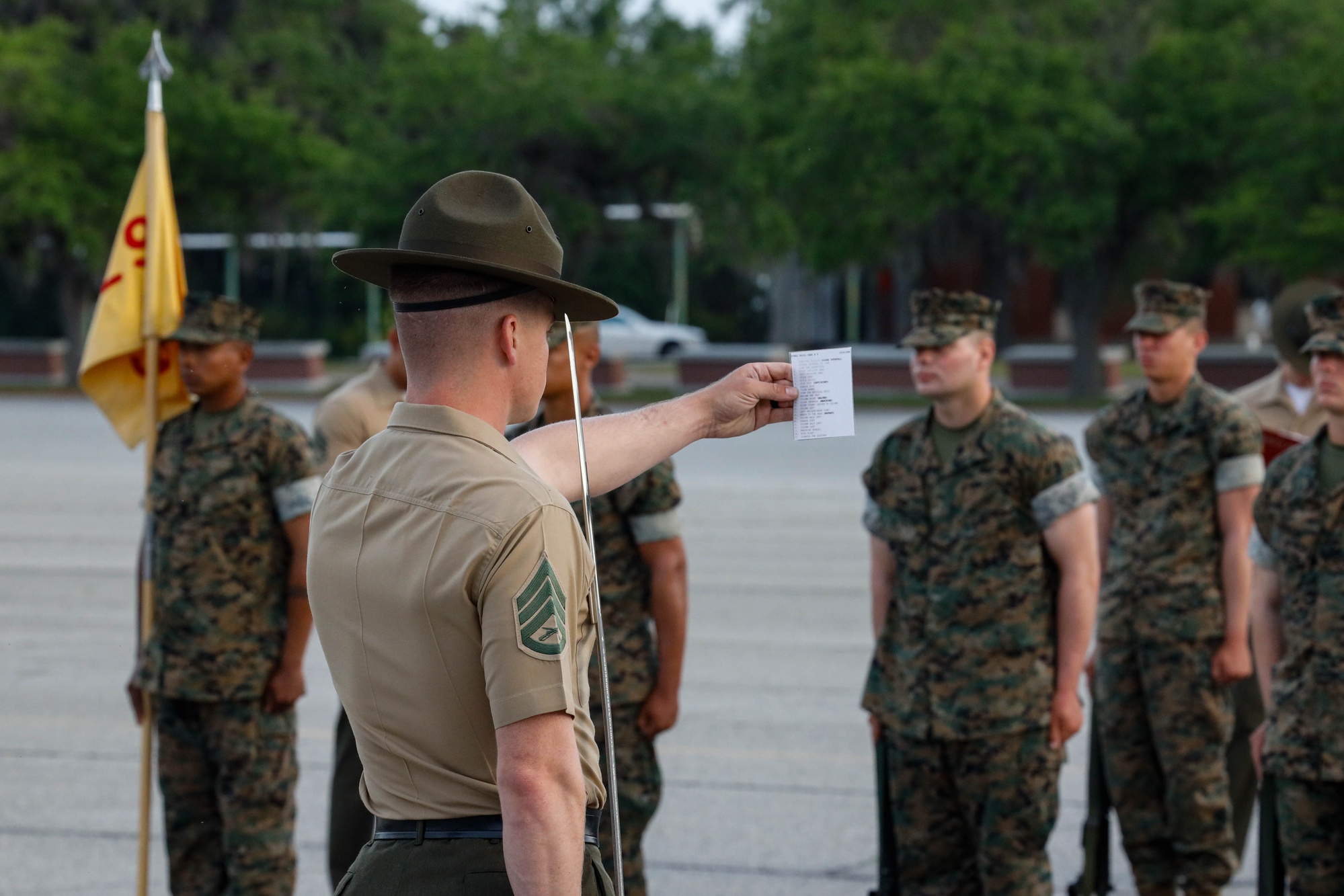
Marine Drill Instructor: When a DI Is Charged, the Whole World Hears About It
When a Lance Corporal gets busted to E-1 for an off duty incident, the story rarely leaves the battalion. When a Marine Drill Instructor faces a court martial at MCRD Parris Island or MCRD San Diego, the whole country hears about it. These cases make front page news, generate congressional inquiries, and create institutional pressure that has nothing to do with the facts of what actually happened.
The high profile cases of recent years have put every DI in an impossible position. You are expected to take civilians and forge them into Marines, to break them down and build them back up, and to do it inside lines that shift and get reinterpreted the moment an allegation is made. When that allegation surfaces, the command does not weigh context or intent. It weighs optics, and in this environment the optics always favor prosecution. If you are a Drill Instructor facing charges, you need to understand exactly what you are up against.
The Instructor Who Went Back to Lead from the Front
No Marine ever embodied what the DI billet is for like Gunnery Sergeant John Basilone. At Guadalcanal in October 1942, Basilone and about fifteen men held off a force of several thousand Japanese through a night of relentless attacks, keeping his machine guns in action by sheer will, and he received the Medal of Honor for it. The Corps brought him home and assigned him as a machine gunnery instructor at Camp Pendleton, where he trained the Marines who would carry the fight forward. He could have spent the rest of the war safe behind that role. Instead he asked again and again to return to combat, and when they finally let him he landed on Red Beach at Iwo Jima, knocked out a blockhouse, and guided a tank through a minefield under fire before a mortar round killed him. He earned the Navy Cross there, adding it to the Medal of Honor he had earned on Guadalcanal. Basilone shaped Marines and then went back to lead them from the front, which is exactly the kind of Marine the DI billet exists to create. We bring that standard to your defense, and we do not back down.
Why DIs Fly Us In
The publicity around Drill Instructor cases forces commands to treat even minor allegations as serious matters. It is not unlike the SAPR environment around sexual misconduct: the command will do almost anything to avoid negative press, and if ending a DI's career is the price of looking accountable, it will pay it. A serious case at either recruit depot is investigated by the Naval Criminal Investigative Service, and for sexual assault, domestic violence, and other covered offenses, the decision to refer charges to a court martial no longer belongs to your command. It goes to an independent Special Trial Counsel in the Department of the Navy Office of Special Trial Counsel.
Tim Bilecki spent years inside the military justice system as a JAG defense counsel and then a Senior Defense Counsel before going civilian, and he has built his career taking the high profile, hard to win cases other lawyers avoid. The kind of case that draws press and command attention is exactly the kind he wants, because that pressure is what makes a command overreach, and overreach is what a real defense exploits. When prosecutors at Parris Island or San Diego see retained civilian counsel enter a DI case, the easy conviction they expected disappears.
UCMJ Charges We Defend for Marine Drill Instructors
Sexual Assault and Sex Offenses (UCMJ Article 120 / Article 134). With female Marines now training at both recruit depots, the potential for a misperceived interaction or an allegation exists coast to coast, and the Marine Corps Sexual Assault Prevention and Response program has made these cases extraordinarily hard to defend. A rumor or a piece of scuttlebutt about an inappropriate interaction between a DI and a recruit can be enough to end a career, the accused gets no benefit of the doubt, and the accuser is treated as inherently credible. If you are a Drill Instructor facing these charges, you need counsel immediately, because the system is coming with the full weight of that apparatus behind it.
Cruelty and Maltreatment (Article 93). This is the charge that lives at the heart of recruit training, because even recruits expect a degree of what feels like maltreatment as part of the process. DIs have always found creative ways to deliver hard, realistic training without crossing the line, but the line is not always clear, and conduct that was sound stress inoculation in the moment can be recast as cruelty once someone decides it went too far. New Marines go home and tell stories about how cruel their DIs were, and they say it with pride, but that same conduct can become the basis for an Article 93 charge. Defending it means showing the full context of the training and what the conduct was actually for.
Domestic Violence and Assault (UCMJ Articles 128b and 128). Among the cases we handle most often is domestic violence under Article 128b, charged by an independent Special Trial Counsel with the force of a sexual assault. The statute reaches a spouse, an intimate partner, or a family member, and treats strangulation or suffocation as a standalone serious offense even when nothing is visible. A qualifying conviction triggers the federal Lautenberg firearms bar, and a Marine who cannot carry a weapon faces serious career consequences. We also defend assault under Article 128. For a Drill Instructor, an Article 128 charge sometimes arises even when the DI knows a line was crossed. Emotions took over, a recruit did something egregiously dangerous or disrespectful, and the DI reacted physically. That can be a mistake without being a crime that should end a career built over years of honorable service. We defend assault, aggravated assault, manslaughter, and murder, and the work is not always to deny what happened but to make sure the outcome reflects the whole context rather than the worst possible reading of one moment.
Drug Offenses (UCMJ Article 112a). DIs get limited time away from recruits, and when they do, decompression often involves alcohol and, in states where marijuana is legal, social settings where it is as common as beer. It is easy for an off duty DI to get caught up in that and not appreciate the exposure. A positive urinalysis is serious but not the end of the fight, because the chain of custody can be challenged, innocent exposure is a recognized defense, and the government still has to prove that any use was knowing and wrongful. These cases are defensible with counsel who understands both the science and the elements the prosecution must prove.
Military Specific Offenses (UCMJ Articles 77 to 134). To a recruit, a DI is a near deity who can do no wrong, but DIs are human and make mistakes like anyone else, and the punitive articles are where prosecutors like to pile on charges to inflate the punishment and pressure a plea. Each one has to be proven, and when the defense makes the government carry that weight charge by charge, the stack rarely holds up.
Even a Drill Instructor's Mistake Deserves a Real Defense
It is rare for a DI to face charges because a recruit was lying in his rack reading a Bible and the DI walked over and started swinging. That is not how these cases develop. What actually happens is that something went wrong during training, a PT session that should have ended, a recruit who was not hydrating and went down, a moment of lost control when a recruit did something dangerous. There is so much that can go wrong on the line that those who take the billet deserve respect, and so does a DI who crossed a line without fully realizing it in the moment.
That is why we tell Drill Instructors to reach out even if they know they made a mistake. We do not take every case, and if yours is a genuinely minor matter your free detailed defense counsel can handle, we will tell you so rather than take your money. But you do not have to accept the worst the system can impose, because a conviction is a federal criminal conviction that puts a career, a retirement, a good name, and freedom on the line, with confinement governed by the applicable sentencing rules, a punitive discharge, and on a sex offense a place on a registry, and you can still secure the best possible outcome if you fight. You chose to train the next generation of Marines, which means you love the Corps, but you cannot coexist with a military justice system that is out to destroy you. If you are a Marine Drill Instructor facing an investigation or court martial at Parris Island or San Diego, reach out for a free defense strategy session, and we will tell you exactly what you are facing.
FAQ
I'm a DI. Where is the line between hard, realistic training and an Article 93 maltreatment charge?
That is the hardest question in this billet, because the line is real but it is not always visible in the moment. Article 93 turns on cruelty and oppression toward someone subject to your orders, and the same conduct can read as legitimate stress inoculation or as maltreatment depending on context, intent, and how it is later characterized. The danger is that when an allegation is made, the command tends to strip the conduct of its training context and judge it cold. A real defense puts that context back, the purpose of the exercise, the standard you were enforcing, what the recruit was actually doing, so the conduct is judged for what it was rather than for how it looks on a complaint.
A recruit made an allegation against me and it is essentially a rumor. Can that really end my career?
Yes, it can. An allegation against a DI is treated as a matter the command cannot be seen ignoring, and the institutional response often runs ahead of the evidence. Even where there is not enough to prefer charges, a command under pressure may pursue relief for cause or administrative separation, which can end a DI's career on their own. That is precisely why you do not wait to see how it plays out. The sooner counsel is engaged and investigating, identifying witnesses and documenting the truth before memories harden, the better the odds of stopping a rumor from becoming a charge.
NCIS or my command wants to question me about a recruit's allegation. Do I have to answer them?
No, and a DI should be especially careful here. The instinct to explain the training context on the spot is natural, but an NCIS interview is evidence collection, and Article 31b of the UCMJ gives you the right to stay silent and to a lawyer before you say anything. For an Article 93 maltreatment allegation the command drives the charging decision, and for a sexual offense it goes to the independent Special Trial Counsel in the Department of the Navy, not to the people who supervise you on the line. The most valuable defense work happens before charges are preferred, while the context and the witnesses can still be locked down. Decline to answer, ask for counsel, and call a lawyer before you give a statement.