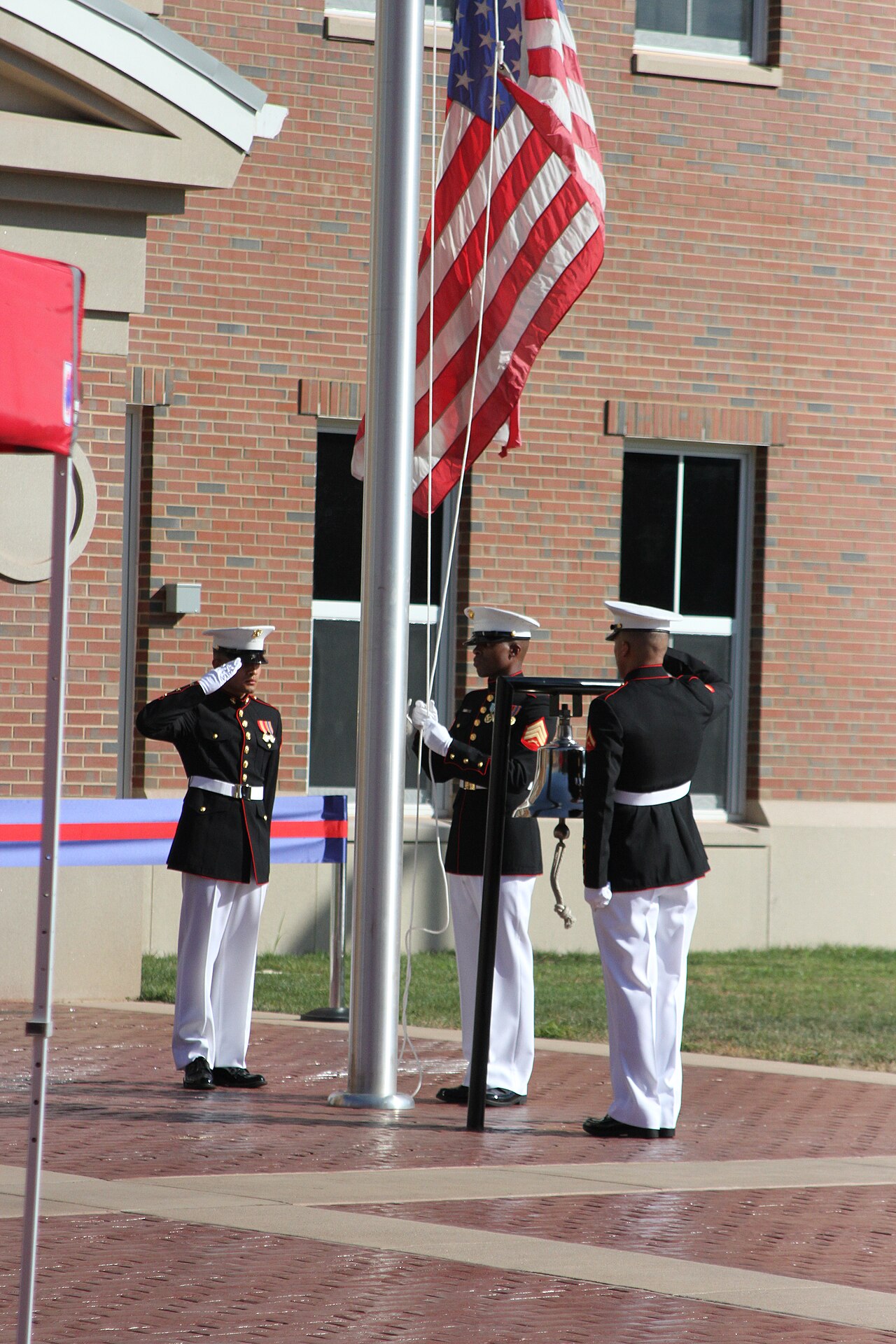
Marine Corps Embassy Security: Standing Post at U.S. Diplomatic Missions, Far from Any Base
Marines stand guard at well over a hundred and fifty U.S. embassies and consulates around the world, protecting U.S. diplomatic premises in some of the most hostile environments on earth. The stakes of that mission are not theoretical. When the diplomatic compound in Benghazi was overrun in September 2012 and an ambassador was killed, the post had no Marine Security Guard detachment, and in the aftermath the State Department asked for hundreds more Marines to be sent to embassies precisely so that gap would not exist again. That is the weight a Marine Security Guard carries, and it is a measure of how seriously the institution takes the duty.
It is also why UCMJ trouble on embassy duty is handled with a particular intensity. Court martial proceedings for Marine Security Guards may take place away from the embassy assignment, including in the United States or Japan, but the conduct, and the evidence needed to defend it, often stays thousands of miles away in the country where it happened. A Marine on embassy duty facing charges is fighting for a career, a clearance, and sometimes freedom, and the case has to be fought on two fronts at once, where the proceedings are held and where the truth actually lives.
They Held the Embassy to the Last Helicopter
The Marine Security Guard mission has always meant holding the post until there is nothing left to hold. There is no better example than the detachment at the U.S. Embassy in Saigon. On April 29 and 30, 1975, as the city fell, the Marine Security Guards ran the embassy evacuation through a night of chaos, moving thousands of people to helicopters from the embassy compound, including the rooftop landing zone while the perimeter collapsed around them, and they held until the very end. The last helicopter, Swift 22, lifted the final eleven Marines of the detachment off the embassy roof at 7:53 in the morning. Two of their own, Corporal Charles McMahon and Lance Corporal Darwin Judge, had been killed by a rocket the day before, the last two American servicemen killed by enemy fire in Vietnam. The detachment held that embassy until the last Marine lifted off the roof, and we hold the line for the Marines who hold the line, anywhere in the world.
Why Marines on Embassy Duty Fly Us In
Investigations get complicated for a Marine Security Guard when the conduct occurred in a country with no large U.S. military presence. Marine Embassy Guards’ immunity depends on their accreditation and whether they serve at a diplomatic or consular mission. Embassy administrative and technical staff ordinarily have broader criminal immunity than consular employees, but any host nation immunity does not erase UCMJ exposure, and it does not guarantee that the investigation was done properly or that exculpatory evidence was preserved. Evidence gets lost, witnesses become unreachable, and the timeline gets distorted when no one with a defense perspective is on the ground documenting what actually happened. A serious case is investigated by the Naval Criminal Investigative Service, and for sexual assault, domestic violence, and other covered offenses, the decision to refer charges to a court martial goes to an independent Special Trial Counsel in the Marine Corps Office of Special Trial Counsel.
Tim Bilecki spent years inside the military justice system as a JAG defense counsel and then a Senior Defense Counsel before going civilian, and Bilecki Law Group has tried cases and run its own investigations around the world, across Asia, Europe, and the Middle East. That overseas reach is the whole point, because what decides the case is what can be documented in the country where it happened, not just what comes out in the courtroom where it is heard. When prosecutors see that you have flown in that kind of counsel, the easy conviction they expected is gone.
UCMJ Charges We Defend for Marine Security Guards
Sexual Assault and Sex Offenses (UCMJ Article 120 / Article 134). The Marine Corps Sexual Assault Prevention and Response program makes these cases hard to defend everywhere, and the difficulty is amplified for Marines at an embassy who are isolated and cut off from the normal support of a large installation. When a relationship develops between guards in that environment, or with embassy personnel, it can be recast as misconduct after the fact if the command decides to pursue it, and the institutional presumption runs against the accused regardless of the facts. If you are accused of sexual misconduct on embassy duty, you need experienced counsel immediately, before the record is built without you.
Fraud and Larceny (UCMJ Article 121). Contact with the local population on embassy duty is often limited by security protocols, and Article 121 charges in this context usually trace back to an administrative error an investigator decided to treat as criminal intent: a paperwork mistake becomes a fraud investigation, a miscalculated entitlement becomes larceny. Intent to defraud is a required element, and many of these cases cannot survive once the defense forces the government to prove it. We handle BAH and OHA fraud, conspiracy to defraud, larceny, wrongful appropriation, and extortion.
Domestic Violence and Assault (UCMJ Articles 128b and 128). A large part of our caseload now is domestic violence under Article 128b, prosecuted by an independent Special Trial Counsel as seriously as any covered offense. The statute reaches a spouse, an intimate partner, or a family member, and makes strangulation or suffocation a separate, serious charge even where no injury shows. A qualifying conviction triggers the federal Lautenberg firearms bar, and for a Marine Security Guard who must hold a clearance and carry a weapon, that can end the career. We also defend assault under Article 128. The hard part for a Marine Security Guard who gets into an altercation with a local national is that it becomes an international incident in a hurry. The diplomatic implications of violence involving American military personnel in a foreign capital are significant, and the command will prioritize managing those implications over determining what actually happened, so a Marine who acted in self defense or in defense of others can be made to pay the price regardless of who started it. It is not justice, it is diplomacy, and beating it takes counsel willing to reconstruct the incident independently. We take self defense, aggravated assault, manslaughter, and murder cases.
Drug Offenses (UCMJ Article 112a). Drug laws vary dramatically from one country to the next, and a Marine overseas can end up in the wrong place at the wrong time, because if a controlled substance can enter a country it can find its way near an embassy through local personnel. State or local tolerance abroad means nothing under Article 112a. A positive urinalysis is serious but not the end of the fight, because the chain of custody, the circumstances of any exposure, and the requirement of knowing, wrongful use are all contestable, and these cases call for counsel who knows how to challenge them.
Military Specific Offenses (UCMJ Articles 77 to 134). Marines overseas face more aggressive UCMJ enforcement than their CONUS counterparts, and embassy duty is a prestigious assignment that commands guard jealously, so infractions handled informally elsewhere become formal charges, and charge stacking is used to pressure a plea. Each charge still has to be proven, and when the government is forced to do that for every count, it frequently cannot.
Why Marines on Embassy Duty Need to Fight Back
A Marine who volunteers for embassy duty makes a deliberate choice to accept a demanding assignment and represent the Corps overseas. That choice reflects a commitment most never make, and it is exactly the kind of career the military justice system can erase in a matter of weeks. Even if you love the Corps and want to make it a career, when the system comes for you, the fight is on, because it preserves order by making examples, and if you do not fight back it will make that example out of you.
We do not take every case, and for a genuinely minor matter your free detailed defense counsel can handle, we will tell you so rather than take your money. But the cases we fight are the ones where everything is on the line: a career, a retirement, a good name, and freedom, because a conviction is a federal criminal conviction. Where the sentencing parameters apply, it can carry confinement a judge has little discretion to avoid, a punitive discharge, and on a sex offense registration, at any rank. You have to fight, even if you made a mistake, and you can still secure the best possible outcome if you are willing to fight for it. If you are a Marine on embassy duty facing an investigation or court martial, it does not matter where the proceedings are scheduled. Reach out for a free defense strategy session, and we will tell you exactly what you are facing. When we say we fly anywhere in the world, we mean it. You stand post for us. We stand for you. The court’s jurisdiction and the convicted offense determine which sentencing rules apply; some offenses use separate sentencing criteria rather than these ranges.
FAQ
The incident happened overseas, but my court martial will be in the United States or Japan. How do you defend something that happened thousands of miles away?
By getting on the ground where it happened, which is the part that decides these cases. The proceedings may be held Stateside or in Japan, but the evidence, the witnesses, the physical scene, and the host nation records are all back in the country where the conduct occurred, and they degrade fast when no one with a defense perspective is preserving them. We have run our own investigations across Asia, Europe, and the Middle East for exactly this reason. The prosecution builds its case from a file assembled by investigators who were looking to confirm an allegation. We build ours from what the ground actually shows, and that difference is often the case.
There are strict fraternization rules on embassy duty. I got involved with someone. Is my career simply over?
Not automatically, though the rules on MSG duty are real and stricter than at a normal command, and a relationship the program prohibits can absolutely lead to charges or administrative action. But a violation is not a conviction, and the facts matter: what the relationship actually was, what was known and when, and whether the conduct meets every element of what has been charged rather than just looking bad. Commands on embassy duty are quick to treat any relationship as misconduct, and a real defense forces them to prove the specific charge instead of relying on the appearance of one. The worst move is to start explaining yourself to investigators before you have counsel.
I hold a Top Secret clearance for embassy duty. What does an investigation do to it?
This is one place a clearance genuinely is the job, because Marine Security Guard duty cannot continue without it. Your command or security manager can suspend your access to classified information the moment a serious allegation surfaces, before anything is proven, which alone pulls you off the post and can end an embassy assignment. Revoking the clearance itself is a separate decision, made not by your command but by the Defense Counterintelligence and Security Agency under the National Security Adjudicative Guidelines; if it moves to revoke, you receive a Statement of Reasons and a written window to respond before anything is final. Because that process, and any security-violation review, feed off what the investigation finds, the way to protect the clearance is to fight the underlying allegation early, not to treat the security side as a separate problem for later.