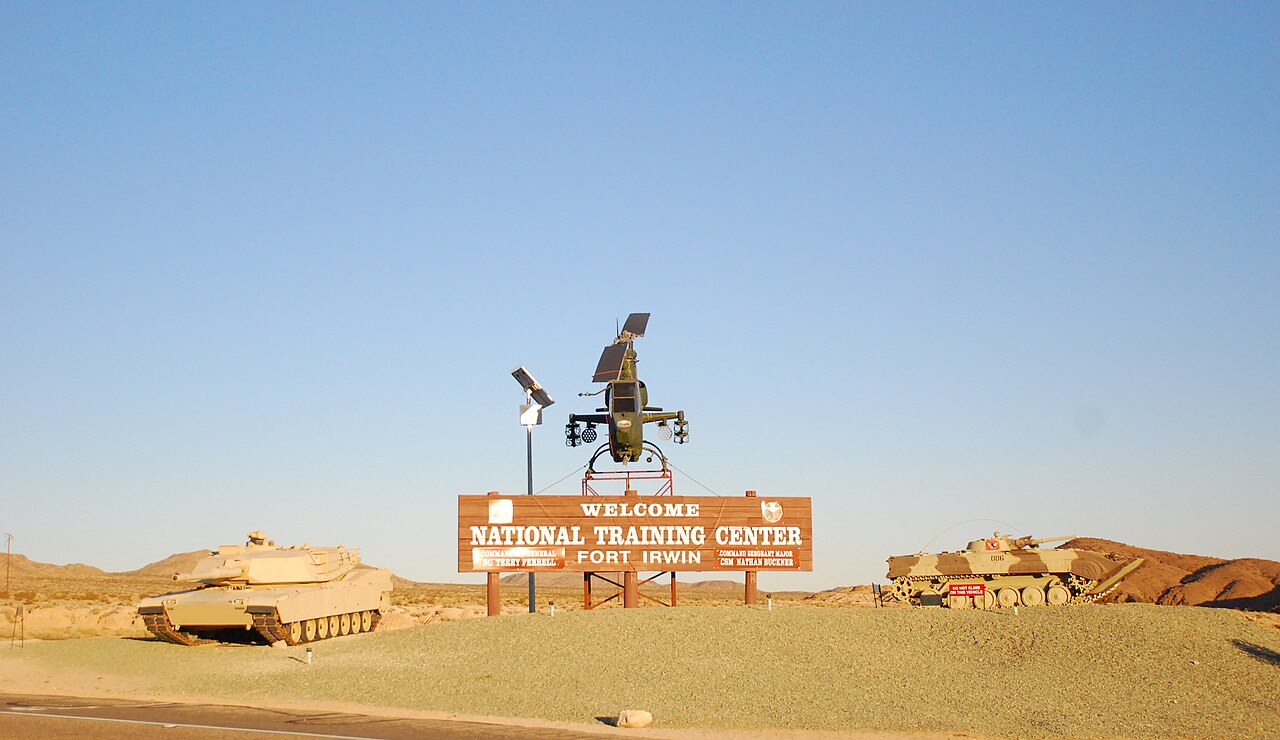
Fort Irwin: The Box in the Mojave
In the high Mojave Desert between Barstow and Death Valley, Fort Irwin is the National Training Center, the Army's premier force on force training ground, where brigade combat teams rotate through the box for the hardest field training short of war. It is the home of the 11th Armored Cavalry Regiment, the Blackhorse, the permanent opposing force that fights every visiting unit, along with the Operations Group observer controllers who grade them. The post is genuinely remote, more than thirty miles of desert highway from Barstow, with searing summers, cold desert nights, and live fire ranges in every direction. The people here are the permanent cadre and their families and the thousands of rotational Soldiers who cycle through. A post built on relentless training will protect that mission and move hard against a Soldier who steps wrong.
Military defense is all Bilecki Law Group does, and Soldiers fly us in from our office in Tampa because a contested court martial is decided by trial experience, and we bring it wherever the case is.
The Blackhorse Trooper Who Saved His Crew
The standard for the Blackhorse was set by Sergeant First Class Rodney J. T. Yano, a crew chief with the 11th Armored Cavalry Regiment over Vietnam on January 1, 1969. Aboard a command helicopter directing the fight below, Yano was hurling phosphorus grenades to mark targets when one detonated as it left his hand, tearing into him, blinding him in one eye, and setting off ammunition and burning rounds inside the aircraft. Half blind and badly burned, he threw the exploding ammunition clear with his bare hands to keep the aircraft flying, saving the crew at the cost of his own life. He gave himself to save the men beside him. That is the standard the Blackhorse carries, and it is the standard we bring to a case at Fort Irwin.
Why Soldiers at Fort Irwin Bring Us In
We win court martial cases. Military defense is all we do, and Soldiers fly us in from all over the country because of our trial record. The military justice system is not built to find the truth; it exists to preserve good order and discipline, and a training center under constant evaluation will make an example of a Soldier to protect its standards. The isolation cuts both ways here, because an incident in the field or in the barracks on a remote post draws fast attention and a command eager to show it acted. A serious case is investigated by Army CID, and for sexual assault and other covered offenses the decision to refer charges to a court martial no longer belongs to your command but goes to an independent Special Trial Counsel. The free Trial Defense Service may be capable but carries a heavy caseload inside the same system, which is why Soldiers serious about winning bring in their own counsel.
UCMJ Charges We Defend at Fort Irwin
These are the most common cases at Fort Irwin. They are examples, not limits, and we defend Soldiers against the full range of UCMJ offenses.
Sexual Assault and Sex Offenses (UCMJ Article 120 / Article 134). These allegations route to an independent Special Trial Counsel now, and the command treats a report as established before the investigation is finished, all the more so on an isolated post where word of an allegation travels fast. These cases demand counsel who will run an independent investigation and contest the case rather than let the allegation stand in for proof, because a conviction can mean confinement and a federal record, with registration required for a covered sex offense under the applicable federal and state law.
Domestic Violence and Assault (UCMJ Articles 128b and 128). Domestic violence under Article 128b is charged as aggressively as any offense in the UCMJ since the Office of Special Trial Counsel took these cases over. It covers a spouse, an intimate partner, or a family member, and it treats strangulation or suffocation as its own charge that the government can bring even with no visible injury. A qualifying conviction also triggers the federal Lautenberg firearms bar, which can end an Army career because a Soldier has to be able to carry a weapon. We also defend assault under Article 128, the usual charge when an isolated post and a long rotation boil over into a fight, where self defense is a recognized defense.
Training Environment Offenses: Dereliction and Reckless Operation (UCMJ Articles 92 and 113). A post built on hard field training is where these charges live. The government brings dereliction of duty under Article 92 when it says a Soldier failed a duty he knew he had, from a range safety lapse to a negligent discharge, and it brings reckless or impaired operation under Article 113 when a tactical vehicle rolls over or a Soldier drives after drinking on the long desert roads. An accident in a punishing training environment is not the same as a crime, and the government still has to prove the duty, the breach, and a culpable state of mind, not just that something went wrong.
Drugs and Off Duty Conduct (UCMJ Articles 112a and 134). Drug cases often turn on the chain of custody and the government's burden to prove any use was knowing and wrongful. Marijuana is legal under California law but remains a federal controlled substance and a court martial offense under Article 112a, and a dispensary purchase off post is still a military crime. A positive test is evidence the government may use to argue knowing, wrongful use, not an automatic finding of guilt, so the collection, the chain of custody, and whether any use was knowing all remain the government's to prove.
A Career and a Reputation Worth Defending
We do not pretend that every Soldier who calls us from Fort Irwin is innocent. What matters is how serious the case is, not your rank. If a matter is genuinely minor, the Trial Defense Service can handle it, and we will tell you so honestly. But when the case is serious, everything is on the line at once: your career, your retirement, your good name, and your freedom. A court martial conviction is a federal criminal conviction, and the applicable sentencing parameters tie a confinement range to the offense, two and a half to ten years for sexual assault and ten to twenty for rape, that a judge can depart from only by stating specific facts in writing, on top of any required or adjudged punitive discharge and, on a covered sex offense, sex offender registration. That is why you fight. The court’s jurisdiction and the convicted offense determine which sentencing rules apply; some offenses use separate sentencing criteria rather than these ranges.
If you are facing an investigation or court martial at Fort Irwin, reach out for a free, confidential strategy session. We will tell you exactly what you are facing and how we would defend it. The government is already building its case. The only question is whether anyone is building yours.
Cases Connected to Fort Irwin
These cases include trials, hearings, investigations, and administrative matters. A connection to this location does not necessarily mean that the trial occurred here.
- Case connected to this location: E-8 Retains Bilecki After Admitting Sexual Assault to CID, Sentence Reduced
- Case connected to this location: Bilecki Negotiates Officer Exit Before Article 92 Charges Attach for Army Medical Corps Captain at Fort Irwin; Honorable Resignation, No UCMJ, No GOMOR, No PRB Record
FAQ
CID wants to interview me at Fort Irwin. Do I have to talk to them?
No. Under Article 31b of the UCMJ you have the right to remain silent and to a lawyer, and you can invoke both before the interview begins. CID is gathering evidence, not offering a chance to explain, and a statement made in the field or back in garrison can drive the whole case. Decline, ask for the Trial Defense Service or your own lawyer, and say nothing until you have one.
A vehicle rollover or negligent discharge happened during a rotation. Can that really be a court martial?
It can. The Army can charge a training accident as dereliction of duty under Article 92 or, where alcohol or recklessness is alleged, as reckless operation under Article 113, and a serious injury raises the stakes fast. But an accident is not automatically a crime. The government has to prove you had a specific duty, that you breached it, and that you did so with a culpable state of mind, and the conditions of a hard rotation are part of that defense.
I'm under an Article 120 investigation. Will I have to register as a sex offender if I'm convicted?
A court martial conviction for a covered Article 120 offense triggers registration duties under the applicable federal and state law, with requirements and duration determined by the covered conviction and jurisdiction. The entire defense is aimed at defeating the charge or reducing it to an offense that carries no registration, and the investigation and the charging decision are where these cases are most often turned. Get your own counsel involved before you ever sit down with CID.